The Buckeyes - Family Hippocastanaceae
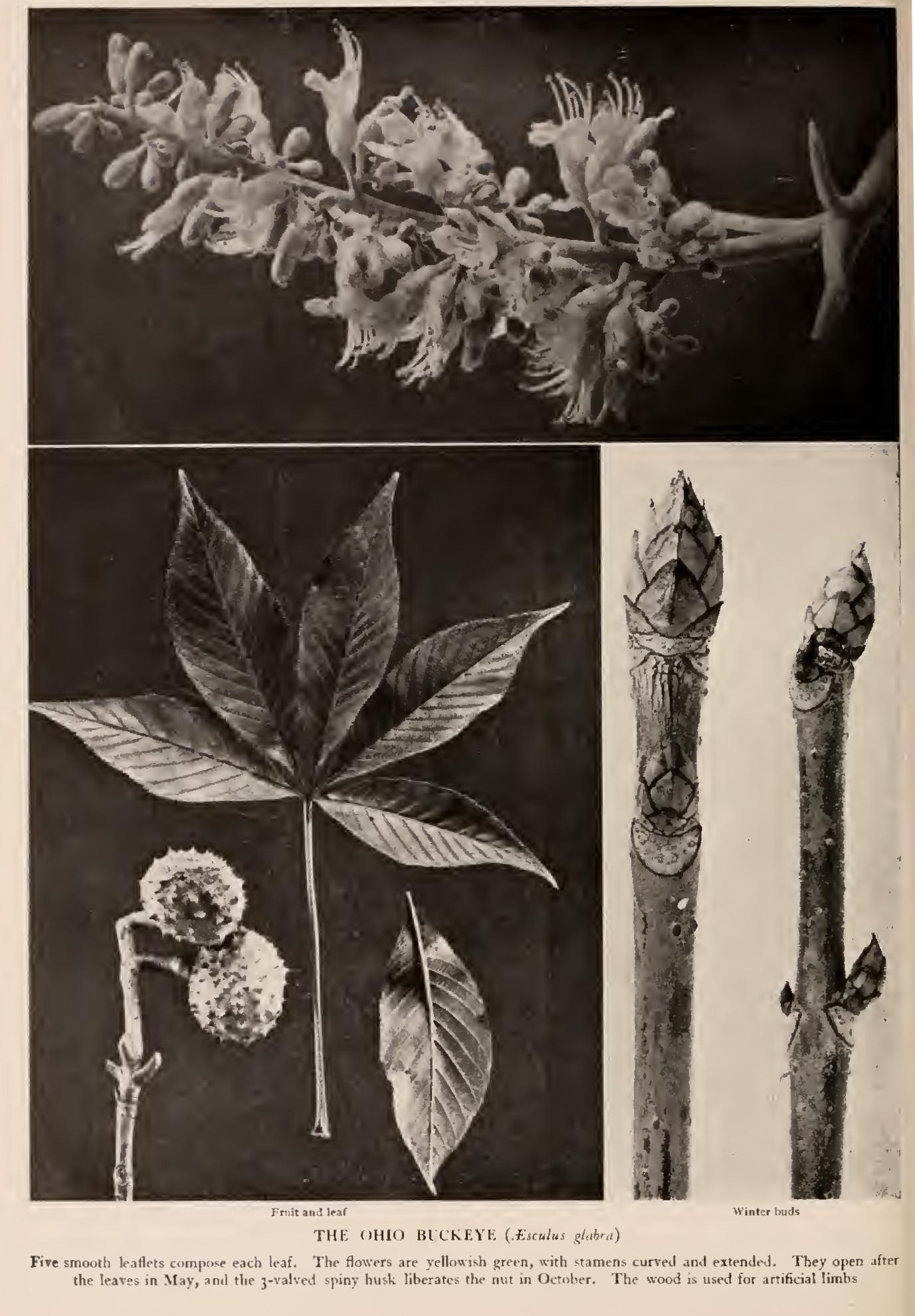
This tree was found most abundantly in Ohio by the botanical explorer, Michaux, and though it grows more plentifully farther west, Ohio will always be called "the Buckeye State." The tree is gradually becoming rarer, for the strong, disagreeable odour exhaled by its bark impels people to cut it down. There is nothing about the tree to offset this disadvantage. Its flowers are inferior to those of other species. Only the special use to which its wood is put—the making of artificial limbs—seems to justify this ill-favoured tree in the eyes of practical people. Its vigorous nuts are too bitter to be eaten, and thus it seems to be well fitted to hold its own in the woods.
The Yellow, Sweet, or Big Buckeye (zEsculus octandra, Marsh.), grows on mountain slopes of the Alleghanies, from western Pennsylvania south into Georgia and Alabama, and west to Iowa and Texas. It is a handsome large tree, with leaves of five slenderly elliptical leaflets, more or less pubescent below and on the veins above. The showy yellow flowers are elongated into tubes. The husks of the nuts art smooth. This species lacks the disagreeable odour of the Ohio buckeye, and its nuts, though distasteful to people, are eaten by cattle. Paste made from these nuts is preferred by bookbinders. It is strong in two senses: it holds well, and destructive insects will not eat it.
The California Buckeye (/Esculus Californica, Nutt.) is a close, wide-topped tree, 3o to 4o feet high, with leaves much like the horse chestnut's, large, compact clusters of white or rose-coloured flowers, and smooth pear-shaped fruits. Its winter buds are pointed and resinous. The upper Sacramento Valley is its northern limit. It is found along the coast and on the western slopes of the Sierras as far as Los Angeles County. It is occasionally seen in European gardens.
A red-flowered buckeye (/Esculus austritta, Sarg.) has but recently been assigned a place among the species of this genus. It is a small tree, often scarcely more than a shrub. Its thin bark is pale, the leaves have five leaflets, but the distinctive character is the bright red flower cluster, with stamens protruding from the tubular corollas. Later, the pitted husk of the fruit, and the two thin-shelled nuts within it are good characters.
The Buckeyes The tree occurs from Missouri to Texas and from near Memphis, Tennessee, to northern Alabama.
carnea is a garden species produced by crossing our shrubby red buckeye, A. Pavia, with the horse chestnut, Hippocastanum. The handsome hybrid tree is 20 to 3o feet high, with leaves like the horse chestnut and flowers flesh coloured to scarlet. The colour is derived from the smaller species, but size,
foliage, waxy winter buds, and slightly prickly fruit, as well as its hardiness, come from the larger one. This is one of the most desirable kinds for ornamental planting.
The Horse Chestnut (fEsculus Hippocastanzim, Linn.) came originally from southern Asia, and has for centuries been a favourite tree for avenues and parks in Europe. In America it grows with even greater vigour than in the Old World. It is one of the trees commonly planted in the Eastern States, and has escaped from cultivation in many places.
Longfellow's "spreading chestnut tree" was a horse chestnut. He called the tree by the name popular in England, where the word "horse" is ordinarily left off. The most aged and imposing specimen trees are to be seen in our Eastern cities, or near them. The trees reach their best development in more open country away from choking dust and smothering pavements. It is by no means the most desirable of trees, but it improves on ac quaintance.
If you are in a city with a bare horse-chestnut tree outside your window, look at it. See the great varnished brown buds that tip the stout twigs. There are small buds on the sides in pairs, but these are evidently subordinates. The twigs are generally forked. This tells that a flower cluster came out of an end bud and the growth of the twig had to be carried up by a pair of side buds. The whole treetop is a great complex system of candelabra—each main branch curves up, then down, then up again to hold all its tips erect.
In late winter a subtle change comes over the horse-chestnut buds. They glimmer with an unwonted light as if warned from within of a great change about to take place. When the warm days come they swell and loosen their waxy scales, showing the silky grey down that lines them, and the close-packed leaves inside. If one would see a miracle he must watch the quick unfolding of the leaf bundle, the lifting of the pale green silvery tent and the spreading of the young leaves into erect umbrellas all over the treetop. During this brief period the trees are en chanting. I wish every house-pent human being could stop ‘C/ork and sit with folded hands and absorb the beauty and inspiration of this spectacle. A brief hour and it is over; the leaflets rise and go about their duties, leaving with us only a memory of their hour of adorable appealing babyhood.
