The Cherries
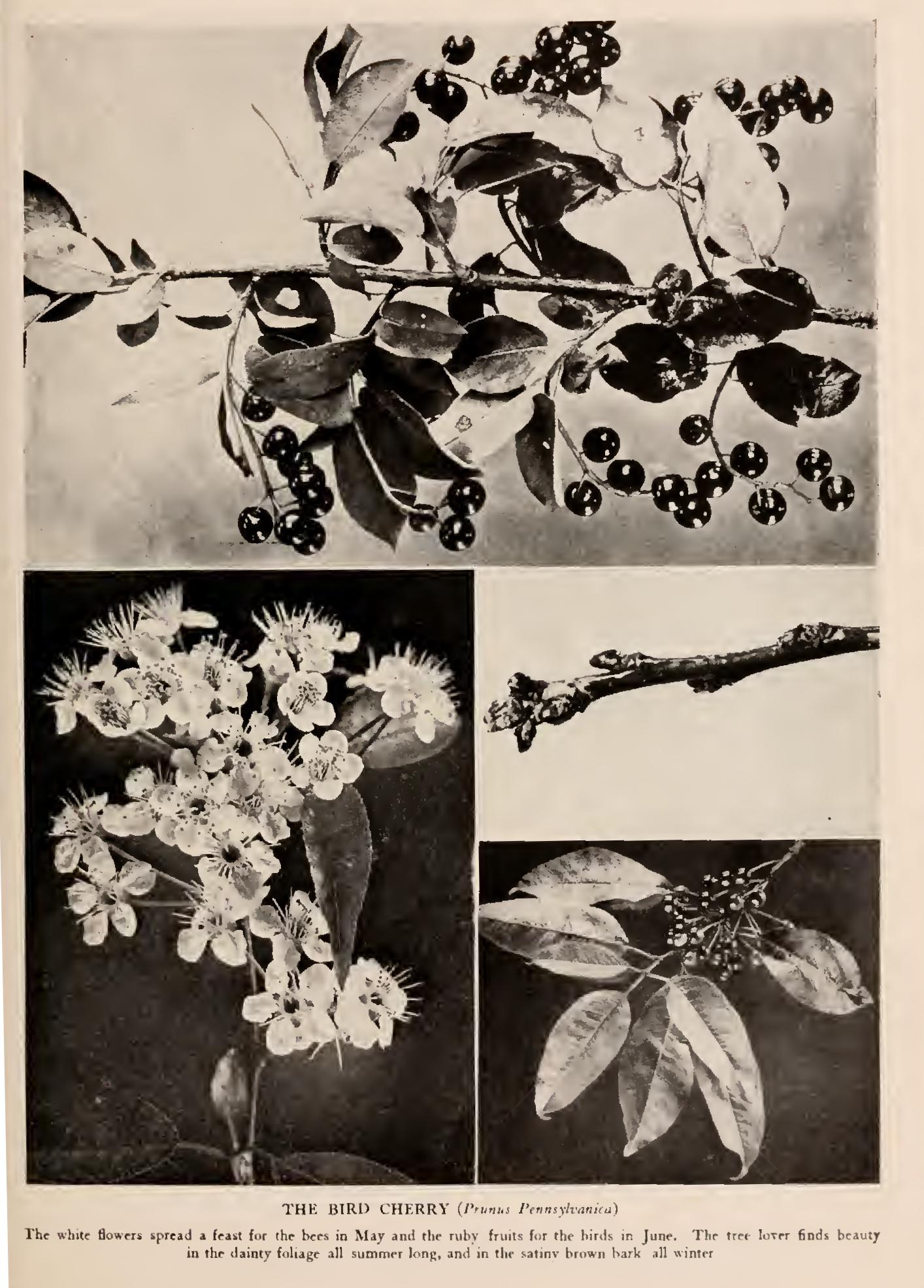
THE CHERRIES The Wild Red Cherry, Bird, or Pin Cherry (Prunus Penn sylvanica, Linn.)—A slender, narrow or round-headed tree, 20 to feet high, with regular, horizontal branches. Bark smooth, shining, reddish brown, with conspicuous rusty lenticels on branches; on trunk broken into thin, curling, horizontal plates. Twigs red. Wood pale, close grained, soft. Buds small, brown, sharp, often clustered. Leaves slender, pointed, finely saw toothed, with wavy edges and shining, smooth surfaces. Flowers white, few in lateral clusters on long stems. Fruit globular, clear red, size of a pea, sour. Preferred habitat, rocky woods. Distribution, Newfoundland to Georgia; west to Rocky Mountains. Uses: Valuable nurse trees to hardwoods in the natural reforest ing of burned areas. Fruit made into cough medicine.
It is hard to find what a hard-headed, practical person would call a sufficient excuse for this tree's existence. It has no timber value, and the horticulturist has little interest in it as a fruit tree. But I consider that it has many uses. It is beautiful, with satiny bark and leaves that catch and reflect the light, providing itself with a sort of nimbus of glory, winter or summer. The wavy leaf margins, fluttering in every breeze, seem to shake the light off as they do the drops of rain.
It is no small boon to a bleak ravine and to the people who live near it that this tree should spring up and clothe both sides with verdure. With the leaves come clustered, nectar-laden flowers, whitening the tree, and calling the bees. Then comes the harvest, and who can see without real emotion a bird cherry, gemmed on all its twigs with these clear, ruby fruits, and the birds holding high carnival among the shining leaves? The cherries are small and sour, to be sure, but the birds pick every one. By them, the pits are scattered far and wide, and seedlings spring up each year, in fence corners, on rocky hillsides, and in the paths of forest fires. Wherever such a tree appears we may be sure it was planted by birds.
This wild cherry, it is acknowledged by foresters, renders a distinct service to the country by furnishing shade under which valuable hardwoods and other kinds of timber trees can make a strong start. By the time the nurse trees are no longer needed
they are gone, for the bird cherry is a fast-growing, short-lived tree.
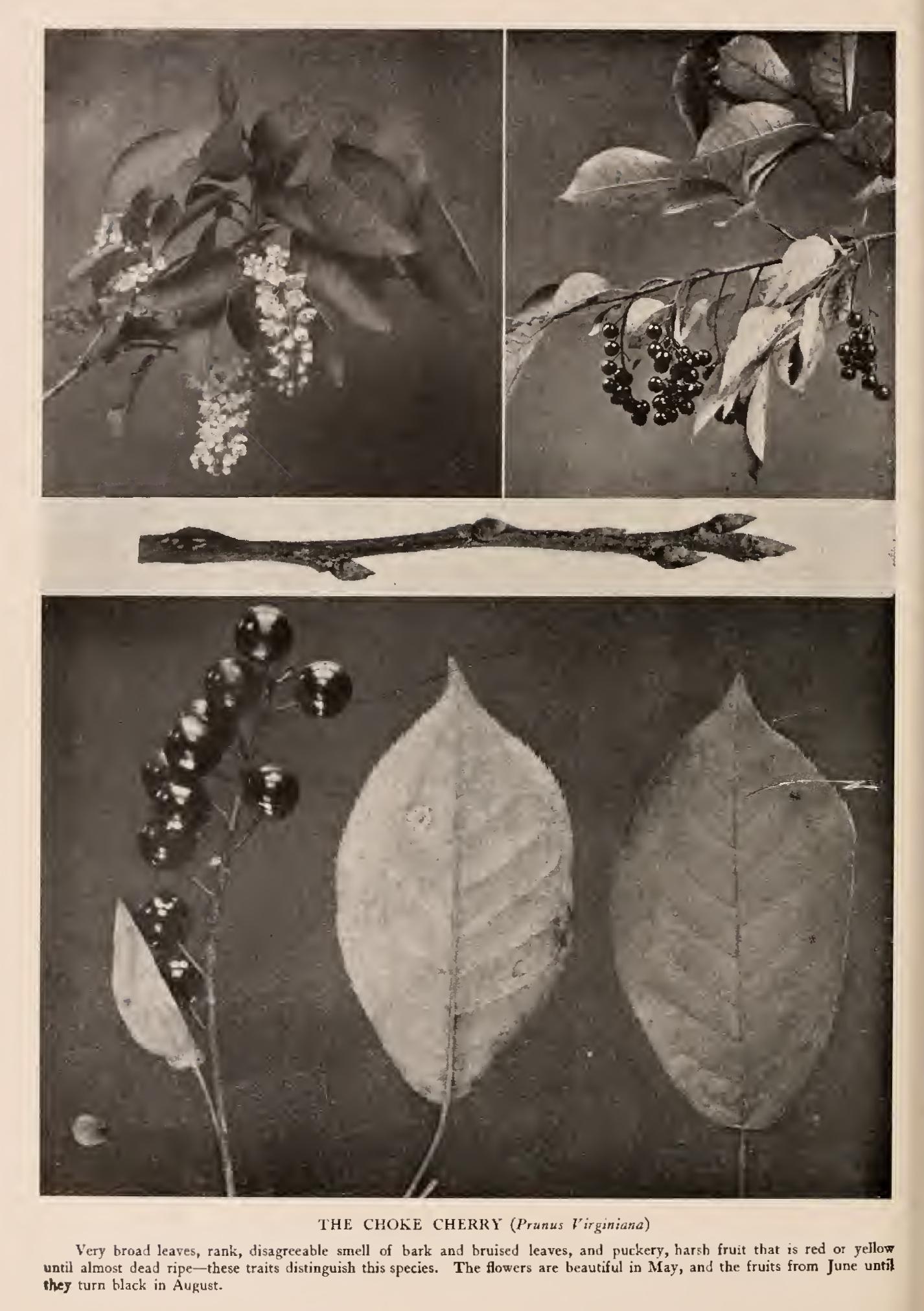
Wild Black Cherry, Rum Cherry (Prunus serotina, Ehrh.) —A large, spreading tree with oblong head and sturdy, rough trunk; branches drooping. Bark dark brown (grey in the South), checked into rough plates, shedding horizontally in curling sheets on branches; bitter taste. Wood reddish brown, hard, light, strong, easily worked, close, lustrous grain. Buds brown, slender, scaly. Leaves narrowly oblong, tapering, 2 to 5 inches long, alternate, finely serrate; dark green, shining above, paler beneath; bitter; yellow in fall; petioles slender, short. Flowers, May, small, white, in racemes 2 to 4 inches long. Fruits, Sep tember, flattened, pea sized, purple, bitter and sweetish aromatic; skin thick. Preferred habitat, moist, alluvial soil. Distribution, Ontario to Dakota; south to Florida and Texas. Uses: A most valuable lumber tree; handsome, quick-growing shade and orna mental tree; the fruit, roots and bark yield a tonic drug.
The black cherry is a substantial citizen in any community of trees. In an astonishingly short time the sapling becomes a tree, low trunked, great of girth, and crowned with a dome of graceful, pendulous branches.
The satiny brown bark reminds us of the birches. It has the same slit-like horizontal "breathing holes," and the birches' way of shedding its bark. But a taste, or even a sniff of a twig, or a bit of bark, will decide the point. The cherry birch, which is the species most likely to be confused with the black cherry, has a pleasantly aromatic flavour. The bark of the cherry is bitter as gall.
In old-fashioned home remedies, in patent medicines, and in the prescriptions of regular physicians cherry extracts and decoc tions are often met. No spring tonic is seriously expected to rid us of "that tired feeling" unless the tang of wild cherry is there.