The Cypresses of Monterey
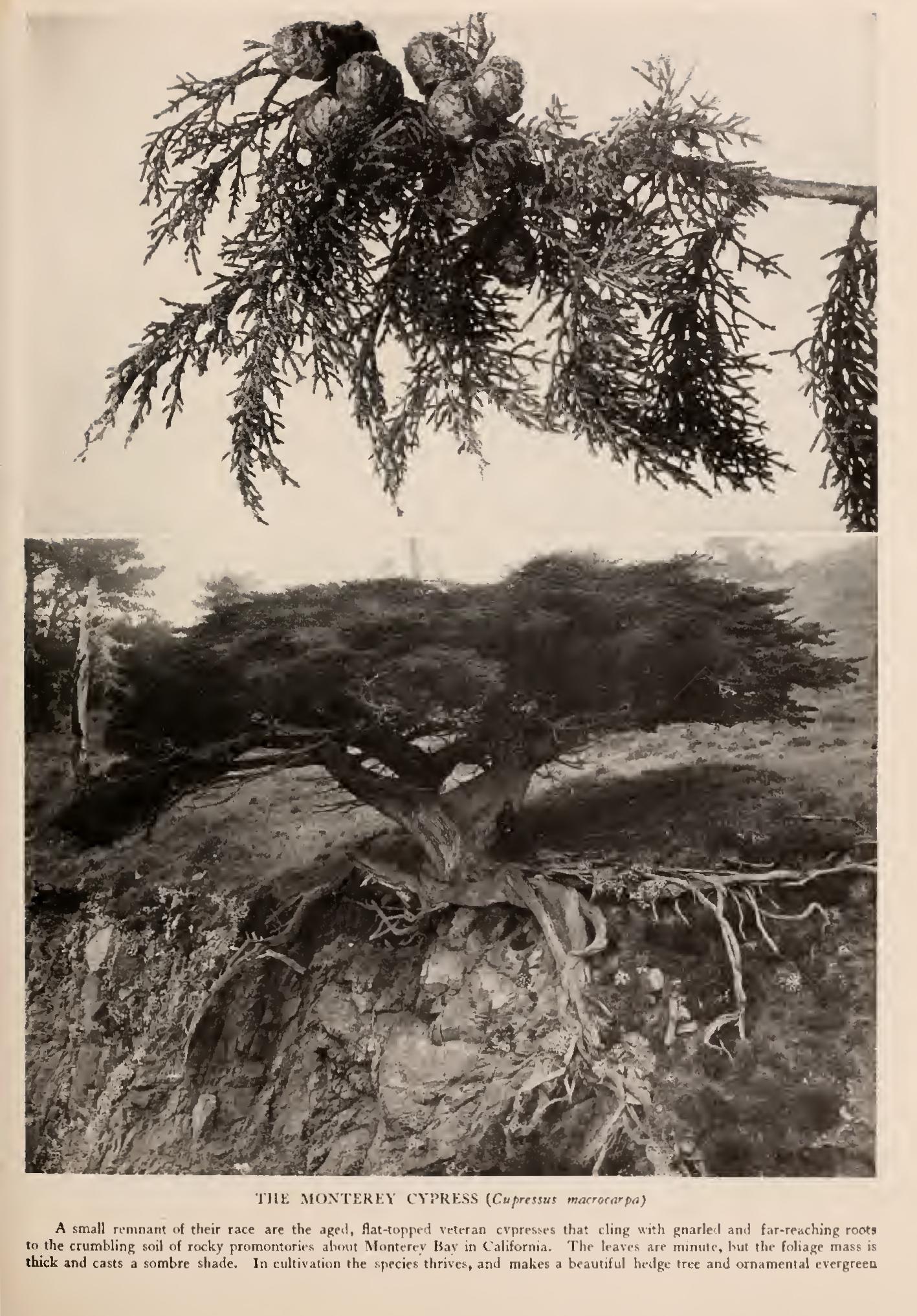
THE CYPRESSES OF MONTEREY Staunch derelicts adrift on Time's wide sea, Undaunted exiles from an age pristine! Your loneliness in tortured limb we see; Your courage in your crown of living green; Your strength unyielding, in your grappling knee; Your patience in the calmness of your mien. Enrapt, you stand in mighty reverie, While centuries come and go, unheard, unseen.
—Anna Botsford Comstock.
The Arizona Cypress (C. Arizonica, Greene) extends as a small or medium-sized tree of pyramidal habit from Arizona into California and Mexico. Forests of it are found at 5,000 to 6,000 feet elevation. The trees are occasionally broad with flattened tops. The leaves are pale green, and a glaucous bloom covers them after the first year of growth. The cones are also glaucous, and each thick scale has a sharp beak at the top. The tree is rare in cultivation, and as yet has no importance in the lumber trade.
The Cypress (C. Goveniana, Gord.), of central and southern California coast mountains, has dark green foliage on spreading branches that form a loose, open head. The tree is not at all rare within its range, but varies from a shrub to a tree 5o feet high. Horticultural forms, usually dwarfs, are cultivated.
The Macnab Cypress (C. Macnabiana, Murr.), also a Cali fornian limited to the northern mountainous part Of the state, is a small spreading tree, rarely 3o feet high, often with many stems. Its leaves are dark green, sometimes whitened by a glaucous bloom, always distinctly set with glands. In cultivation the tree is the hardiest of the genus, although restricted to California and the Gulf States in this country and to the warmer parts of Europe.
The classic Cypress (C. sempervirens, Linn.) of the Old World gives distinction to Italian gardens to-day, and as the symbol of mourning has been planted in the burial places of Europe from the earliest recorded times. It is mentioned more fre quently in classical literature than any other conifer.* Its som bre foliage was the badge of grief. It is one of the trees noted for longevity; its age limit is estimated at 3,000 years. Not hardy
in our Northern States, it is cultivated in the South and in Cali fornia. The species submits to severe pruning, so it is often planted for hedges.
2. Genus CHAMIECYPARIS, Spach.
Trees of tall, narrow pyramidal habit, with short, spreading side branches, and flat branchlets spray. Wood pale, fragrant, durable. Leaves scale-like, sharp, opposite in pairs. Flowers moncecious, minute, globular, lateral. Fruit annual, erect, globular cones of few woody scales; seeds t to 5 under each fertile scale.
•" Nor, when you die, shall any of the trees you have planted, save only the mournful cypresses, follow their KeY TO SPECIES A. Bark of tree thin; ridges flat; leaves blue-green.
B. Twigs slender; leaves dull, glandular.
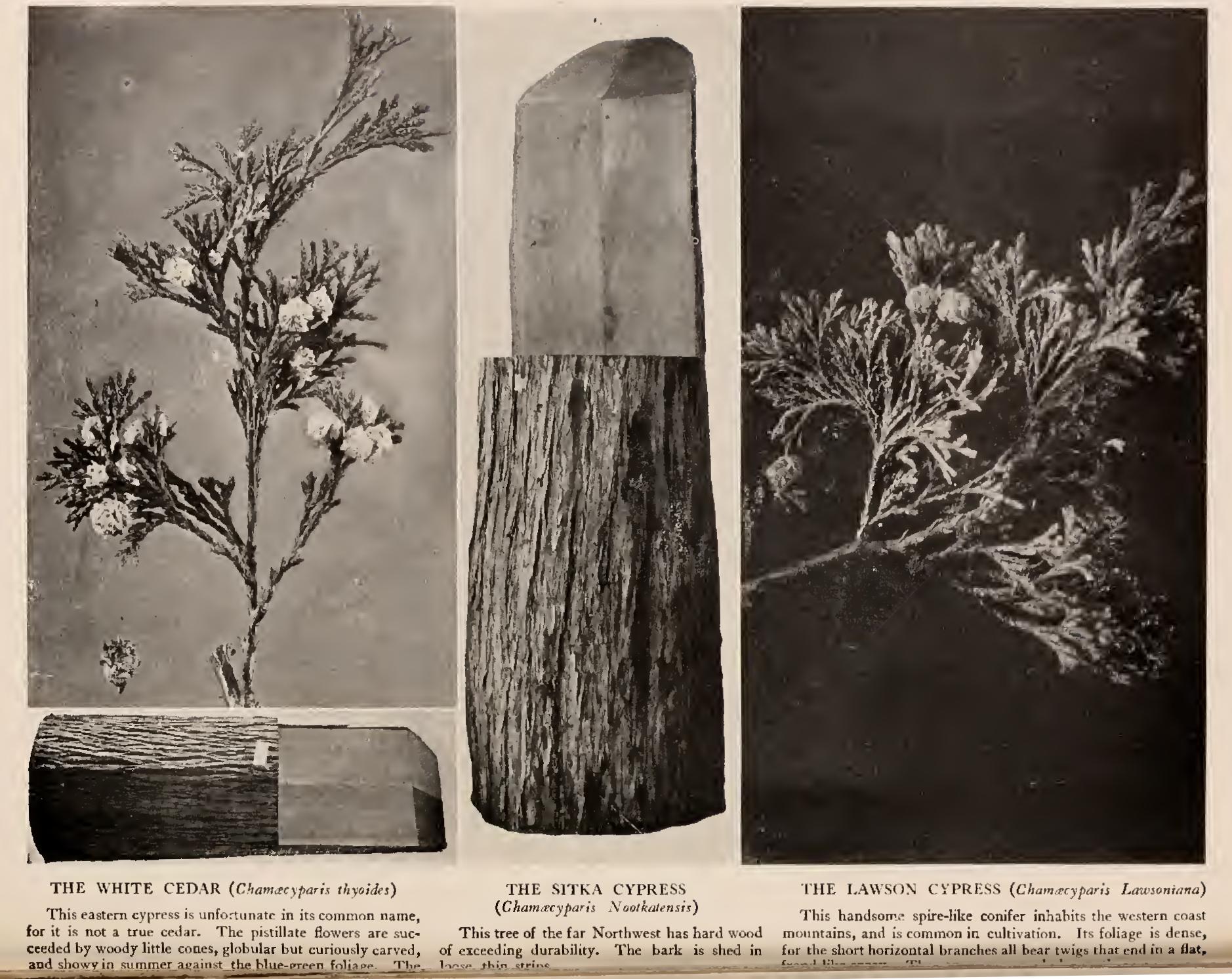
(C. thyoides) WHITE CEDAR BB. Twigs stout; leaves bright, not glandular.
(C. Nootkatensis) SITKA CYPRESS AA. Bark of tree thick; ridges rounded, leaves bright green, glandular. (C. Lawsoniana) LAWSON CYPRESS This genus of six species is distributed in North America and Japan and on the Island of Formosa.
White Cedar (Chameecyparis thyoides, Britt.)—A fast growing, pyramidal tree, 4o to 8o feet high, with flat, graceful spray on erect, spreading branches. Bark pale, reddish brown, furrowed, stringy, often terminal. Wood light reddish brown, soft, light, weak, aromatic, close grained, easily worked, very durable in soil. Buds naked, very small. Leaves dull blue-green, minute, scale like, opposite, 4-ranked, lateral pairs keeled, others concave, fitting compressed twigs. Flowers, April, moncecious, small, terminal, made of 4 to 6 scales; staminate red or yellow, abundant; pistil late few, greenish. Fruit woody, spherical cone, I- inch in diame ter, annual, glaucous, blue-green, becoming brown; scales with beak in centre; seeds winged, 1 to 2 under each scale. Preferred habitat, deep swamps near seacoast. Distribution, seaboard states, Maine to Mississippi. Uses: Important ornamental evergreen. Wood used for interior finish of houses, for boats, fence posts, rail road ties, buckets, barrels, shingles, and small woodenware.