The Dogwoods
THE DOGWOODS Genus CORNUS, Linn.
Small, slender-twigged trees, with very hard wood. Leaves simple, entire, opposite (except one). Flowers small, in dense cymes; perfect. Fruit a berry-like, 2-celled drupe.
KeY TO SPECIES A. Leaves opposite.
B. Fruit red.
C. Flower buds covered; bracts 4, notched.
(C. florida) FLOWERING DOGWOOD CC. Flower buds naked; bracts 4 to 6, not notched.
(C. Nuttallii) WESTERN DOGWOOD BB. Fruit white (rarely dark blue); leaves rough above.
(C. asperzfolia) DOGWOOD AA. Leaves alternate; fruit blue.
(C. alternifolia) ALTERNATE-LEAVED DOGWOOD The dogwoods include about thirty species distributed over the Northern Hemisphere, with a single species in Peru. They are chiefly shrubs, a few small trees, and all hardy and ornamental, with handsome foliage, flowers and fruits. An attractive char acter is the vivid autumn foliage.

From ancient times dogwoods have been planted as orna mentals about homes, and in parks and pleasure grounds; tonic drugs, dyes and inks have been derived from their bark; and the wood has been used for engravers' blocks, tool handles, and in turnery. The name Cornus (from cornu, a horn) calls attention to the hardness and toughness of the wood. "Dogwood" is one of those unfortunate popular names fastened without reason upon a family of beautiful trees and shrubs. In the good old times it was the practice in England to steep the bark of a certain species and wash mangy dogs with the astringent decoction. Perhaps the dogs were as indignant at this treatment as we are to be persistently reminded of it.
There are eighteen American species in the genus Cornus; one is the little herbaceous bunchberry, scarcely six inches high, but distinctly a near relative of the tree dogwoods, as anyone can see.
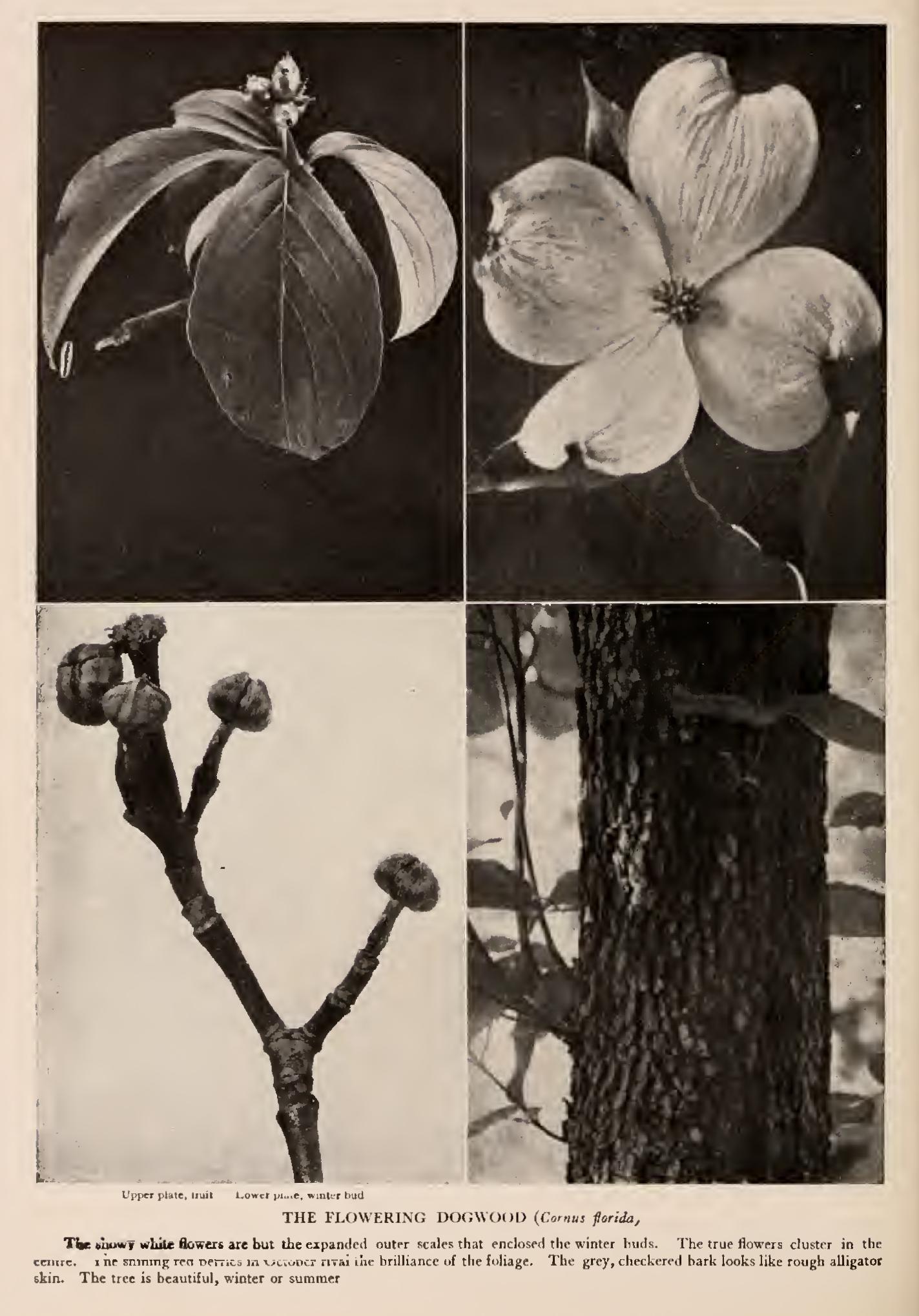
Flowering Dogwood (Cornus florida, Linn.)—A small, flat-topped, bushy tree, 15 to 4o feet high. Bark dark grey or brown, broken into squarish plates; branches grey; twigs velvety, purplish green. Wood heavy, strong, hard, tough; brown, fine grained. Buds conical; flower buds vertically flattened. Leaves opposite, simple, 3 to 5 inches long, oval, with midrib and parallel side ribs indented above; whitish. Flowers, March to May, before
the leaves, in close clusters at ends of branches; greenish, small, tubular; 4 white or pink involucral bracts, notched at tip, sur round the flower cluster. Fruit, October, ovoid, scarlet drupes, inch long, few in a cluster; seeds 2. Preferred habitat, and rocky hillsides. Distribution, Massachusetts to Florida; west to Michigan, Missouri and Texas. Uses: Hardy and handsome ornamental trees. Wood used for bearings in machin ery, hubs, tool handles; also for wood engravings and wood carving. Bark yields a drug like quinine; also a red dye.
The striking thing about the flowering dogwood in winter is the alligator-skin appearance of its grey, checkered bark. This identifies it in any-stretch of woodland without further aid to the observer. One notices, too, the greyness and the platformed stratification of its bushy top, from whose larger branches the twigs rise with curious bendings so as to hold their clustering buds into the light. The tree has a picturesque waywardness of habit in the woods: it crouches in the shadows of tall trees, and leans out to reach the sunshine that sifts through the forest cover. The twigs are thickly set with buds, formed in midsummer, for the flowering dogwood is a thrifty, far-sighted tree. The slim leaf buds are inconspicuous among the squat, box-like buds that contain the flowers.
I need not tell anyone how beautiful a dogwood tree is when the thick cloud of white or pink-flushed blossoms covers its bare branches to their utmost twig. It is a sight to remember to the end of one's days. Perhaps it may seem pedantic, and even unkind, to say here that the beauty of the tree is not in its flowers, but in the four large petal-like scales, or bracts, that surround the greenish bunch of small, tubular, true flowers. In winter these four bracts enfold the flowers. They are the outer envelope of the little flattened and pointed buds. In spring these bud scales do not fall, but grow at an amazing rate. Only the very tips of them are too dry to grow. They form the peculiar notch at the apex, and give the bract an artistic, if rather irregular, twist.