The Heaths - the Rhododendron and the Mountain Laurel Family Ericaceae
Rhododendron means "rose tree"—and we wisely cling to the long, sonorous Greek name. The common English name, rose bay, seems trivial applied to so beautiful a plant. The traveller who visits the southern Appalachian Mountains in early summer sees Rhododendron maximum in its best estate. Above each umbrella-like whorl of glossy evergreen leaves appears a rounded cluster of white or rosy blossoms, dimmed only by the bright green of the new leafy shoots that stand out between the flower clusters. For miles these tree-like growths illuminate the woods, as their shrubby relatives, the azaleas, do in woods farther north. where the rhododendrons dwindle in size and in numbers.
Through late summer the green capsules, each with its curv ing style atop, mark the place where the blossoms were. They hang on all winter, though the seeds fall in autumn. Against the snow the broad leaves shine brighter than all other evergreens, and a large scaly bud in the centre of the young shoots conceals and promises flowers in profusion for the com ing summer.
R. Catawbiense, a more brilliant species in bloom, but always a shrub, is brought by the carload from the high Alleghanies, and planted on great estates in the North, where it passes R. maximum in hardiness. The transplanting of these rhododendrons is accom plished with a loss of scarcely t per cent. if done by responsible nurserymen.
2. Genus KALMIA, Linn.
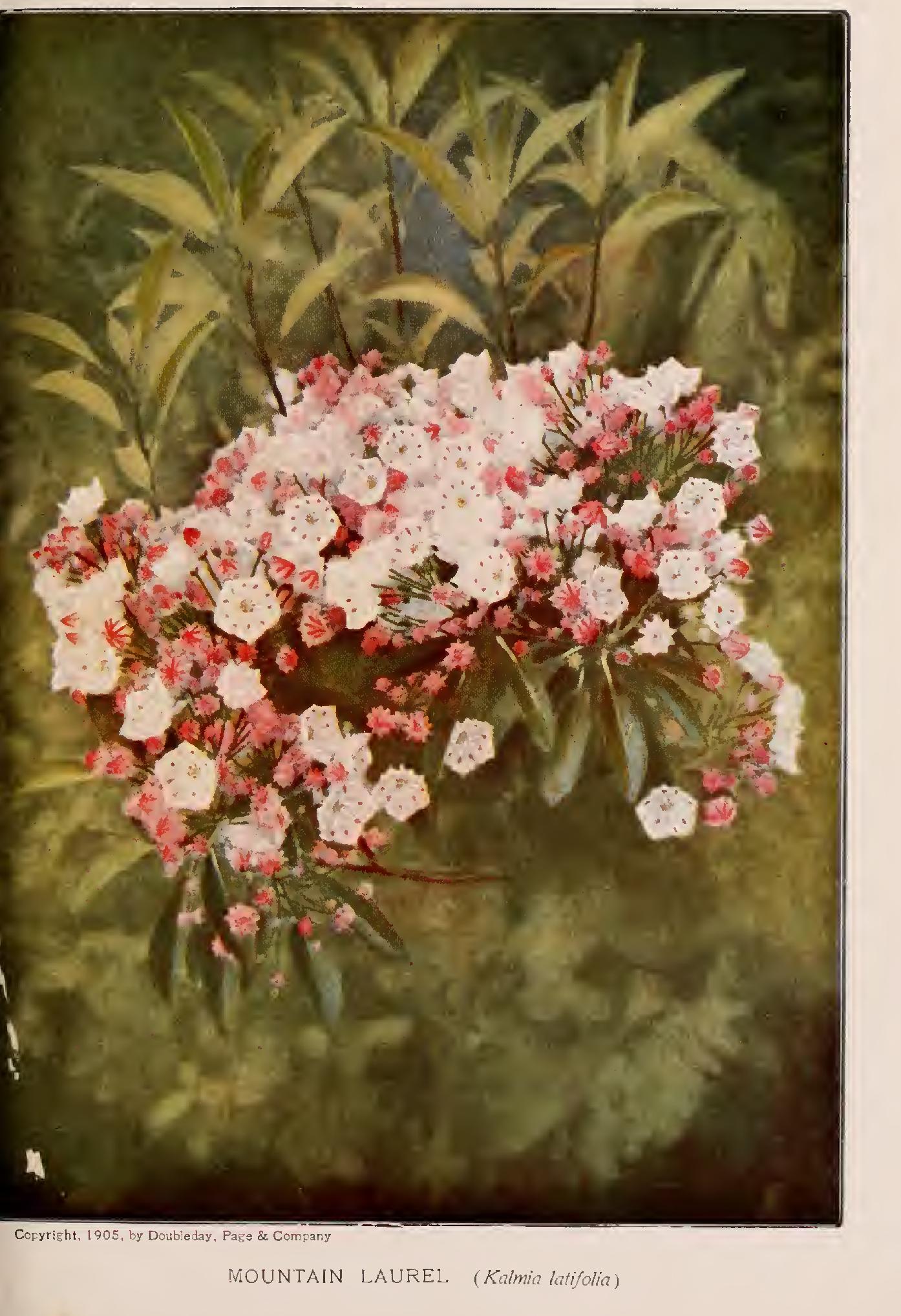
Mountain Laurel (Kalmia latifolia, Linn.)—Evergreen shrub or tree, becoming 3o feet high, with dense, round head and crooked branches. Bark dark brown with tinge of red, scaly, branches red or yellow, smooth. Wood reddish brown, heavy, fine grained. Buds large, scaly, sub-terminal ones contain flowers; leaf buds small, naked, axillary. Leaves alternate or irregularly whorled, oblong, tapering at both ends, leathery, stiff, dark green and shining above, yellow-green below; 3 to 4 inches long, on short petioles; evergreen, falling during second summer. Flowers in large terminal compound corymbs, on viscid peduncles; perfect in June; calyx 5-parted, on to-lobed disc; corolla, saucer shaped, rosy or white with purple markings in short tube, to tiny pouches below 5-parted border; stamens to, with anthers in pouches, and filaments bent over until time to discharge pollen, when they straighten; pistil 1, with head on long style; ovary 5-celled. Fruit a globular, woody, 5-celled, many-seeded capsule. Preferred
habitat, cool, moist, well-drained soil that contains no lime. Sheltered situations in the North. Distribution, Nova Scotia to Lake Erie (north shore); southward through New England and New York, and along Alleghanies to northern Georgia. Uses: Hardy ornamental evergreen. Foliage used for winter decora tion of houses and churches, and to trim fruit stands in city markets.
Along with the rhododendrons in June and July the mountain laurel hides its shining evergreen leaves with flower clusters larger than any the rhododendron bears. At least it seems so, for the clusters lie close, cheek by cheek, quite subordinating the foliage, making often a great mass a foot across, upon a single slender branch.
Smaller than the rhododendron in blooms, the laurel shows more exquisite colouring, and more interesting and beautiful forms from bud to seed. First, the buds, little fluted cones of vivid pink, make with the green of the new leaves one of the finest colour combinations to be found in any shrub. The largest ones open first, spreading into wide, 5-lobed corollas with ten pockets in a circle around the base of each. Ten stamens stand about the free central pistil, and the anther of each is hid in a pocket, its filament bent back. This is a curious contrivance, and well worth looking into. There is a bee lighting on the border, and probing the tube of the corolla for honey. Her clumsiness makes her Nature's agent for the fertilising of these flowers. As she steps on a bent filament, it straightens itself with a spring, the hidden anther is drawn forth and bangs against her furry body, dusting her well with the pollen, which comes in a jet out of a small pore at the top of the anther. The mountain laurel is not self-fertile. Only insects, gathering nectar by the hour, fertilise these flowers. They brush their pollen-laden bodies against the erect pistils, thus bringing about cross-fertilisation wherever they go. A net tied over a mass of blossoms, excluding the bees, will defeat Nature, for the stamens are never released, though the pollen cells are ripe and waiting, as is the sticky stigma in their midst. No seed will be set, though all about, on branches not covered, little flattened green capsules, each waving a curved green wand aloft, ripen their seeds and cast them in the fall.