The Hemlocks
THE HEMLOCKS - Genus TSUGA, Carr. Tall, graceful trees of pyramidal form, with flexible tip shoots and pendulous, much-divided horizontal limbs. Leaves evergreen, petioled, flat and 2-ranked (except one). Flowers moncecious, solitary, in early spring. Fruit annual cones, small and oval (except one), with thin, entire scales. Wood soft, pale, cross-grained, stiff.
Key TO SPECIES A. Leaves flat, 2-ranked, pale beneath; cones about I inch long, oval.
B. Cones stalked.
C. Scales as wide as long, not flaring at maturity.
(T. Canadensis) HEMLOCK CC. Scales longer than wide, flaring at maturity.
(T. Caroliniana) CAROLINA HEMLOCK BB. Cones sessile, scales constricted in middle.
(T. heterophylla) WESTERN HEMLOCK AA. Leaves 3-angled, whorled, pale blue-green; cones 2 to 3 inches long, oblong-cylindrical.
(T. Mertensiana) MOUNTAIN HEMLOCK Hemlocks are distinctly graceful and symmetrical trees. Japan has two native species, the Himalayas one, our Eastern States one, the Western States three—seven in all—and Tsuga is the Japanese name for hemlock. The prostrate, shrubby "ground hemlock," familiar to many of us who have eaten its aromatic scarlet berry, is not a hemlock but a yew. The hem L lock that Socrates drank was the deadly infusion of an herb, Coniurn maculation, related to our wild carrot.
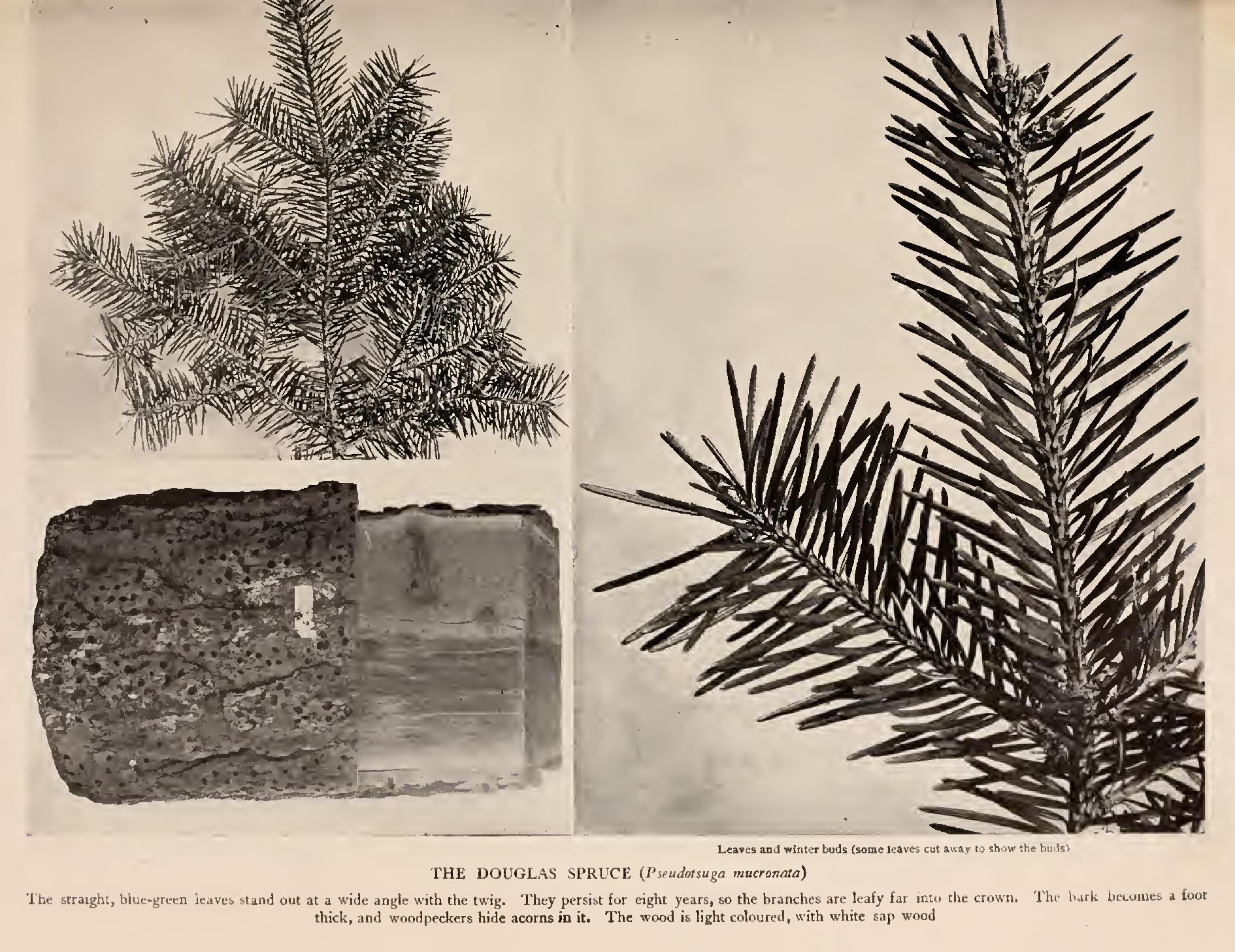
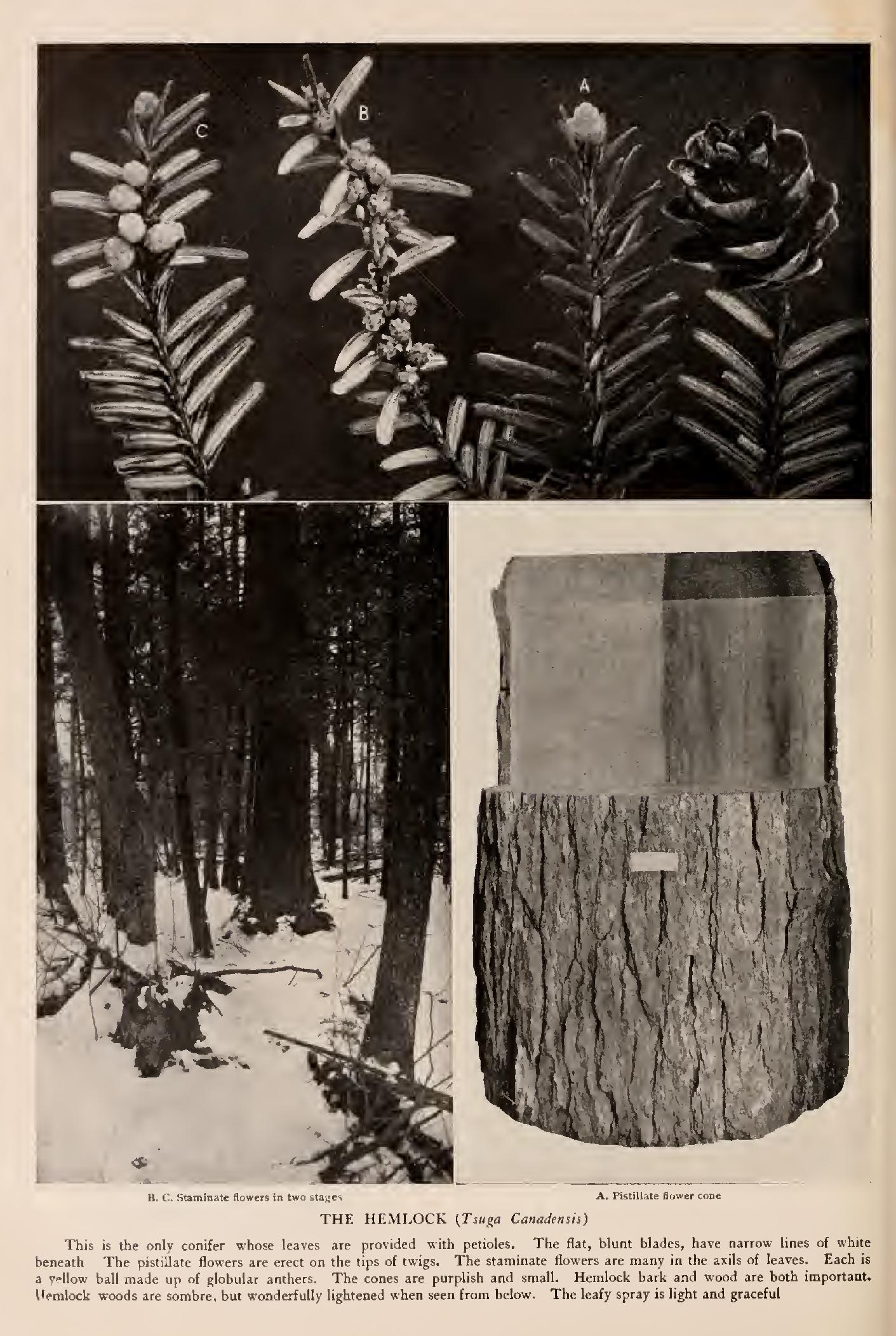
The best character by which to recognise the hemlocks is the tiny petiole of the leaf. No other cone bearer has leaf stalks. Of our native species, all have white lines on the under side of each leaf; the mountain hemlock has them above and below. The first three species have leaves 2-ranked and flat and cones under an inch in length; the fourth has leaves 3-angled, whorled on the twigs, and cones 2 to 3 inches long. Cones are pendant, and thin scaled in all the species, and are borne annually.
Hemlocks are important ornamental trees. They come readily from seed, if shaded, and transplant safely, owing to their dense fibrous root system. They submit to severe pruning of roots or tops. They are not particular in regard to soil, if only it be moist. The two Japanese species are propagated from cut
tings, or are grafted on our Eastern hemlock. All hemlocks have bark rich in tannin. The west American species are all large trees, except at high altitudes.
Hemlock (Tsuga Canadensis, Carr.)—A broadly pyramidal tree, 6o to loo feet high, with tapering leading shoot and pen dulous horizontal limbs. Bark cinnamon red to grey, thin, fur rowed, scaly. Wood light, soft, coarse, cross-grained, not durable. Buds small, obtuse. Leaves flat, blunt, pale beneath, dark, shining above, on short petioles jointed to projecting bases, 2-ranked, shed in third year. Flowers in May, moncecious, soli tary; pistillate terminal on short shoots. Fruit small, annual cones, falling in spring, oval, thin scaled, red-brown, turning to grey. Preferred habitat, rocky uplands near streams. Dis tribution, Nova Scotia to southern Michigan, central Wisconsin and Minnesota; southwa Delaware, and along Appalachian Mountains to Alabama. Wood, in building and for rail road ties; bark, in dyeing and in tanning leather. Cultivated as an ornamental tree and hedge plant.
" Hemlock Hill" in the Arnold Arboretum is a shrine at which the true tree-loving Bostonian worships at least once a year. I t is a remnant of the forest primeval that clothes a steep promontory just inside one of the gates. In winter the hemlocks look black in contrast with the snow that hides the paths and smothers the brook into silence. It is awesome—this solitude of winter on the hill. But in summer all is different. The severity of its winter aspect is gone. Every twig waves in welcome a yellow-green plume, the new growth of the year, and up the hillside climb the well-remembered paths. The brook goes singing along between borders of laurel and rhododendron. The gloom of the hemlocks is wonderfully lightened, when one is actually under them, by the pale linings of the individual leaves. Just two parallel lines of white on each narrow blade, but the aggregate makes a mighty difference in the atmosphere of the place.