The Magnolias and the Tulip Tree - Family Magnoliaceae
Swamp bay flowers are globular and small for a magnolia— only two or three inches across—but delightfully fragrant.
One of the sights on the streets of Philadelphia and New York in May is the street Arab hawking the blossom clusters. A flower with a half-open bud in its whorl of leaves costs ten cents. An absurd custom prevails among these flower venders. They "open" the globular blossoms by springing back the curved petals. The finest flowers are produced by cutting back 25o the tree and letting the suckers grow up thickly around the stump. These bear flowers of unusual size, and clean, hand some leaves.
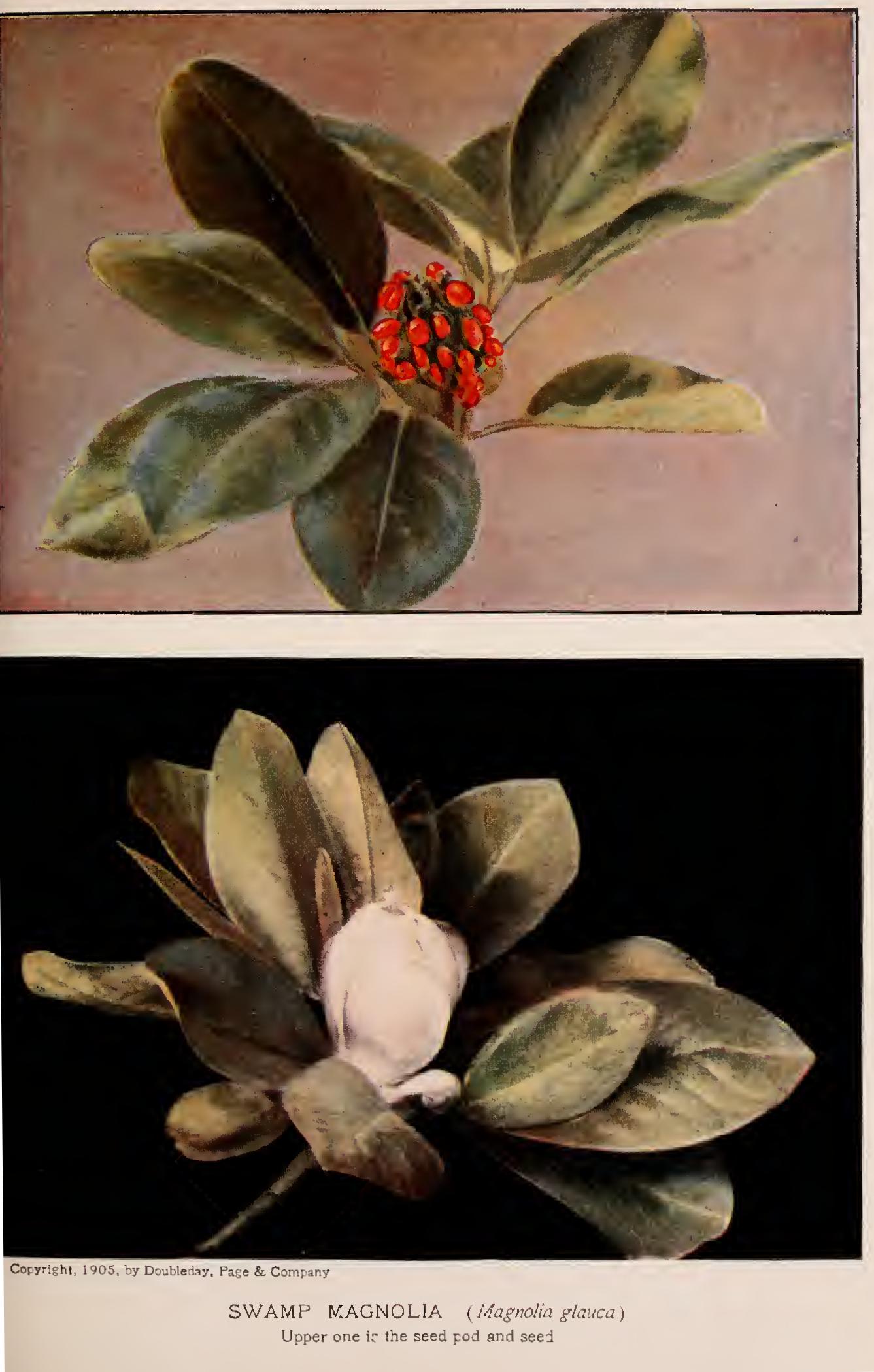
Professor Gifford recommends the systematic planting of swamp lands in New Jersey to this species of magnolia as a profit able enterprise. He would prune with care, so as to produce the finest leaves and flowers. The blooming period covers several weeks. Cut flowers and leafy branches command good prices in the markets. Waste land near large cities can be transformed and beautified by this means, and become a source of income to the owners at small outlay. The prunings are salable for house decoration at holiday time.
The swamp bay is also called white bay, sweet bay and beaver tree. Beavers used its soft wood for their lodges in earlier times. The English call it laurel magnolia.
Sweet bay it is called because its foliage is somewhat like that of the bay tree of the Old World, which is commonly grown in tubs by florists and is much used in this country for porch decoration. This is Laurus nobilis, the "laurel" of the ancients. The sweet bay of the swamps grows well in gardens if only the soil is moist. But it is safer and in every way more desirable to get plants of it from nurserymen.
Cucumber Tree (Magnolia macropbylla, Michx.)—A broad, round-headed tree, 3o to 5o feet high, with slender trunk and stout branches. Bark thin, smooth, grey, minutely scaly. Wood light, close textured, pale brown, weak; sap wood thick, yellow. Buds terminal, II- to 2 inches long, blunt, covered with white silky hair; axillary small, flat. Leaves 16 to 3o
inches long, obovate, rounded or acute at apex, broadened at base into ear-like lobes, or deeply cordate, margin entire; upper surface bright green, lining silvery white; petioles stout, 3 to 4 inches long, veins prominent. Flowers to to 12 inches across, bowl shaped, made of 6 white fleshy petals much broader than the 3 sepals. Inner petals with purple spot at base. Fruit almost globular, 2 to 3 inches long, turning red at maturity. Seeds inch long. Preferred habitat, deep, fertile valleys, protected from wind. Distribution, foot hills of Alleghany Mountains in North Carolina, south to middle Florida, and west to southern Alabama, to northern Mississippi and Louisiana, and in central Arkansas; range not continuous, trees occur in small, detached groups.
Uses: Cultivated as an ornamental tree in Europe and America. Hardy to Boston.
This species excels all other magnolias in the size of its leaves and flowers. The leaves are almost a yard long. In fact, no tree of simple leaf approaches it outside of the tropics. It is the remarkable size of its leaves and flowers that commends this tree to planters. Of beauty we cannot credit it with quality to match its size. A flower as big as a man's head is sure to be lacking in delicacy. There is a dash of purple at the base of the inner row of petals. The wind lashes the broad leaves into ribbons early in summer, and every twig or leaf that touches a petal mars it with a brown bruise. So the flowers soon spread wide open and become discoloured. Two fine young specimens stand in front of the Museum of the Arnold Arboretum, Boston. The protection of the building and the border planting are not sufficient to defend these trees from the common fate of all plants which offer an unusual expanse of leaf surface in a region where winds are frequent and strong. Though but a dozen feet high these trees have already bloomed freely. The silvery leaf linings tend to obscure the white flowers in spite of their extraordinary size.