The Mangroves
THE MANGROVES - The true mangrove family, Rhizophoracex, of fifteen genera, is chiefly confined to the tropical regions of the Old World. One genus with a single species reaches the extreme end of Florida. Two other species of the genus Rhizophora are found in tide pools and marshes of Asiatic and African equatorial waters. The remarkable habit of throwing out aerial roots from trunks and limbs, and of germinating its seeds before they fall enable the mangrove to extend its range on all sides, encroaching upon the surrounding water slowly but surely. The secondary roots fasten themselves in the soil, and the young plantiets, as they fall, strike root at varying distances from the parent tree. The flotsam and jetsam brought in and out by tides lodge among the network of roots and stems, and thus new soil is formed.
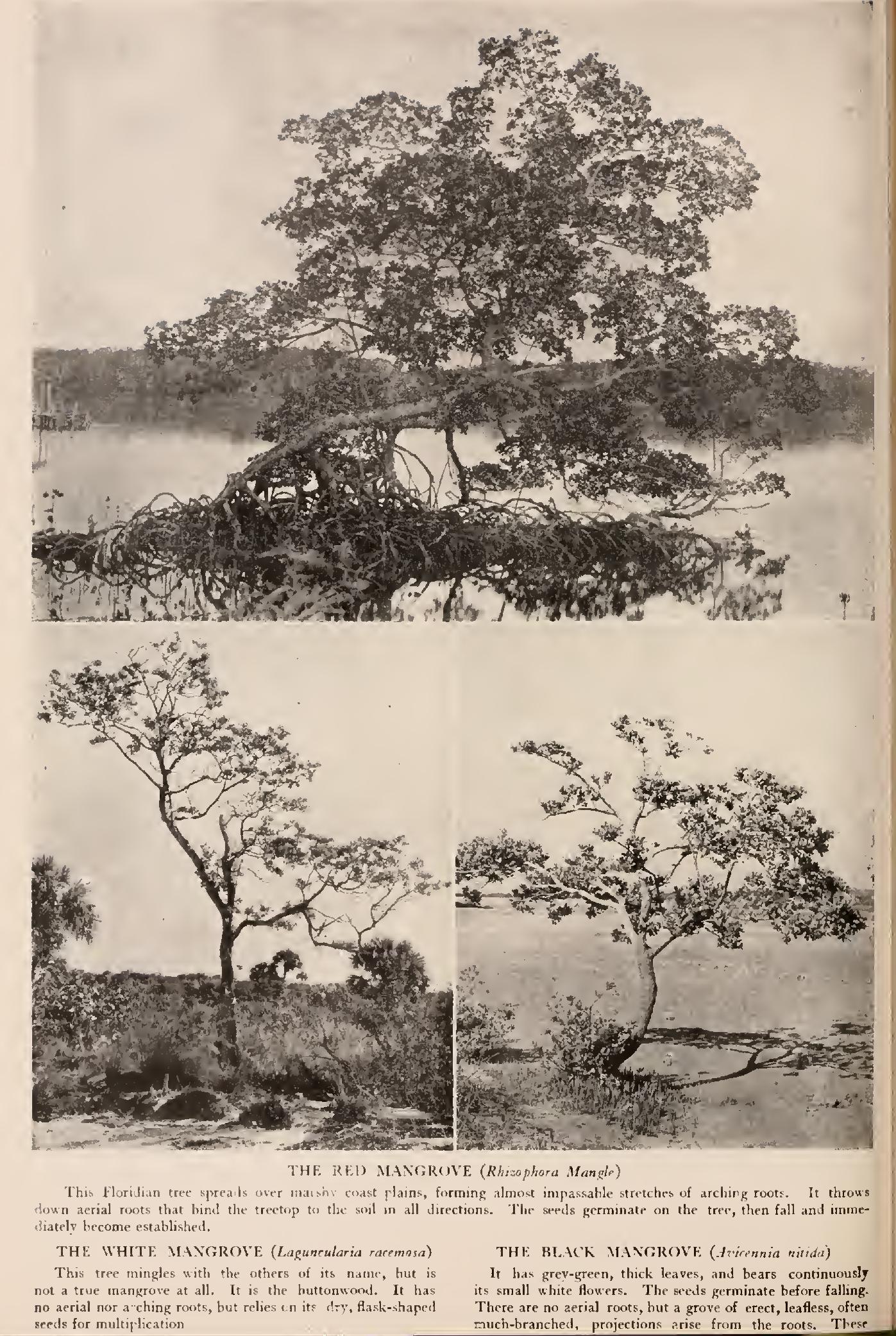
Red Mangrove (Rh4ophora Mangle, Linn.)—A round-topped tree, 15 to 25 feet high, with drooping, aerial roots. Occasionally 75 feet high, with small, narrow head. Bark reddish brown or grey, irregularly broken by shallow fissures; branches smooth. Wood reddish brown, streaked with paler brown, hard, heavy, close grained. Leaves persistent, thick, oval, blunt, 3 to 5 inches long, dark green and shining above, paler beneath; margins entire. Flowers, axillary, perfect, 2 to 3 on short stalk, petals 4, yellow, hairy inside; ever-blooming. Fruit berry-like, 1 inch long, with leathery, rough, brown skin; 4 calyx lobes curl back from base, and tube of developing cotyledon of germinating seed protrudes from apex. Preferred habitat, along coasts and rivers in wet soil. Distribution, Florida from Mosquito Inlet to Cedar Keys, rounding the southern end of the peninsula, and outlying islands. Uses: Wood for wharf piles and fuel. Bark yields tannin, and a decoction of it is used as a febrifuge.
This is the true mangrove of the West Indies and the Florida coast, found also along the Pacific coast of Mexico and Lower California. With the coral polyp it co-operates to extend the borders of island and mainland. It spreads in monotonous green thickets over marshy coast plains and in the estuaries of rivers, forming almost impassable stretches of arching roots, accumu lating rubbish of all sorts that finally lifts the level above the tide and makes solid ground that is soon covered with the char acteristic vegetation of the tropics. Mangrove islands of varying sizes now dot the surface of shallow bays which a few years ago were quite destitute of islands.
The tree reaches its greatest height on dry ground back from the coast. Here the trees grow tall and bare of limbs for two-thirds of their height, and almost abandon the habit of throwing down aerial roots. The wood is used for fuel and built
into wharfs. It is not counted a valuable tree.
The White Mangrove, or Buttonwood (Laguncularia race mosa, Gertn.), is not a true mangrove at all; it belongs in a different botanical family, and is related to the aralias. It mingles with the mangroves, but lacks the aerial roots character istic of the latter. The foliage is red when it unfolds, becoming dark green and glossy. The flowers are small, in axillary spikes. The fruit is a flask-shaped, i-seeded drupe with corky flesh and leathery skin. The wood is hard and dark brown, except for the wide white sap wood. The bark is rich in tannic acid, and were the trees located in less miasmic regions they would soon be cut down for the bark alone.
The buttonwood the Floridian esteems as a fuel tree is Conocarpus erecta, Linn., whose flowers and fruits are button-like. It is also esteemed for its bark which yields tannin and a tonic drug.
The Black Mangrove (Avicennia nitida, Jacq.) is an ever blooming tree, with inconspicuous white flowers and a dry, ' seeded capsule, i to t a inches long. The leaves resemble those of the true mangrove in form, but have a grey-green colour. The tree's habit enables it to make soil in much the same way. The seeds germinate before they fall, and are ready to root as soon as they lodge in the mud. The roots of the adult trees extend far out and, branching, send up a grove of leafless projections a foot or two above the tide level, thus forming a network that holds the soil, and soon makes land out of what was a tide-swept marsh. No aerial roots strike downward from the branches of this tree.
The bark of the black mangrove exceeds that of Laguncularia racemosa in value to tanners. It is certain that were the trees located in more accessible regions, on solid ground instead of bottomless swamps, they would fall a prey to the peeler's axe. The Floridian depends upon a smudge of punky black mangrove to rid him of mosquitoes and sandflies, the twin scourge of the summer nights. The range of this tree reaches north to St. Augustine and Cedar Keys. From the southern end of the peninsula and the neighbouring keys it extends into the West Indies, the Bahamas, and on to Brazil.
The black mangrove is a tropical member of the verbena family, well known to us in its herbaceous representatives that grow in Northern gardens. The fiddlewood of lower Florida (Citheraxylon villosunt) is its nearest relative. The most important timber tree in the family is the teak, Tectoria grandis, which grows in tropical Asia and the East Indies. The catalpas in the bignonia family are also close tree kin of the black mangrove.