The Maples - Family Acerace
The great leaves that distinguish this species make it a favourite on the Pacific slope. Unfortunately it is not hardy north of Philadelphia, and does better in Europe than in our Eastern States. It really is happiest in the bottom lands of southern Oregon, where it forms forests and attains tremendous proportions. One must see it at home in order to appreciate this maple.
John Muir, writing of the western slopes of the Cascade Mountains, says: "In a few favoured spots the broad-leaved maple grows to a height of a hundred feet in forests by itself, sending out large limbs in magnificent interlacing arches covered with mosses and ferns, thus forming lofty sky gardens, and rendering the underwoods delightfully cool. No finer forest ceiling is to be found than these maple arches." The wood of the broad-leaved maple ranks highest of all deciduous lumber trees on the west coast. It is equal to the best maple of the Eastern States.
The Vine Maple (Ater circinatum, Pursh.) grows from British Columbia into northern California, and from the low bottom lands to an altitude of 1,000 feet, but always along streams. In the lowlands it throws up several stems from the root, which droop as they grow as if their weight overcame their strength. Branches that spring from these prostrate stems strike root, and soon the interlacing trunks and the branches they bear cover the ground to the exclusion of everything else.
The vine maple's leaf is thin and almost circular, with a heart shaped base, and 7 to 9 triangular, cut-toothed lobes, uniform in size and shape. In summer they are green, with prominent veins and veinlets, and pale linings. In autumn they turn to orange and scarlet. The flowers are borne in terminal umbels, and the samaras are smooth, with widely divergent wings.
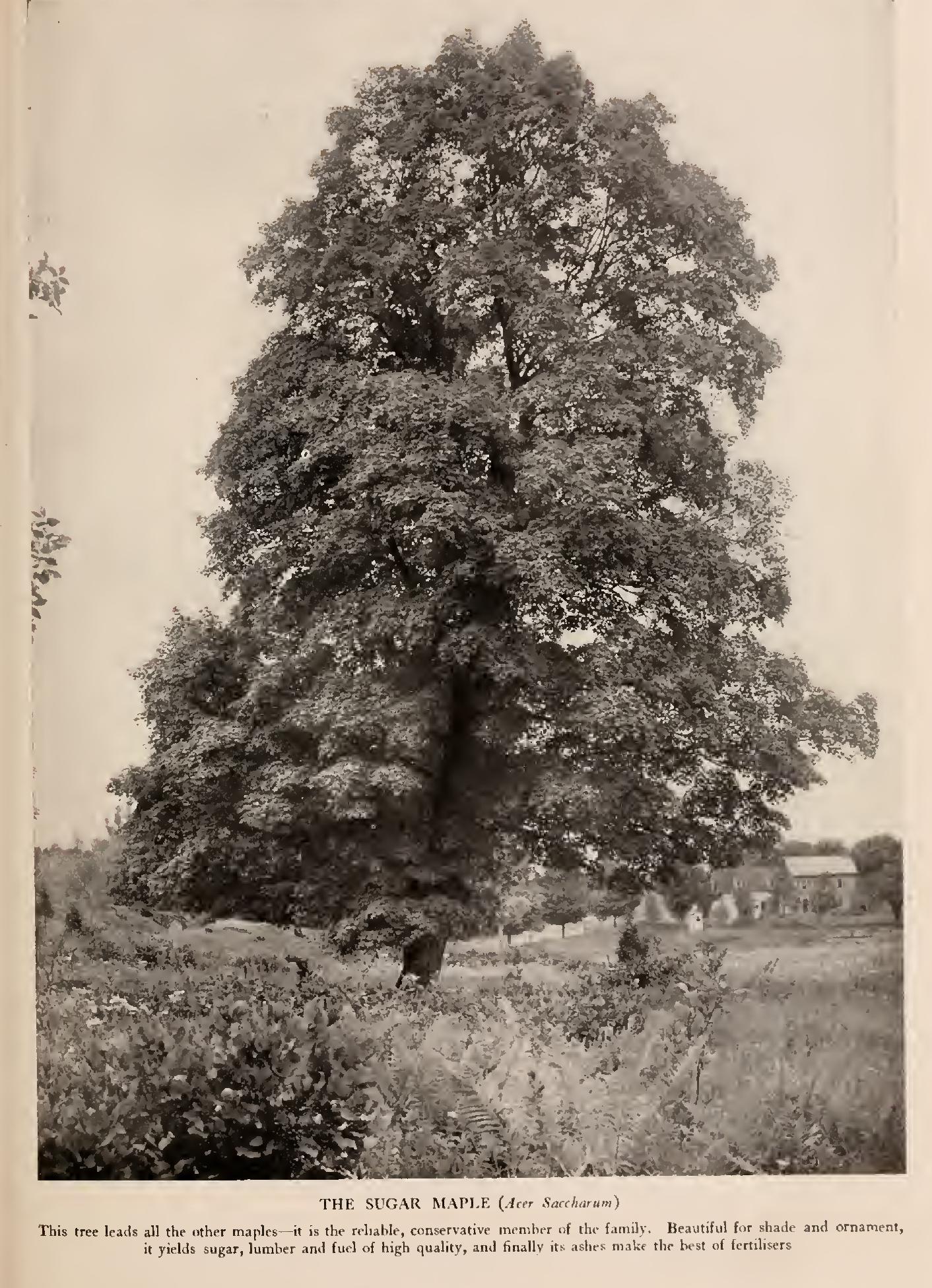
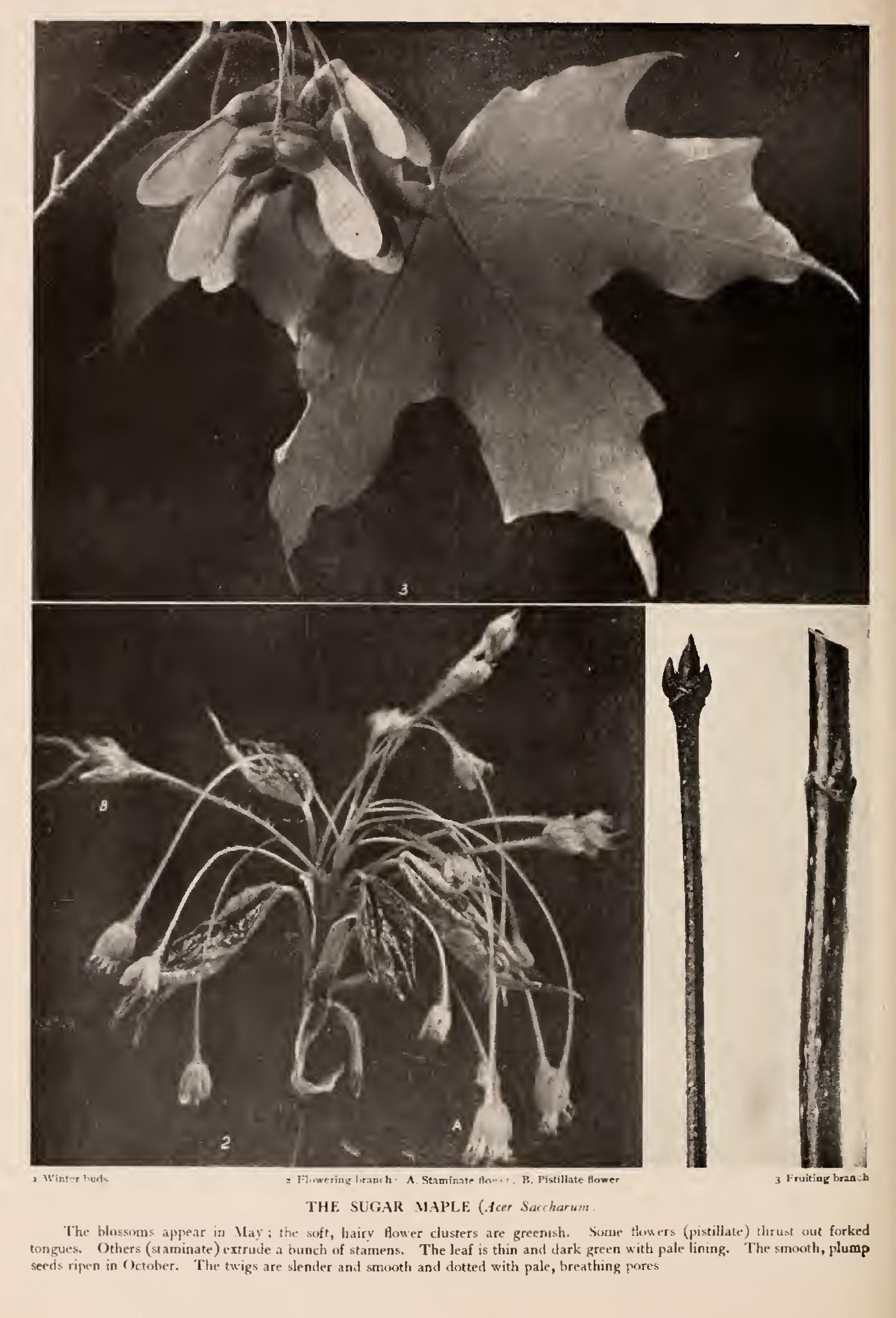
Sugar Maple, Rock, or Hard Maple (Ater Saccharum, Marsh.; Acer saccharinum, Wangh.; Acer barbatum, Michx.)—A large, handsome tree, 75 to 12o feet high, with many upright limbs forming an oval or oblong head. Sap sugary. Bark grey, deeply fissured. Wood reddish brown, close grained, tough, hard. Leaves broad, 4 to 5 inches across, 3 to 5-lobed, each lobe with straight sides and peaked apex, which has 3 to 5 prominent teeth with curved sinuses between; thin, dark green above, paler lining; turn to yellow, orange and red in the fall. Flowers, with the leaves in late spring, on long stems, in hairy, thick clusters, without petals, greenish; moncecious or polygamous. Fruits, October, i to l inches long, smooth, in pairs, on stems, I to 2 inches long, with wings only slightly diverging. Preferred habitat, rich, moist soil in valleys or uplands. Distribution, Great Lakes to Newfoundland; south along mountains to Florida; west to Nebraska and Texas. Uses: Best of all maples as lumber and shade trees. Wood used for flooring, interior finish of houses, saddles, furniture, boats, shoe lasts, all turned wares and fuel. Shows occasionally curly grain. Sap makes maple sugar.
The sugar maple is one of the most characteristic and valuable trees in the eastern forests of America. It leads all the other
maples—it is the reliable, conservative member of the family, slower than many of them, and less brilliant, but with staying qualities—an absolutely dependable tree. Soft maples come and go. These come and stay—standing always "proud and tall under their leafy crowns." They are hardy, clean and vigorous. They turn gradually to gold and reds in the fall, and drop their burden of foliage without haste.
Hard maple lumber outranks all other species, and as fuel it is surpassed only by hickory. Its ashes yield potash and alkali in large percentages. Fresh unleached hard maple ashes are highly esteemed as fertiliser for orchards and vegetable gardens.
Wise men were they who set hard maples along the boundary lines of their farms in earlier days. They now have avenues to be proud of. And they have also a source of revenue, for these low-branched, isolated trees give abundant flow of sap in the early spring.
The Black Maple, or Black Sugar Maple (Acer nigrum, Michx.), is now counted a distinct species, but was long regarded as a variety of Acer Saccbarum. The best year-round character to look for is the orange colour of the stout branchlets. The tree's head is less compact and has a duller, darker green foliage mass than that of the hard maple. The leaves vary much in size and shape, but in general have three pointed lobes with broad, shallow sinuses and scantly toothed or unbroken margins; the basal sinus is often closed by the overlapping of its sides. The leaf is usually green on both sides, and smooth, with hairy tufts along the principal veins below, and on the petioles. The drooping of the leaves is very noticeable, as if the stout petioles were too weak to support their burden. The samaras differ from those of the previous species in having more widely divergent wings.
The black maple predominates over A. Saccbarum in the Western prairie states. It is the sugar maple of South Dakota and Iowa. In the East, it is a rare tree. It ranges from Montreal to Ontario and to the Dakotas, and from New Hampshire and Vermont south to lower Virginia, Kentucky, Missouri and eastern Kansas. It is an admirable shade and sugar tree, and its wood has the characteristics of the rock maple.
The Florida Maple (Ater Floridanum, Pax.) is smaller than our Northern hard maple, and differs from it in its small 3-lobed leaves, with blunt or faintly 3-lobed apexes, and pale, hairy linings. The fruits are also small. This tree varies con siderably, and grows along streams and swamps, throughout the Gulf States.
The Large-toothed Maple (Acer grandidentata, Nutt.) resembles the last species, but its leaves are leathery and have very wide sinuses and very short petioles. It is found on the mountains from Montana to Mexico.
The two species named above are considered by some authors to be varieties of the Eastern rock maple.