The Palms and the Palmettos - Family Palmae
3. Genus
WASHINGTONIA, H. Wendt.
The Desert Palm of California (Washrngtonia filantentosa, 0. Kuntze) is a striking feature of the Colorado desert and of canon sides in the neighbouring mountains. It is found in groves or in isolated clumps in wet alkali soil, where it rises to the height of 5o to 75 feet, a crown of spreading, fan-like leaves above a stout trunk clothed almost to the ground with a dense thatch of the dead leaves, which, bending back upon each other in succession, form a broad basal cone. The black berries are pro fusely borne on the branching spikes in September. They are dry and thin fleshed, but Indians use them for food. The Wash ington palm has come into extensive cultivation in California and southern Europe.
4. Genus SERENOA, Hook.
Serenoa arborescens, Sarg., grows on hummocks in swampy lands along the southwestern coast of Florida. It is a slender tree 3o to 40 feet high, often with more than one arching or prostrate stem. The fan-like leaves are pale yellow-green above, blue green below, and about 2 feet across. The flower stems are branched and about a yard long, thickly set with minute yellowish flowers, which are followed by resinous black drupes.
5. Genus THRINAX, Sw.
The Thatch,
or Silk-top Palmetto (Thrinax Floridana, Sarg.) has a silver lining in its glossy green fan leaves, making it a beautiful and showy tree. It mounts its leaf crown zo or 3o feet high on a slender white stem which is clothed half way down in the sheaths of dead leaf stalks. The branched flower stems are pendant from among the leaves; the fruit is a white berry with bitter juice. The tree inhabits coral reefs and the mainland coast between Cape Romano and Cape Sable.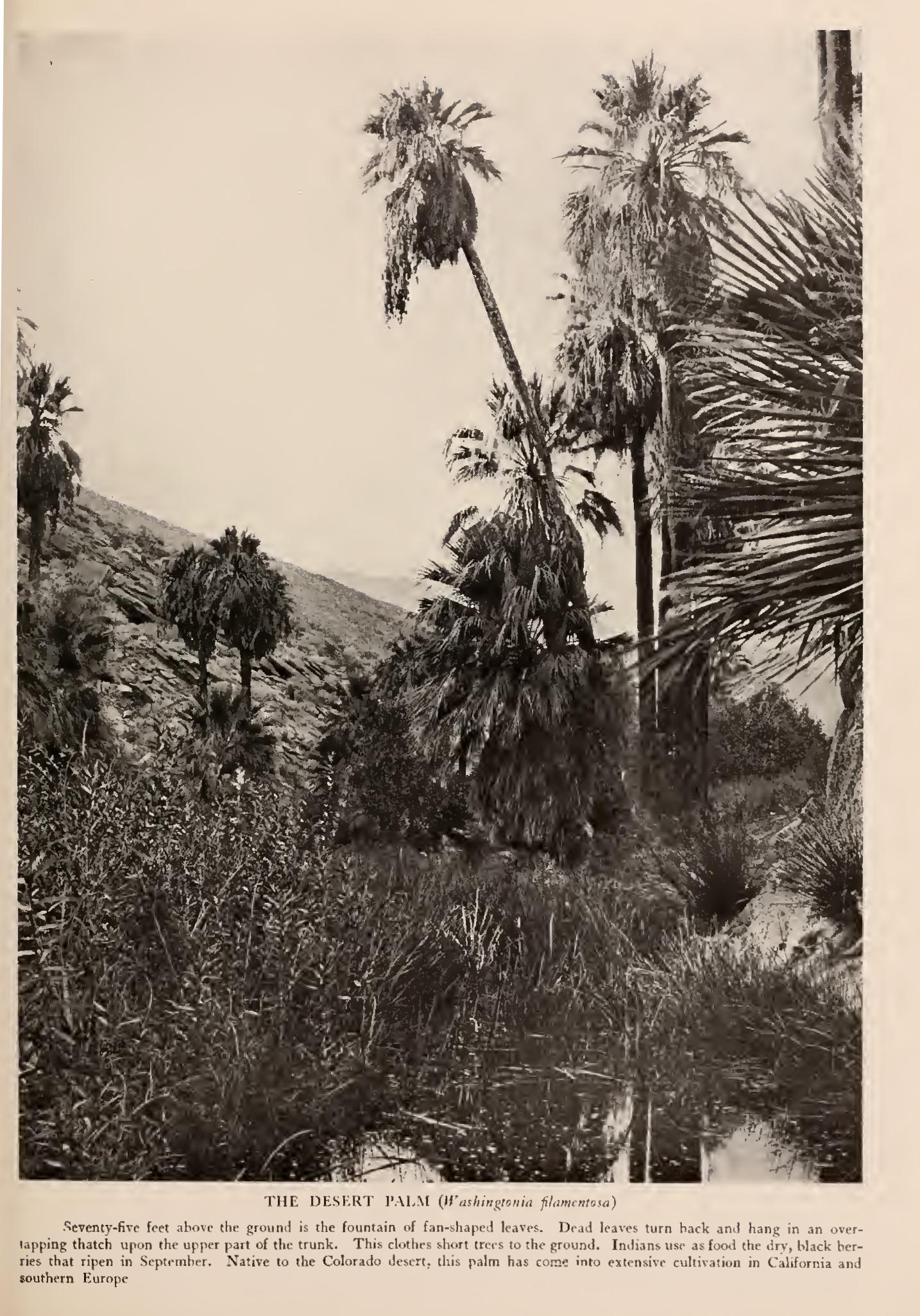
Another silver-leaved Thatch (T. K eyensis, Sarg.) rises on a supporting framework of its own roots 2 or 3 feet above the beach sand of the Marquesas Keys, Crab Key and the Bahamas.
The Palmetto (T. microcarpa, Sarg.) has its leaves coated when they unfold with dense white down. Flowers and fruit are abundant but minute. The tree rarely exceeds 25 feet in height. It inhabits No Name and Bahia Hondo Keys, south of Florida. The leaves of the three species are used for weaving hats, baskets and ropes. The trunks are used as piles for wharves.
6. Genus COCCOTHRINAX, Sarg.
The Brittle Thatch (Coccotbrinax jucunda, Sarg.) is a sender tree, 20 to 3o feet high, with a gradually tapering blue trunk. It inhabits the shores of Bay Biscayne, and follows the Keys to the Marquesas group. The round leaves furnish fibre for baskets and hats. The stems are used in construction, chiefly for wharves.
7. Genus SABAL, Adans.
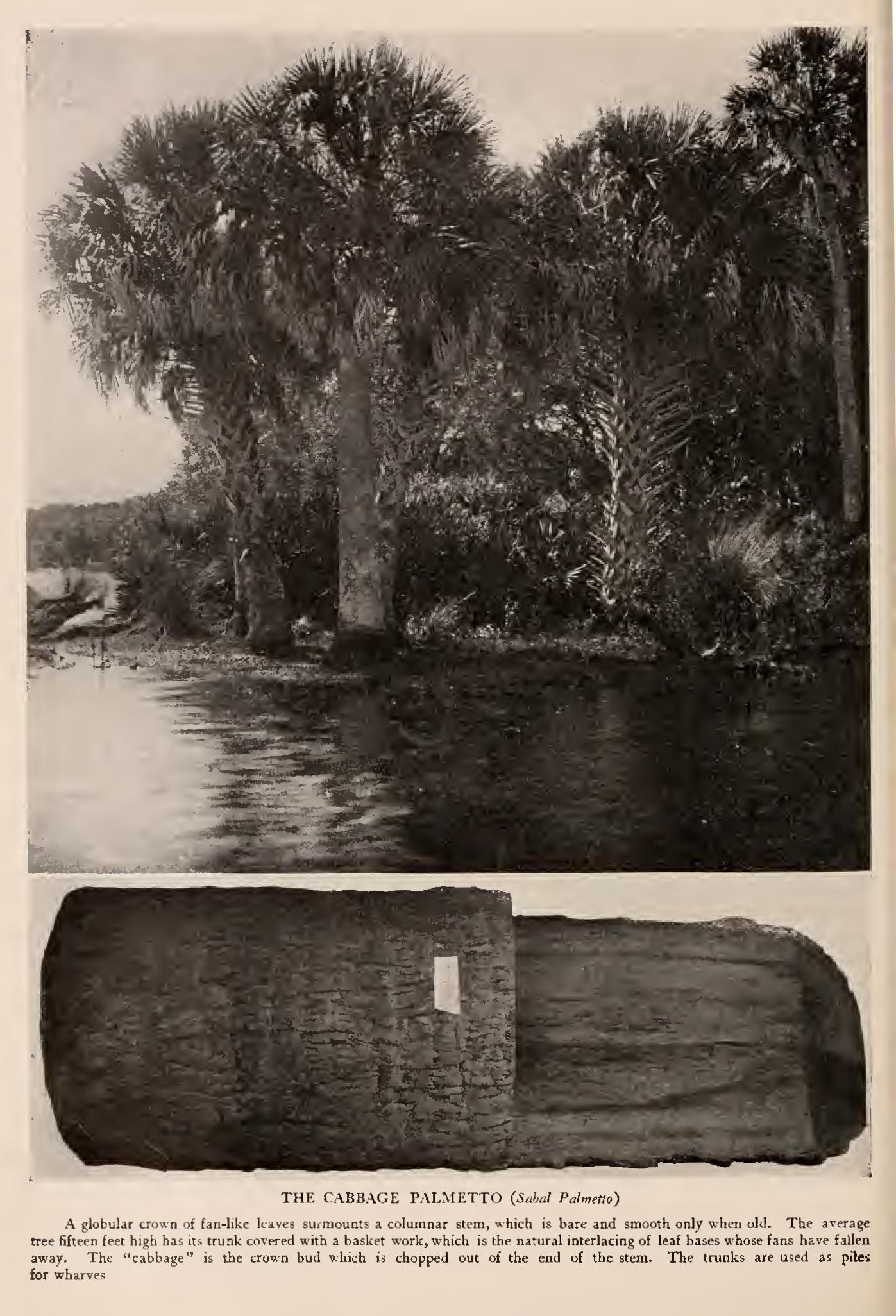
The Cabbage Palmetto (Sabal Palmetto, R. & S.) is one of the characteristic features of the southeastern coast. It attains its largest size on the west coast of Florida. Its western limit on the Gulf is the mouth of the Appalachicola River. It extends north to the Cape Fear River in North Carolina.
A crown of spreading, fan-like leaves surmounts a stout stem which is covered for a considerable distance from the top with the broad concave petioles of the leaves. These are finally split by the enlargement of the growing stem, giving the trunk the appearance of being encased in a kind of regular basketwork. Trees 20 feet high are common along sandy shores. Less frequently North, but often in Florida, one sees these trees 3o to 40 feet tall, with bare, slender stems crowned with round, leafy heads, looking almost like the royal palms. The great clusters of small yellow flowers followed by black berries hang from among the leaves, ripe in autumn but persisting into the following summer.
The cabbage palmetto grows, as do all palms, from a central terminal bud. This bud is the "cabbage" in this genus, a tender, succulent vegetable which is cut out of the middle of the stem, cooked and eaten. It is said to be "the very quintescence of cabbage." It is, of course, the death of the tree to lose this growing point.
The fibrous roots are matted in an intricate fashion under these trees, and long, tough rootlets go out on all sides for twenty feet or more. The wood is soft and spongy, with many hard fibro-vascular bundles running lengthwise of the stem. The outer rind is thick and much lighter than the centre. The trunks are used as piles and manufactured into canes and other small articles. The fibrous bark in cross section is made into cheap scrubbing brushes, and fibres of leaf sheaths make the bristles of more permanent ones. Houses are thatched with the adult leaves. Baskets, hats and mats are made from strips of the white, immature leaves. In Southeastern cities palmettos are used as a street and ornamental tree to a considerable extent. "Palmetto scrub" is the bane of hunters, surveyors and others who are obliged to go on foot through regions covered with the tough young growth of these trees.
The Mexican Palmetto (Sabal Mexicana, Mart.) grows in the valley of the Rio Grande in Texas and down the coast to Mexico. Its height somewhat exceeds that of the cabbage palmetto, which it strongly resembles. The trunks are used for wharf piles, and leaves for the thatching of houses. It is a favourite street tree in many Texas towns.