The Persimmons - Family Ebenaceae
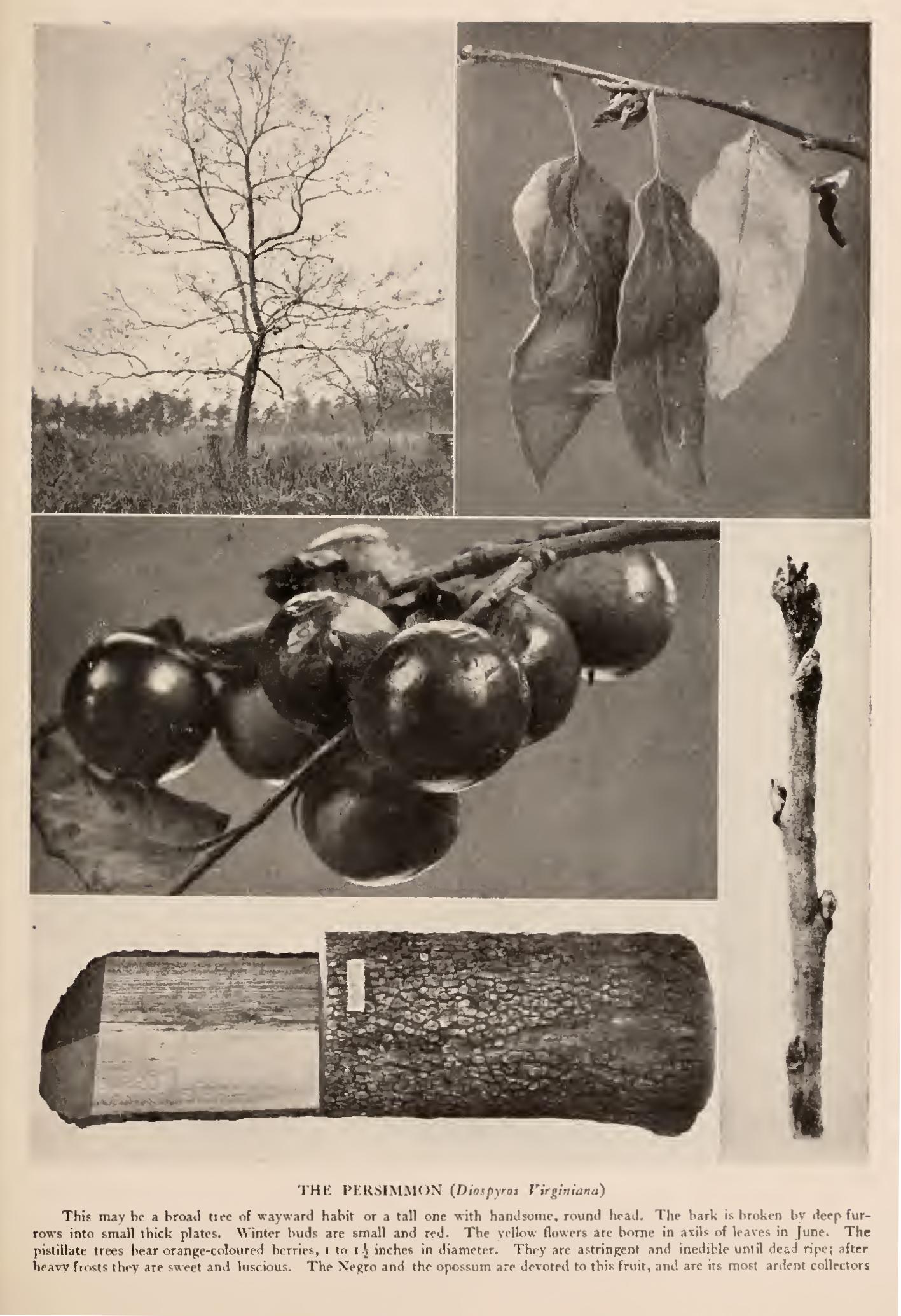
The 'possum is a nocturnal beast, and he likes company. It is not unusual for three or four to be found by night up a persimmon tree, hanging on with their bare, prehensible tails, or bracing themselves in crotches of limbs, within reach of the soft sugar lumps of fruit. They are lazy, and do not climb up if enough fruit is to be found under the tree to satisfy their appe tites. In a near-by rail heap or a hollow tree the opossums sleep off the effects of heavy feeding, and return to their quest with zeal the following night.
The following, from high authority, is conclusive: "Anyone who has hunted quail through the Carolinas in January or Febru ary, when the fruit still hangs on the trees (as it occasionally does in the woods on young trees only six to eight feet high), knows that toward the end of a long day's tramp no more delicious or refreshing morsel can be imagined than these persimmons. They are thoroughly ripe then, entirely without bitterness or astrin gency, sweet, rich and juicy." It is tannin in the fruit that gives it its astringency. This is gradually withdrawn, probably quite independent of the action of frost. The orange colour comes to it long before the fruit is ripe.
The Black Persimmon, or Chapote (Diospyros Texana, Scheele), is a scrubby tree that covers its matted top from Feb ruary till the following midwinter with dark, leathery leaves, which are narrow and scarcely an inch long. The black, insipid
fruit ripens in August, and its juice is used as a black dye. The wood is black, often streaked with yellow, and handsome when polished. It is sometimes used for engravers' blocks. The tree grows in western Texas, and south to the Gulf of Mexico.
The wood of our two persimmon trees somewhat resembles that of their esteemed tropical relatives, the ebony trees of the East and West Indies. But, as often is true of temperate-zone species, the quality is inferior.
In Japan, the native persimmon, Kaki, in the Japanese language, has been improved, until there are numberless horti cultural varieties. They bear large, luscious fruits, much better in all respects than those of the American species. The Depart ment of Agriculture at Washington has successfully introduced several varieties of Kaki into the Southern States. They do best when grafted upon our own trees.
Prejudice against persimmons results when a stranger to the fruit attempts to eat it before it is ripe. The handsome Japanese sorts are often ripe-looking before the tannin has left them. The experienced person knows that there is no fruit more delicate than a thoroughly ripe Kaki, so soft it must be eaten with a spoon.