The Service-Berries - Family Rosaceae
THE SERVICE-BERRIES - FAMILY ROSACEAE. Genus AMELANCHIER, Med. Slender, pretty trees often cultivated. Leaves simple, alternate, deciduous, Flowers white, numerous, in racemes. Fruits small berry-like, with 4 to io-celled core.
KeY TO SPECIES A. Leaves ovate, finely saw-toothed; fruit flattened, red to purple.
B. Fruit to inch across; leaves sharp pointed.
(A. Canadensis) SERVICE-BERRY BB. Fruit about inch across; leaves blunt pointed.
(A. obovalis) LONGLEAF SERVICE-Berry AA. Leaves broad, coarsely toothed on apical half, blunt; fruit ,} to 1 inch across, blue-black.
(A. alnifolia) WESTERN SERVICE-BERRY The genus Amelanchier occurs in southern Europe, northern Africa, China and Japan, and in southwestern Asia as well as in eastern and western North America. It includes few species, all delicate and pretty in foliage and flower, planted for ornament in many countries. Dwarf varieties are raised for their fruit. The flowers cover the slender branchlets before the leaves appear. The sweet berries feed the birds. Our Western service-berry has especially large and juicy fruits.
June-berry, Service-berry, (Amelanchier Cana densis, T. & G.)—A slender, round-headed tree, rarely 4o feet high, usually less than 20 feet. Bark smooth, purplish brown, with pale lenticels. Wood heavy, hard, dark brown. Buds pointed, brown, inner scales elongate in spring. Leaves alternate, oval or oblong, serrate, tapering, smooth; 3 to 4 inches long, midrib grooved above and ridged underneath. Flowers, April, before leaves, white in loose, drooping racemes, with silky bracts, I inch across narrow, long petals. Fruit, June, a red, juicy, sweet berry, with to-celled core. Preferred habitat, rich, upland soil, borders of woods. Distribution, Newfoundland to the Dakotas, south to the Gulf. Uses: A desirable park or lawn tree; wood occasionally used for tool handles, etc.
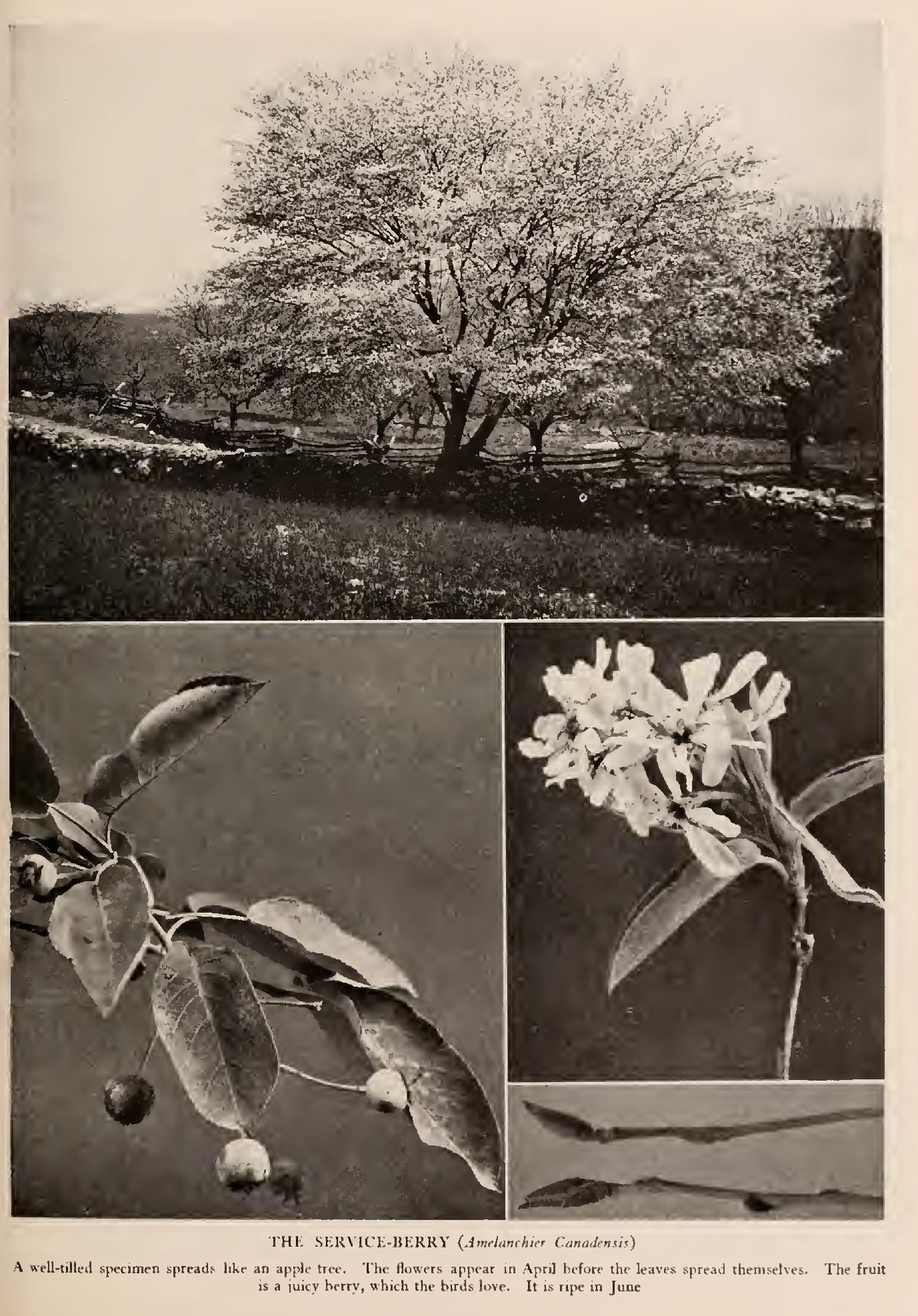
Do you wait until you are sure of finding violets a-plenty before you take the time to go to the woods? Then you miss a rare and most delightful experience. Go two weeks earlier this year, and you may see the little June-berry tree put on her bridal veil. The larger trees which stand about with naked branches are but a background to set off the charms of this modest wood land beauty. It is not simply by contrast with the barrenness around it that this tree delights the beholder. The soft, graceful, feathery clusters and the individual, starry blossoms would be attractive at any season. But that flowers so delicate should unfold so early, while yet winter lingers, is a marvel that goes straight to the heart. You break the sprays that lean toward you as if in invitation, and carry them home with a sense of personal gratitude. What makes one feel a glow of warmth when looking at this tree? The sharp spring air does not justify it. There is a faint undertone of colour that takes off the chill of the white cloud of blossoms. Looking close we see that the strap-shaped bracts are red, a pair of them below each flower, and the tinge is deepened by the red-brown of the silky infant leaves, which hang limp and helpless, their two halves folded on the midrib, and quite obscured by the mass of bloom.
In summer the leaves are not distinctive. They are daintier than those of the apple and pear, and have not the hydrocyanic acid odour of the foliage of plums and cherries. The twigs lack the thorns characteristic of the hawthorns. So, by elimination, we may be able to identify this tree among the multitude of its relatives.
The fruit cluster is a good clue all summer long, though the birds take the berries so promptly that it is ,exceptional good luck if you find a ripe one on the tree. But the long branching stems which bore the sweet morsels are held out empty, or with dry, undeveloped berries upon them,' longer and looser in structure than the racemes of the cherry group.
Showy as it is in blossom, the June-berry is never a self assertive tree. Its flowers are gone as suddenly as they came, and the little tree quite loses its identity when the forest wakes and covers itself with a dense thatch of green. Cloistered thus, and cut off from the benefits of wind and sun, no wonder that the tree ordinarily rises little higher than a thrifty shrub.
The Dwarf June-berry, or Swamp Sugar Pear (A. obo valis, Ashe), has its young leaves and tender shoots covered with dense white wool until quite matured. The flowers are smaller than those of its sister species, and crowded in shorter, denser racemes. The fruit is juicier and of richer flavour, and eagerly sought by children and birds. The tree bears the name, long-leaf service-tree in some localities, and in others, shad-bush. The noted that these trees blossomed along the banks of tide water streams about the time that the shad came up to spawn. The colonists adopted this name. Naturally, it is not used in the inland states, where shad are seen only in fish markets. This June-berry frequents swamps and stream borders, ranging from New Brunswick to Florida and Louisiana, and west to Minnesota and Missouri.
The Western (A. alnifolia, Nutt.) has a thick, roundish leaf, broad and toothed, which makes it a hand some foliage tree. Its large, juicy, fine-flavoured berry commends it to horticulturists as worthy of cultivation. It grows over a vast territory which extends from the Yukon River south through the Western States, and east to Ontario, Michigan and Nebraska.
Widely distinct as is this species from A. Canadensis when individuals from distant localities are compared, these differences become less marked as each species is studied nearer and nearer the regions where their ranges overlap. It is believed that in these two we have the offspring of a single species which came from the North, and, spreading east and west on the slopes of the Rocky Mountains, became modified by climate into two distinct species as we see them to-day. Comparisons of specimens taken at regular intervals on both sides of the mountains form a most interesting chain of evidence to support the theory of a common origin. Fossils of the Glacial Period show clearly the charac teristics of the ancestral type.