The Silver Bell Tree and the Sweet Leaf - Family Styraceae
The black ash is not a tree for the lawn. It loves to stand with its roots submerged, and often dies of thirst in the rich loam of a garden. It is a short-lived tree, at best, and very slow of growth; it keeps its foliage but a short time, turning a dull, rusty hue in early autumn. So we shall not wish to plant it anywhere unless perhaps in swampy land. The roots range far and wide and drink up the moisture at a marvellous rate. A few trees will soon cover such a tract, sending their seeds broadcast, and throw n. ing up suckers from their roots.
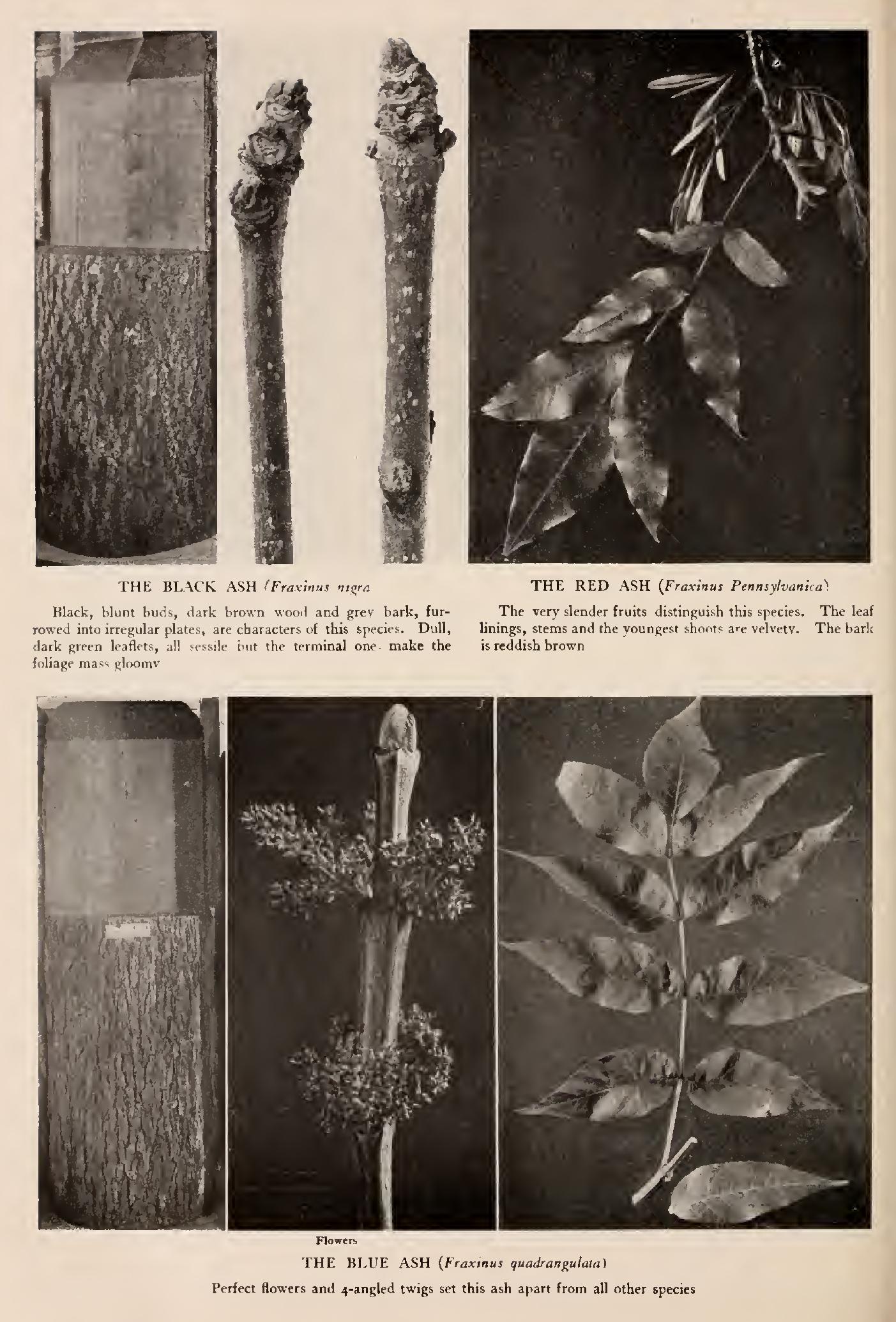
It was the Indians who taught our forefathers to weave baskets of black-ash splints. The wood is split into sticks an inch or so wide and two or three inches thick. These are bent over a block, and the strain breaks the loose tissue that forms the spring wood, and separates the bands of dense, tough summer wood into thin strips suitable for basket weaving.
The grain of black ash is normally straight, but warty excres cences called "buds" form on the trunk sometimes, and these show wonderful contortions of the grain. Innumerable radiating pins, or abortive branches, keep on growing within the wood, each the centre of a set of circles or wavy lines, which show when a "burl" is cut across. Bowls hollowed out of single burls and polished show exquisitely waved lines as delicate as those in a banded agate.
European ash sometimes shows a twisted and warped con dition of the fibres known to woodworkers as "ram's-horn" and "fiddle-back" ash. Knotty parts of stems and roots once went under the trade name of "green ebony," and fancy boxes and other articles made of it and polished brought extravagant prices. "When our woodmen light upon it, they make what money they will of it," says Evelyn. And he tells of a famous table made of an old ash tree on whose polished surface "divers strange figures of fish, men and beasts" were discernible in the grain of the wood! Another enthusiast, with still livelier imagina tion, saw in the cleft trunk of an ash tree, before it was polished even, "the various vestments of a priest, with the rosary and other symbols of his office!" Red Ash (Fraxinus Pennsylvanica, Marsh.)—A small, spread ing tree, 4o to 6o feet high, with irregular, compact head of twiggy branches. Bark reddish, closely furrowed, scaly; young twigs pubescent. Buds small, dark brown, nodes close together.
Leas es io to 12 inches long, of 7 to 9 leaflets, lanceolate, coarsely serrate, on short stalks, smooth, yellow-green above, silvery pubescence on petioles and leaf linings; yellow in fall. Flowers, May, with leaves;. dicecious, in hairy panicles; pistillate green ish, inconspicuous. Fruit slender, clustered keys, i to 2 inches 161 long, on hairy stems; wing i inch long and extending half way around the body. Preferred habitat, moist soil near streams or lakes. Distribution, New Brunswick to Ontario and the Black Hills in Dakota; south to Florida, Alabama and Nebraska. Uses: to white ash in all ways. Often planted in eastern United States for shade and ornament.
The red ash thrives best in the Northeastern States, especially in Pennsylvania. West of the Alleghanies it is an inferior tree. Its lumber is of poor quality compared with white ash, but being of the same colour it is often substituted for the latter by unscru pulous lumber dealers.
The common name of this species probably refers to the red inner layer of the outer bark of the branches. This trait alone is not a distinguishing one, however, for white ash sometimes shows the same character. The red ash has velvety down that invests its new shoots. Winter and summer, this sign never fails. The tree has slimmer twigs and branches than most of the ashes, and crowds its buds and twigs much more closely. The silky leaf linings lighten and soften the yellow-green foliage mass. Red-ash seeds are extremely slender, and vary in size and form, the most graceful in outline of all the darts the various ash trees bear. Lingeringly the tree gives up its seeds in winter. A breeze strong enough to tear off a few from the cluster will carry them a considerable distance. The heavy body or seed end of a key pitches downward, but the thin wing gives the wind a chance to lift it. So on its dainty sail the seed is borne away to plant an ash far from the parent tree, if by chance it fall in good ground. It is easy to understand why ash trees always grow scattered here and there through the woods. Go out on a winter day when the wind blows a gale and see the pistillate tree launching its seeds. It is worth a journey and some discomfort to see it.