The Sycamores - Family Platanaceae
THE SYCAMORES - FAMILY PLATANACEAE. Genus PLATANUS, Linn. Large, ornamental, deciduous trees with smooth limbs from which whitish bark peels in irregular flakes. Leaves simple, alternate, palmately lobed. Flowers moncecious in pendant heads. Fruits swinging, many-seeded balls, hanging all winter.
KeY TO SPECIES A. Fruits solitary, rarely 2; leaves with shallow sinuses, broader than long; seeds blunt.
(P. occidentalis) SYCAMORE AA. Fruits 4 to 6 on each stem; seeds pointed.
B. Leaves with triangular lobes and deep sinuses.
(P. raceinosa) CALIFORNIA SYCAMORE BB. Leaves with variable lobes, often finger-like and 8 to io inches long. (P. Wrightiz) ARIZONA SYCAMORE AaA. Fruits 2 to 4 on each stem; seeds pointed; leaves deeply lobed, broader than long. (Exotic.) (P. orientalis) ORIENTAL PLANE There are six species of the genus Platanus found in the Northern Hemisphere, and equally divided between the Old and New Worlds. The geologist finds evidences of much wider distribution for our sycamore than it now enjoys. The Arctic regions from Greenland west bore forests of these trees, and so did central Europe before the Glacial Epoch. The plane tree of Europe extends east to India.
The trees are all characterised by brittle, smooth bark of light colour, except on old trunks. The flaking off of this bark in irregular plates, leaving the white under layer exposed, enables the most casual observer to recognise the trees of this family by sight. The broad leaves, lobed like a maple's, and the hanging seed balls are striking characteristics.
Sycamore, Buttonwood, American Plane Tree
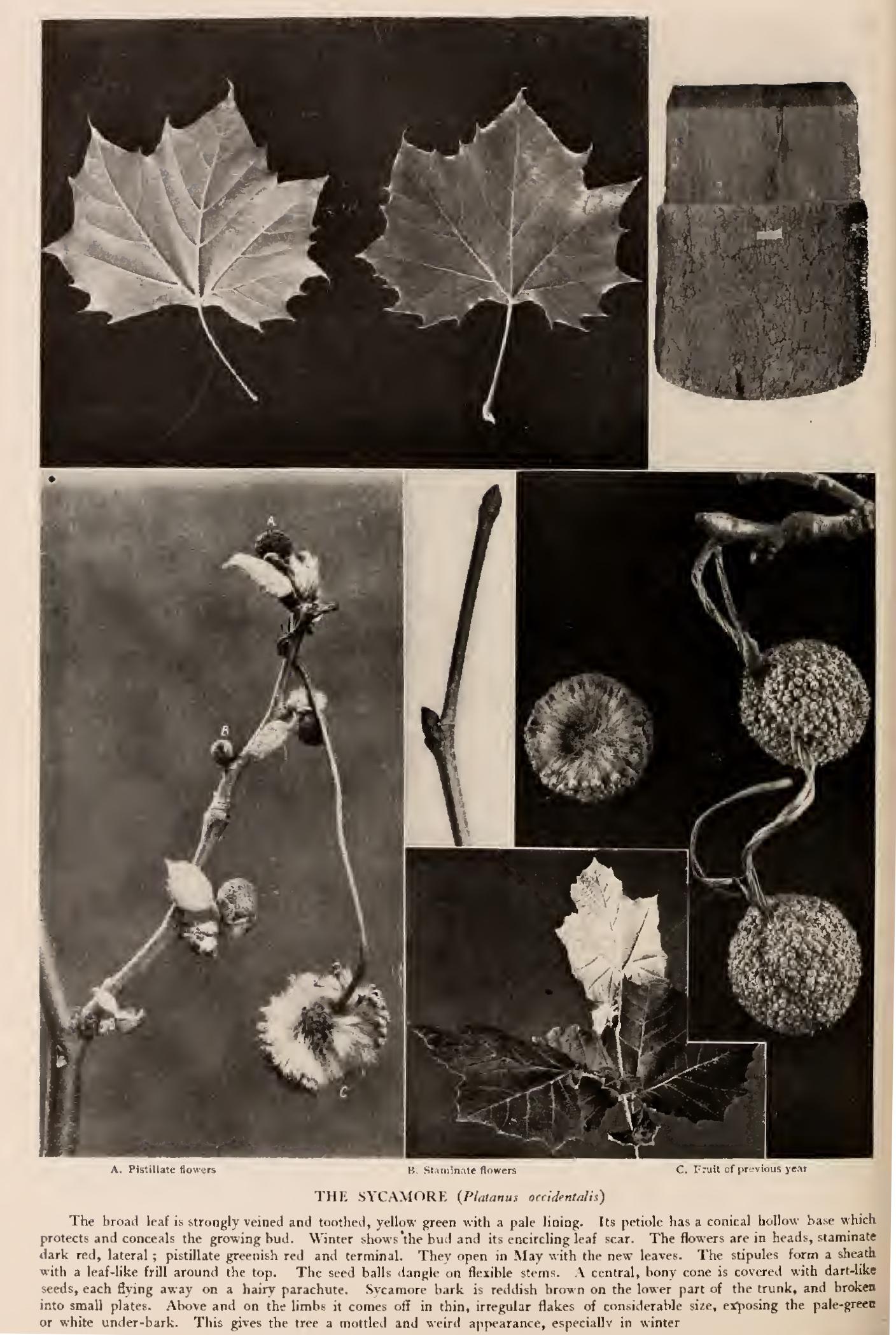
(Plata NUS occidentalis, Linn.)--A large, stately tree, 75 to 15o feet high, with tall trunk and loose, broad head and mottled green and white limbs. Bark dark reddish brown on trunk, breaking into small scaly plates; smooth and thin on branches, olive green, flaking off in irregular plates, exposing whitish inner bark. Wood light reddish brown, hard, heavy, with prominent satiny pith rays. Buds conical, with hood-like scales, covered by hollow base of leaf stalk, and encircled by a single leaf scar. Leaves deciduous, alternate, simple, 5 to 6 inches long, 7 to 9 inches broad, 3 to 5 lobed, with broad, shallow sinuses and wavy-toothed lobes; yellow green above, paler beneath, and fuzzy on veins; yellow in autumn and papery; petiole short, with hollow, dilated base; stipules, a sheath, tubular, flaring into ruffle-like border. Flowers, May, moncecious, in globular heads on flexible stems; staminate axillary, deep red; pistillate terminal, pale green tinged with red, with long stems. Fruit, dry pendulous balls, solitary or rarely two on a single pedun cle, 1 inch in diameter, made of a close-set, pointed akenes. Pre ferred habitat, borders of streams and rich bottom lands. Distribution, southern Maine to north shore of Lake Ontario; west to Minnesota and Nebraska; south to Florida and Texas. Uses: Excellent shade and ornamental tree, especi ally in cities and towns. Wood is used for furniture and inside woodwork of houses; also for butchers' blocks and tobacco boxes.
The "hoary antlered syCamore" in our damp woods is a tree that the stranger will never forget after his first introduction to it. There is only this one native tree with such strange, crazy patch work on its branches. These patterns in dull olives and dingy white show themselves from any reasonable distance in winter, and the grey balls dangling from the twigs are another sure means of identification. In the summertime the thickest foliage never quite conceals the scarred trunk and excoriated branches, splotched as if with whitewash to the utmost twigs. Moulting is a continuous performance during the buttonwoods' growing sea son. Even in winter flakes of bark may be picked up on the snow blanket that protects the roots. This tree seems utterly lacking in the power to stretch its bark fibres and fill in the chinks to fit the growing limbs. Instead, with the first rift sycamore bark loosens separates, and lets go, leaving only the inner layers between the tender cambium and the cold outdoors. It is the sycamore's way.