The Tupelos and the Dogwoods - Family Cornaceae
THE TUPELOS AND THE DOGWOODS - FAMILY CORNACEAE. The cornel family is a large temperate zone group comprising fifteen genera, a few of which are tropical. Comparatively few species are arborescent. Two genera in the United States have species of tree habit. They both include ornamental trees with showy flowers and fruit, and foliage of exceptional beauty. The wood of all is extremely hard and close textured.
KeY TO GENERA A. Leaves alternate; flowers and fruits inconspicuous.
I. Genus NYSSA, Linn.
ThE TUPELOS AA. Leaves opposite (excepf alternifolia); flowers and fruits showy.
2. Genus CORN US, Linn.
ThE DOGWOODS ThE TUPELOS Genus NYSSA, Linn.
Trees of picturesque habit, with twiggy, contorted branches; growing in wet soil. Wood cross grained, tough. Leaves alternate, simple, deciduous, leathery. Flowers minute, greenish, in short racemes or heads. Fruit, a fleshy drupe.
KeY TO SPECIES A. Stones of fruit with rounded ridges; leaves broad, blunt at apex; fruit small. (N. sylvalica) runts AA. Stones of fruit with sharp, winged ridges; fruit large.
B. Leaves blunt pointed; fruit red.
(N. Ogeche) OGEECHEE LIME BB. Leaves sharp pointed; fruit purple.
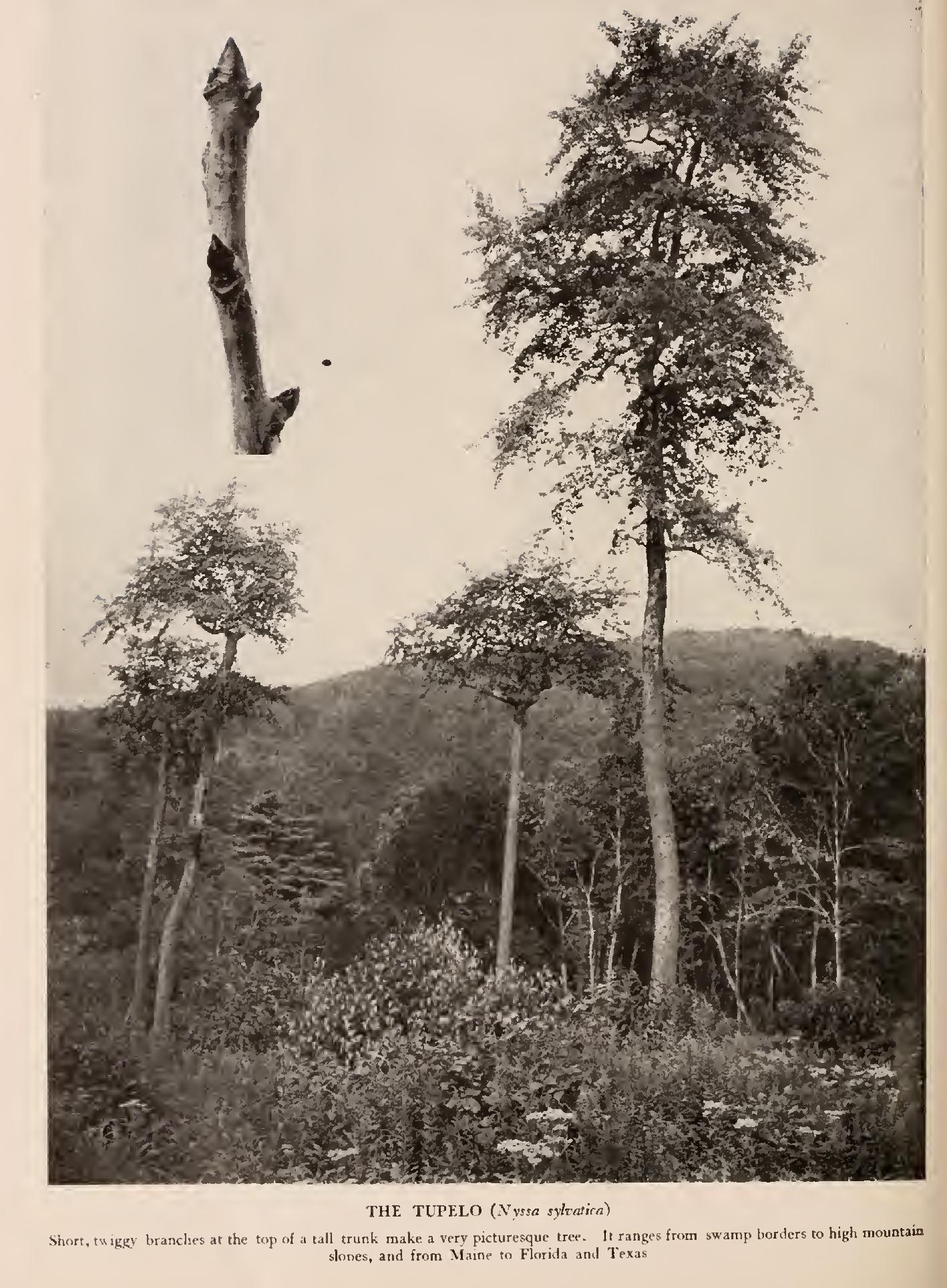
(N. aquatica) COTTON GUM Tupelo, Pepperidge, Sour or Black Gum (Nyssa sylvat lea, Marsh.)—A medium-sized tree of variable shape, 5o to la) feet high, with short, rigid, twiggy, horizontal branches. Bark rough, dark grey, broken into many-sided plates; on younger trees, pale brown or grey; branches brown; twigs green to orange, often downy. Wood heavy, tough, cross grained, soft, not durable in contact with the soil, hard to work. Buds small, brown, with hairy scales. Leaves alternate, entire, 2 to 4 inches long, oval, leathery, shining above, pale, often hairy beneath, turning scarlet above in autumn. Flowers, May, after leaves, yellowish green, inconspicuous, polygamo-dicecious; staminate in loose, pendant heads; pistillate larger, 2 or more in a cluster. Fruits, October, l to 3 in cluster; fleshy drupes ovoid, blue-black, sour, inch long; stone ridged. Preferred habitat, low, wet soil, borders of swamps, rivers and ponds. Distribution, Maine to Florida; west to southern Ontario, Michigan, Missouri and Texas. Uses: Handsome, hardy ornamental trees. Wood used for mauls,
pulleys, hubs, rollers, ox yokes and woodenware.
In early fall the rambler in the woods is often startled to see on the mossy carpet in front of him a thick, shining leaf, part of which is still deep green and part as red as blood. It is the tupelo's signal that winter is on the way. Look up, my friend, and the branches above show only a few leaves coloured like the one you found. Come again in a week or two and the tree is ablaze with reds of every shade. It is a pillar of fire, indeed, among the yellowing ashes and hickories; only the reds of the swamp maples and sumachs compare with it in brilliancy. Who can fail to know the tupelo in the glory of its dying foliage? Certainly no rational being, if he has eyes in his head, and the tree in his neighbourhood. The sight of one, and a few sprays of its lustrous leaves to put up behind the picture frames at home, are well worth a Sabbath day's journey.
"Tupelo" is the pretty Indian name. "Pepperidge" cannot he accounted for. It is probable that the fiery foliage first led people to suppose this tree to be a relative of the sweet gum. They grow together—both large trees in the bottom lands of the South. This "black gum" can be readily distinguished from the red gum, or liquidambar, as far as the colour of the trunks can be made out. The name, "sour gum," refers to the fruit. Lintreus gave to this water-loving genus the name of Nyssa, the water nymph who reared the infant Bacchus. It was the fashion for the old botanists to give new plants names derived from classical mythology, without much thought of appropriateness.
The foliage of the tupelo is without question its chiefest charm, but there are others which the leaves partially conceal. The winter aspect of the tree is strikingly picturesque. There is a central axis, such as we see commonly among evergreens but seldom among broad-leaved trees. From this tapering shaft the slender branches spread in level platforms that subdivide into wiry, angular branchlets and end in a dense, flat twig system. A young tupelo in winter has as much rigidity of mien as a young honey locust.