The Willows - Family Salicaceie
The Shining Willow (S. lucida, Muehl.) is an inhabitant of the North. From Newfoundland it ranges westward to Hudson Bay and the Rockies, and southward only as far as Pennsylvania and Nebraska. A small, round-headed tree, its distinction is the lustre of its ruddy twigs and the beautiful sheen of its dark green, leathery leaves. It is coming to be recognised by landscape gardeners and nurserymen as a species of consider able horticultural value.
The Western Black Willow (S. lasiandra, Benth.) grows to be a tree 6o feet high on river banks and lake shores from British Columbia to California and east into Montana, Colorado and New Mexico. The type becomes modified in the remote limits of its range. The leaves are 4 or 5 inches long, lanceolate and finely cut-toothed; they are a dark, lustrous green above, paler or glaucous below.
Missouri Willow (Salix Missouriensis, Bebb.)—Tree, to 5o feet high, with trunk to 11 feet thick. Twigs pubescent. Bark grey, thin, with small scales. Wood dark brown. Leaves lanceolate, acuminate, finely serrate, with rounded bases, 3 to 6 inches long, -I to I inches wide; pubescent at first, becoming smooth, green above, pale and glaucous below; stipules leaf-like in pairs, often persistent; petioles about inch long. Flowers before leaves; aments slender, long; scales persistent, hairy; stamens 2; style short. Fruit capsules, stalked, narrowly ovoid, smooth, above hairy oval scale. Preferred habitat, river banks. Distribution, northern Missouri, northeastern Kansas, Nebraska and western Iowa.
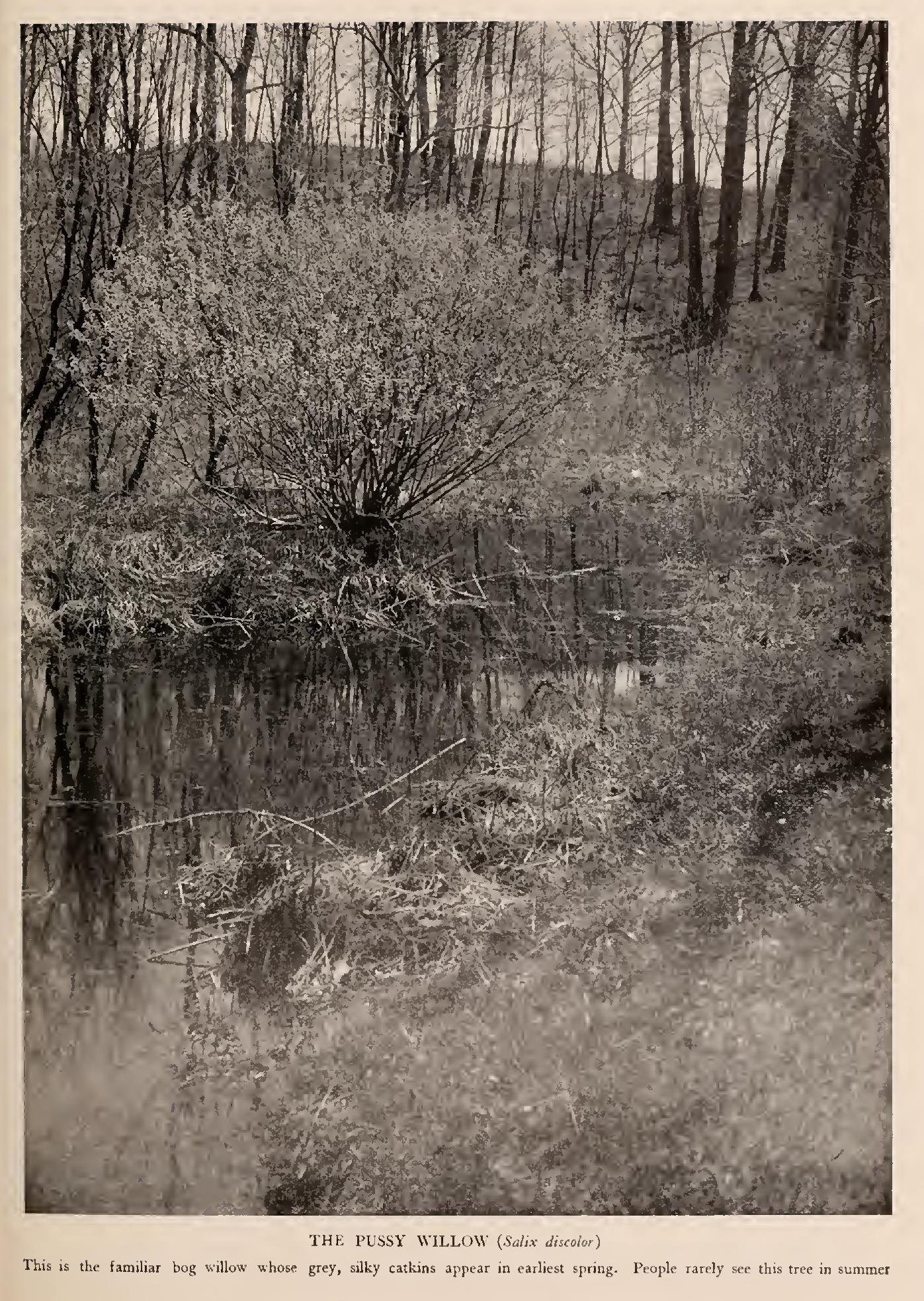
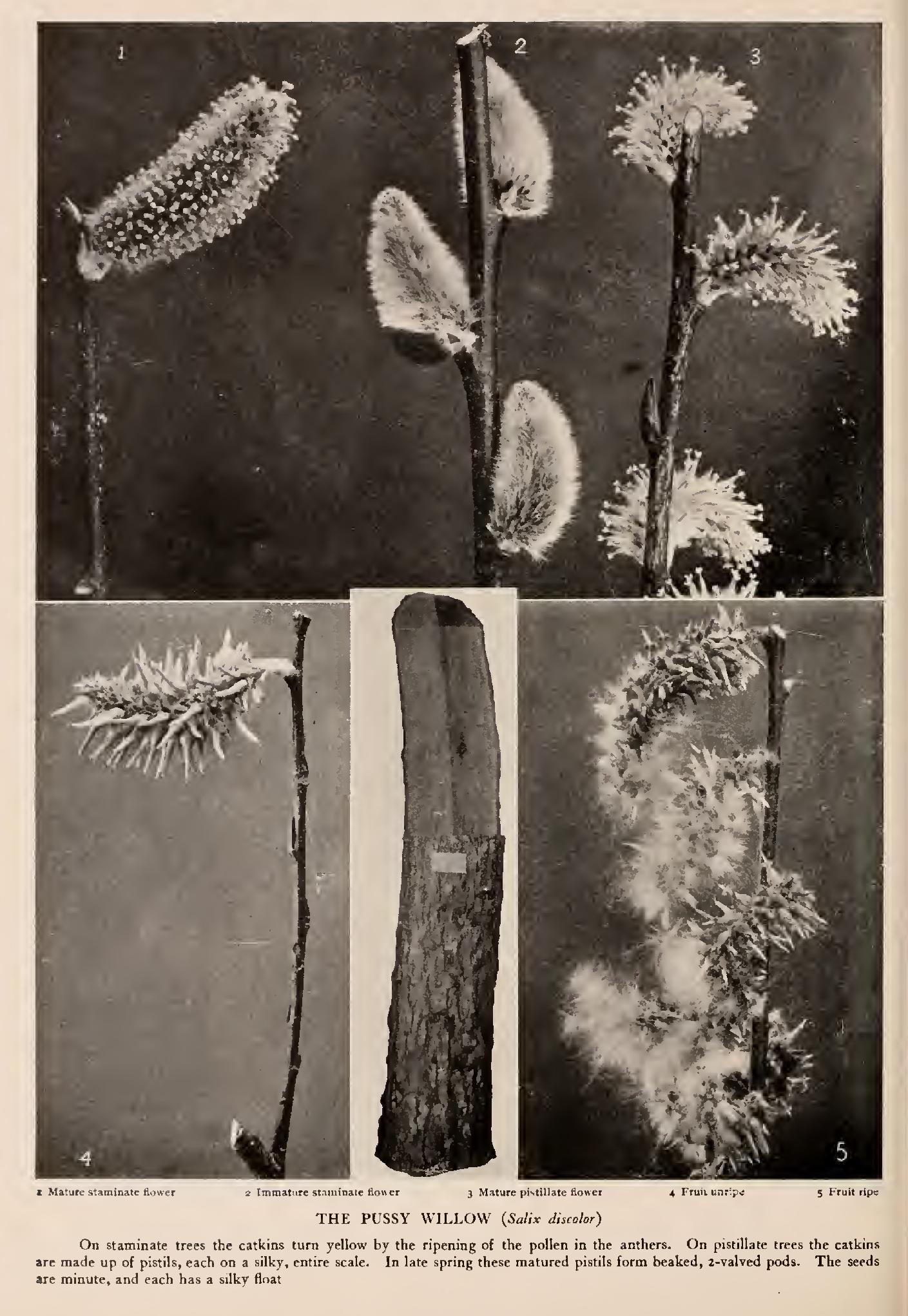
Pussy Willow (Salix discolor, Muehl.)—Shrub, or small tree, to 25 feet high, with stout branchlets, purplish red with pubescent coating. Buds reddish, flattened, pointed. Leaves oblong-lanceolate, acute at both ends, irregularly serrate, often crenate, thick, 3 to 5 inches long, bright green, with pale or silvery lining; midribs broad, yellow; stipules leaf-like, half-moon shaped; petioles slender. Flowers, March, often showing earlier, before the leaves; aments silky, oval, grey, turning yellow as flowers open. Fruits aments of beaked capsules, each long pointed, on long stem, with broad, hairy scale. Preferred habitat, swamps and moist hillsides. Distribution, Nova Scotia to Manitoba; south to Delaware and Missouri.
This is the familiar bog willow which we rarely recognise in leaf. The twigs are usually cut when the little furry catkins peep out in ]ate winter. Florists in Eastern cities buy large quantities of these twigs in winter, and force them out for the early spring trade.
The Heart Willow (S. cordata), a shrub in the East, has a Western variety, Mackenzieana, Hook., that assumes the tree habit and size. It extends from the far North to the Rocky Mountains in Idaho and west into California. The narrow
leaves are acute at the apex and bear minute kidney-shaped stipules throughout the summer. It is an extremely variable willow.
The Hooker Willow (S. Hookeriana, Hook.) has broad, oblong leaves, blunt at apex, and white below, with hoary tomen turn. It is the little willow of sand dunes and salt marshes from Vancouver Island to southern Oregon. Its hoary twigs further identify it. It rarely grows above 3o feet in height.
Bebb's Willow (Salix Bebbiana, Sarg.)—Small tree, with short trunk, to to 20 feet high, with downy twigs and smooth. 16o reddish bark. Leaves 1 to 3 inches long, oblong-obovate, acute or blunt at apex, sparingly toothed or entire, dull green and downy above, distinctly veined and pale blue or silvery, hairy beneath; petioles short; stipules semi-cordate, acute, deciduous. Flowers with leaves, sessile, erect, terminal; staminate silky white, becoming golden; pistillate silky, with yellow stigmas which spread in pairs. Fruits pubescent, beaked capsules; stalk much longer than scale. Preferred habitat, dry soil or stream borders. Distribution, throughout British America and south to New Jersey, Nebraska and Utah.
The Balsam Willow (S. balsamifera, Barr.) is dressed in spring, like the Balm of Gilead, in young shoots that glisten in a coating of balsam. The broad, ovate leaves are blunt at the apex, and look scarcely willow-like, but the flowers and seed pods maintain the family traditions and leave us no doubts. The tree is found in the northern tier of states and ranges far north, becoming a prostrate shrub. In its best estate it grows into a long stem crowned with a small clump of branches bearing the foliage. It is an inhabitant of cold bogs, and extends no farther west than Minnesota.
Golden Osier (Salix alba, Linn., var. vitellina)—Venerable.. looking tree, with short trunk and regular, spreading top, 4o to 6o feet high. Twigs golden yellow. Bark grey, rough. Leaves elliptical, sparingly serrate, tapering at both ends, 2 to 4 inches long,:silky hairy, becoming smooth; lining white and somewhat hairy; stipules ovate-lanceolate, deciduous ; petioles short. Flowers with leaves; scales deciduous; stamens 2; stigmas sessile. Fruits flask shaped, sessile, smooth capsules. Preferred habitat. moist, rich soil. Distribution, eastern North America.
This American derivative of the white willow of Europe deserves mention among native trees. It is truly naturalised. Its yellow twigs are its best identification. It is far more common in cultivation than its parent, although the latter is occasionally seen. This variety is one of the most vigorous and useful of all the willows grown in this country.