Three Little Maples
THREE LITTLE MAPLES There are a few members of the great maple family which do not share the lofty aspirations of the majority, They arc to be sought in thick forests of mixed hardwoods, and they do much to make our walks through such a wood delightful. With the viburnums and the ground hemlocks they spread their leafy branches "amidst the cool and silence," and the sun rarely looks in upon them.
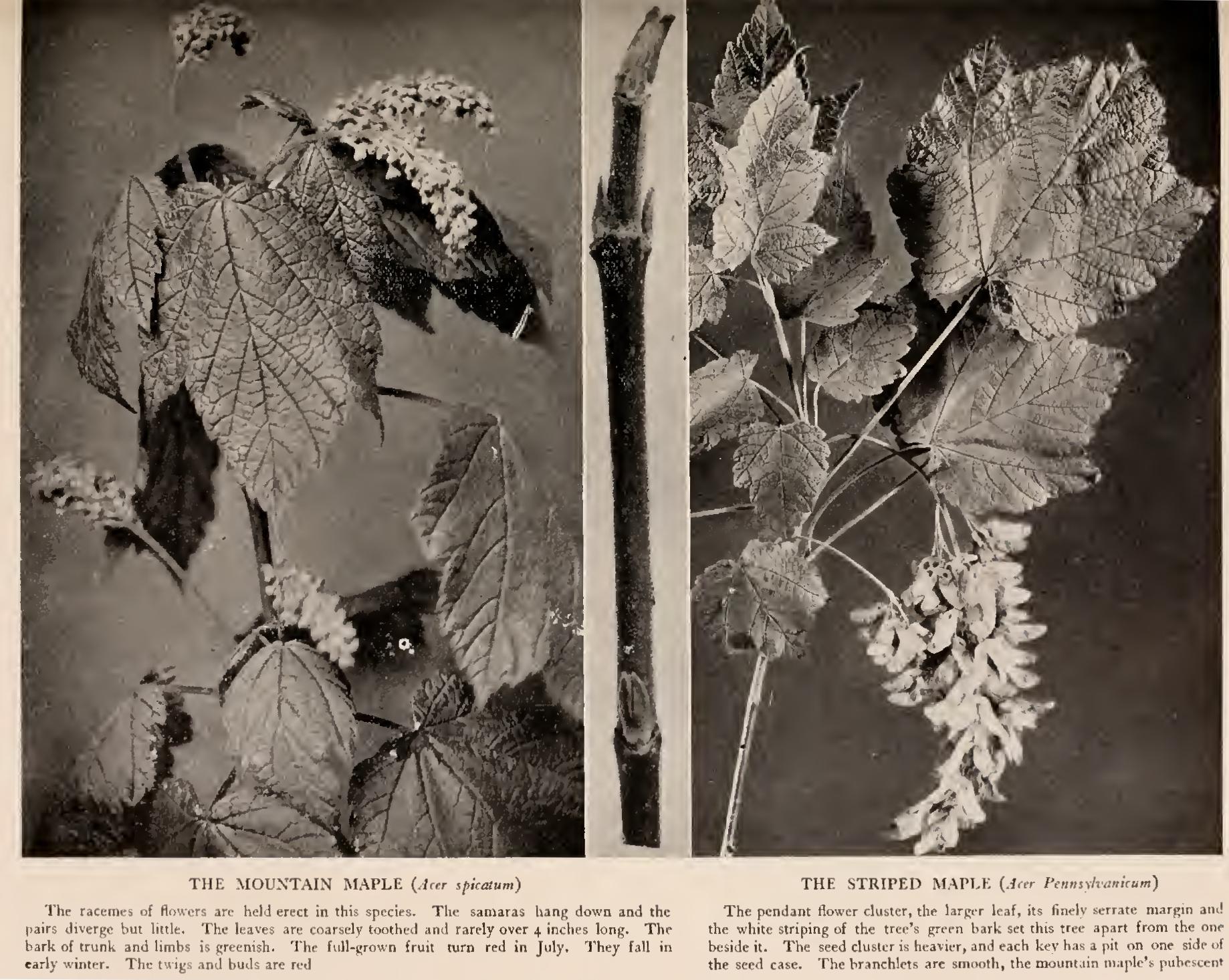
The Mountain Maple (Acer spicalum, Lam.) is usually shrubby in habit; very rarely it reaches 3o feet in height, and a maximum trunk diameter of 6 to 8 inches. Its green bark is not striped, a character which at any season distinguishes it from the striped maple. The lobes of its leaves are taper pointed, and their margins coarsely saw-toothed. The petioles are long and slim and scarlet throughout the summer. The flowers are small, greenish yellow with long, narrow petals; they are clustered in racemes that stand erect in the axils of the fully-expanded leaves. The fruits hang in clusters, the little samaras but slightly divergent, and showing clear red in the summer. In autumn they are brown, while the foliage takes on brilliant shades of yellow and scarlet. After the leaves fall the grey, downy twigs are bright with the winter buds only.
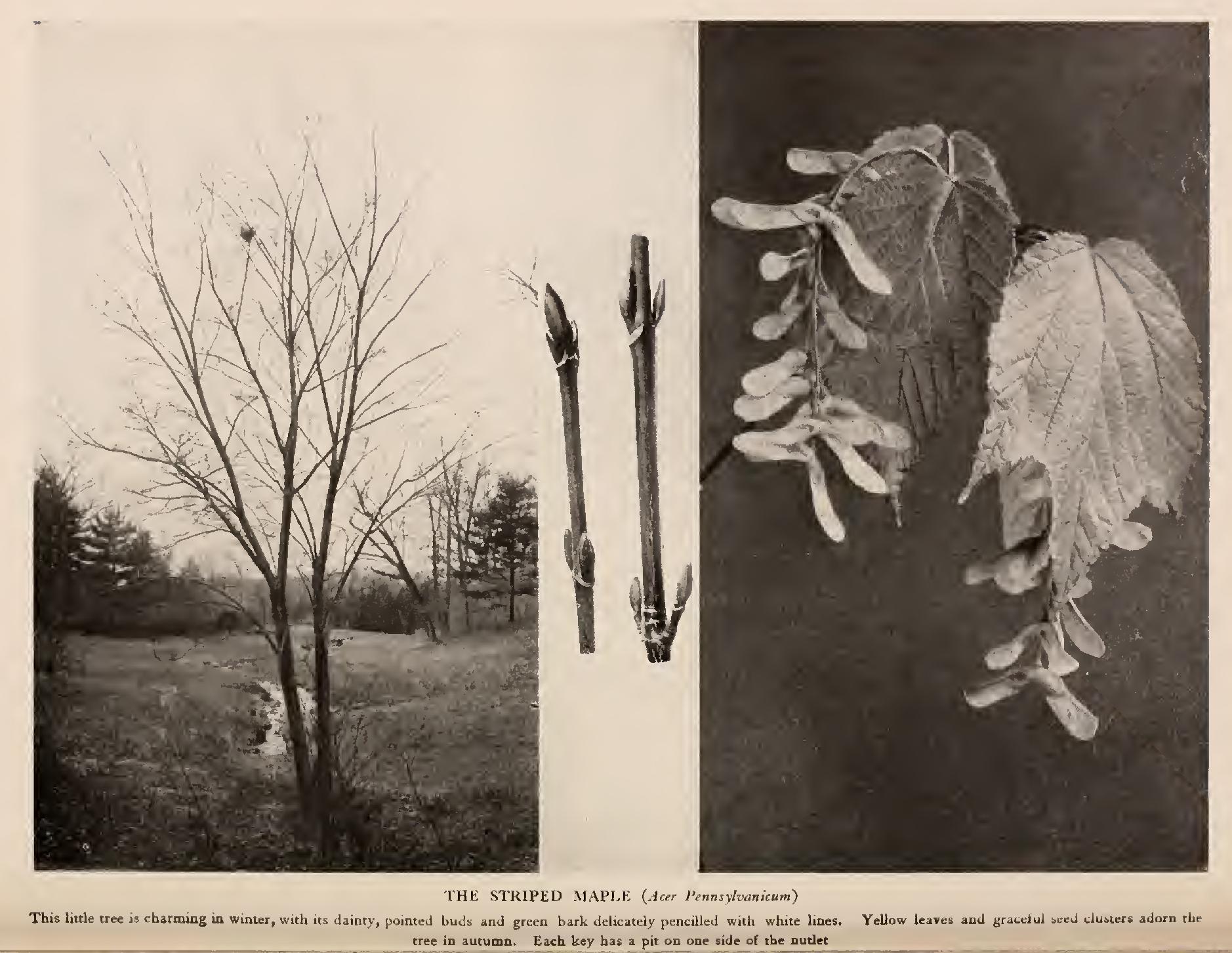
The Striped Maple, or Moosewood (Acer Pennsylvanicum, Linn.) grows from a shrub to a tree 4o feet high, best always in the shade of taller trees and usually in rocky woods that cover mountain slopes. It has green bark that breaks as the stems increase in diameter into a network of furrows, which expose a pale under layer, and make the green appear to be delicately striped with white. Sometimes the stripes are dark brown.
The leaf of this maple is unusually large, often 6 inches in length. It is about as broad as it is long, with three triangular lobes, whose points form the leaf's broad apex. There are faint suggestions of two basal lobes sometimes, but not always. The margin is finely serrate, and the petiole grooved. In the autumn the leaves turn yellow. The yellow, bell-like flowers in long, pendulous racemes appear among the leaves in May. The samaras are larger than those of the mountain maple, and the wings in each pair are more widely divergent.
The striped maple is most brilliant in colouring when its bud scales lengthen in late April, and the rosy, down-covered leaves appear. The stems and unfolding shoots are delicate and beautiful enough to repay an artist for making a pilgrimage each spring to the place where this budding maple blushes unseen.
It is hard to make people believe that all this exquisiteness of line and colour and texture can be revealed by "a common maple that grows wild in our woods." The name, moosewood, calls attention to the fact that in the north woods the green shoots are browsed by the deer and moose. "Goose foot" is from the shape of the leaf; "whistle wood" from the easy slipping of the tough bark in early spring.
This little tree is rare in cultivation, though it is more inter esting and beautiful even than many an expensive exotic. One may easily transplant a seedling from the neighbouring woods, and it thrives in good garden soil if not too dry. A shady corner is best, but there is a good specimen growing in the sunniest part of a garden I know.
The Dwarf Maple (Ater glabrum, Torr.) is a shrub or low tree of bushy habit which grows on the western mountains from Canada to Arizona and New Mexico. The leaves are variable, one type being a three-lobed, cut-toothed form not unlike the red maple leaf; the other extreme is a compound leaf made of three oval, coarsely toothed leaflets. They vary in diameter from one to five inches. The flowers are usually on separate trees as in the box elder. The fruits as well as the leaves are smooth and small, with wings that spread but little. They are often ruddy during the summer.
Box Elder, Maple (Ater Negundo, A quick-growing, sturdy tree, 5o to 7o feet high, with irregular spreading top. Bark greyish, regularly furrowed; twigs purple, glaucous. Wood soft, white, weak, close grained. Buds opposite, blunt, reddish. Leaves opposite, compound, of 3 to 5 pinnate leaflets, irregularly toothed and lobed; smooth, pale beneath; yellow in autumn. Flowers open with leaves on separate trees, fertile, greenish, in drooping racemes, sterile, in clusters on pink, silky pedicels. Fruits narrow, flat, winged samaras, 11 to 2 inches long, in pairs, clustered in drooping racemes; ripe in September, but hanging until early spring. Preferred habitat, rich, moist soil, by streams or along borders of swamps. Dis tribution, Vermont to Montana; south to Florida and west to Colorado and Utah. Rare east of Appalachian Mountains. Uses: Much planted for shade and ornament. Wood inferior; used for cooperage and small woodenwares.