Ancient Arctogaea
distribution, fauna, fish, surface, found, ocean, represented, animals and range
Freshwater Fishes.
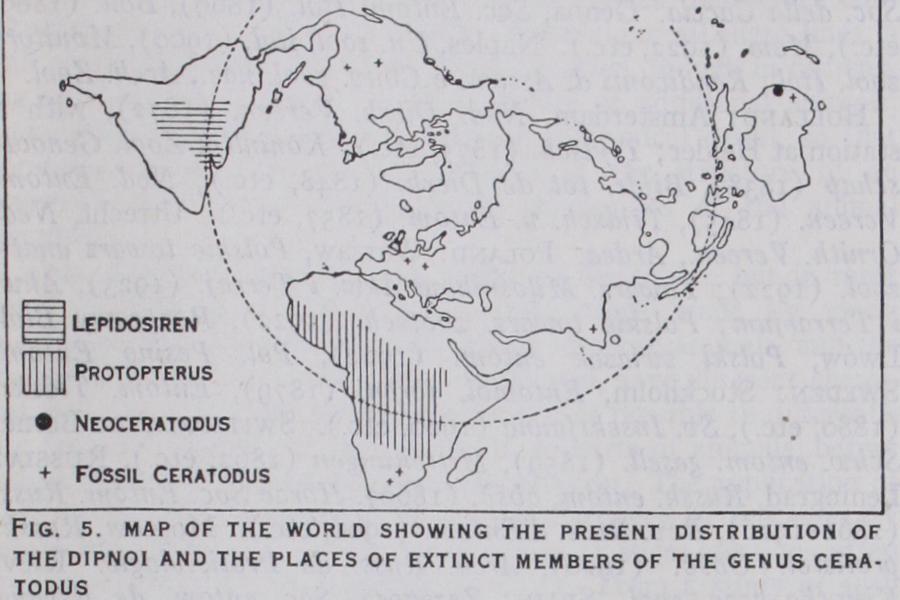
The distribution of freshwater fish does not fall easily into the zoo-geographical regions established for the mammals, a fact which is remarkable because the bony fish are in the main a Cretaceous and Tertiary group. The most archaic of living vertebrates, the lung-fish Neoceratodus, now lives solely in two small rivers in southern Queensland, but remains of the same genus have been found in the Pleistocene of South Australia. Ceratodus itself is a Triassic form found widely spread all over the world in fresh-water deposits. It is clear that the present restricted distribution has resulted from the extinction of this fish over the greater portion of its former range. The other two dipnoans, Lepidosiren of South America and Protopterus of tropical Africa, are very closely related to one another, but differ materially from Ceratodus. A specimen of Protopterus has been found in the Oligocene of Egypt, proving that the group is an ancient one, and its present distribution must depend on factors incapable of analysis. Polypterus and its close relative Calamoichthys, which are the much modified descendants of the Palaeozoic Palaeoniscidae, are now restricted to tropical Africa, but isolated scales perhaps of the same type occur in the Eocene of Egypt. The sturgeons, belonging to a group which first appears in the Lower Jurassic, are remarkable for their restriction to the temperate waters of the northern hemisphere, where are found all the members of the two existing families. That the only two other living ganoids, the bowfin and the garfish, live in temperate parts of North America, and that both are known from the Eocene of Europe, shows yet again how present distribution may give no clue to former extent of range.
One peculiar family of bony fish, the cichlids, extraordinarily abundant in the great lakes of equatorial Africa, is represented in equal numbers in tropical America, a phenomenon which with the similar distribution of lungfishes and octodont rodents has led to a belief that South America and Africa were connected by a land-bridge until late in Tertiary times. The distribution of mammals makes this view untenable, and when the fossil history of the cichlids comes to be known, it will probably be found either that they once occurred in the northern hemisphere or that the African and American forms are not really closely re lated. It is impossible to deal in this article with the distribution of invertebrates but the matter is dealt with in the articles dealing with individual groups.
Marine Animals.
The distribution of marine animals de pends on many factors. To a considerable extent it is controlled by temperature, many marine forms being capable of life and reproduction only within a narrow range of temperature variation. The seas may be divided into the open oceans and the shallow waters into which detritus derived from the land is carried by rivers.
In the ocean, animals may inhabit three regions ; they may live in the surface layers (4o fm.) to a depth where the light inten sity becomes negligible and growths of plants is no longer possible : or they may inhabit the mid-waters (roughly 40-2,000 fm.) depending ultimately for their food-supply on the remains of dead animals and plants from the surface : or they may live on the ocean bottom even at depths approaching 3,00o fathoms. The fauna of the sea-bottom lives under remarkably uniform condi tions; light is absent, the temperature is not far above freezing point, all the food which reaches this region has fallen from the surface of the sea and the bottom is usually soft mud. The abyssal fauna is nearly uniform over the whole world : it includes the great majority of known species of the primitive hexactinellid sponges, and most of the phyla of the animal kingdom are represented. often by forms peculiar in structure and belonging to groups restricted to deep water. Although a more detailed study shows that species and genera may range over only comparatively small areas of the ocean floor, the abyssal fauna is nevertheless re markably distinct from all others, nearly all its members being recognizable as such at sight.
The free-swimming fauna of the mid-water includes certain radiolarians and medusae. The Crustacea are represented by many forms of prawns, usually bright red in colour, and by a gigantic ostracod. The Mollusca include pteropods and cuttle fish, but the most abundant forms are fish, very characteristic in their possession of light-producing organs, their black, and in shallower water, silvery colour, and the presence of very large or excessively small eyes.
The pelagic fauna of the surface layers of the ocean, consists mainly of transparent animals of delicate structure ; it includes the foraminiferan Globigerina and many radiolarians, innumer able representatives of the dinoflagellates, some brilliantly phos phorescent, medusae and the floating siphonophores, familiar as the "Portuguese man-of-war." The arrow-worm Sagitta is often abundant and certain polychaet worms are of universal occurrence. The Crustacea include immense numbers of copepods, usually very small forms living on diatoms. Other small Crustacea be longing to the Ostracoda are plentiful, whilst of the higher Crustacea, the schizopods may form a large proportion of the catch. The pelagic molluscs belong largely to the pteropods: lamellibranchs are absent and gastropods represented by a few special forms. Cephalopods probably form an important element in the pelagic fauna and tunicates belonging to the appendicular ians, salps and Pyrosoma occur abundantly. The oceanic surface fishes include forms allied to the herrings, with many representa tives of the mackerels, flying-fishes and gar-fishes.