Military B H L H Transport
fleet, british and july
TRANSPORT, MILITARY. (B. H. L. H.) To follow the worldwide ramifications of naval operations dur ing the World War it is best to consider, year by year, the events in each area. At the outset they covered all the seas of the earth, but as the net was drawn around the Central Powers, the area of naval warfare was gradually reduced to European waters and to the seas around the British Isles. In the end, it was due to the irresistible force of sea power (q.v.) that the war was brought to a close.
Preliminary Moves.
In July 1914 in place of the usual summer manoeuvres, a test mobilisation of the British Fleet in Home waters was carried out. The ships of the 2nd and 3rd Fleets, their crews completed from the Reserves, joined the st Fleet at Portland on July 16th for exercises in the Channel. On July 23, the day of the Austrian ultimatum to Serbia, the fleets were ordered to disperse. The ships of the 2nd and 3rd Fleets returned to their Home Ports.
The 1st Fleet remained at Portland, the defence flotillas were sent to their stations around the coast, and at the same time the Mediterranean fleet was ordered to concentrate at Malta.
On July 29 the ut fleet left Portland for Scapa Flow, and, by Aug. 2 the 1st and 2nd fleets were at their war stations, the 3rd fleet was on the move, the defence flotillas were at their posts, and the organisations for taking up auxiliaries and for arming merchant liners were in force. On Aug. 1 the order for general mobilisation was issued, followed next day by the calling up of the naval reserve. Owing to the recent exercise the machinery of mobilisation worked smoothly and by the morning of Aug. 4 the state of naval readiness around the British Isles was such as to preclude the possibility of surprise before the outbreak of hostilities.
The German High Sea Fleet, which had been visiting Nor wegian ports, was recalled. By July 3o all ships had returned to Wilhelmshaven and Kiel and no German ships were sighted by the British Fleet as it passed northward to its war stations.
Distribution of Fleets.
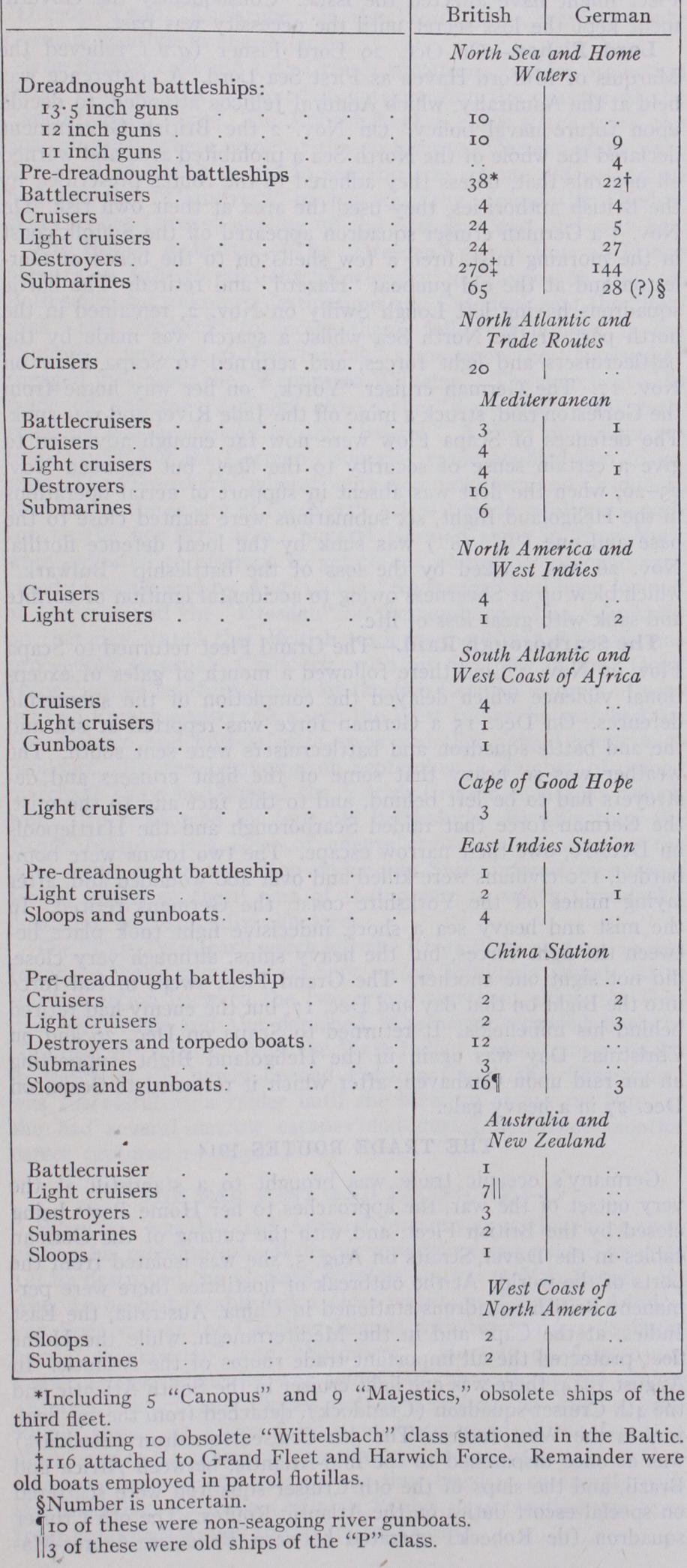
The following table shows the dis tribution of the British and German Fleets upon the outbreak of hostilities.