Radiographic Technique
photographic, x-rays, x-ray, object, rays, tube and film
RADIOGRAPHIC TECHNIQUE It is well to remember that radiography is the production of a shadow picture. The shadows exist in the picture because X-rays are absorbed to different degrees by different media. If we were to radiograph a perfectly homogeneous piece of muscle or steel we should obtain a photographic plate quite uniformly blackened because the X-ray absorption would be quite uniform. The absorp tion of X-rays by any material depends, firstly, upon the material itself—in general the higher its atomic weight the more absorbent it is—and, secondly, upon the penetrating power or wave-length of the X-rays. The latter condition depends, generally speaking, on the voltage which is applied to the terminals of the X-ray tube. Thus, remembering the first condition, lead is more absorbent than iron, iron more than aluminium, and aluminium more than organic substances such as flesh. At the same time, if we use an X-ray tube having a tungsten target the X-rays will be more pene trating when generated by 200,000 volts than at ioo,000 volts, and so on. If a beam of X-rays of suitable penetrating power is passed through an object of varying thickness or varying composition the emerging rays (which affect the photographic plate) will have different intensities corresponding to the variations in the object and the result will be a mixture of shadows of varying degrees of intensity. For example, a hidden cavity in a piece of metal means that the total thickness of the material is less at that particular place, and the X-ray absorption will also be less; there fore we shall obtain more intense X-rays in that area, resulting in a darker patch on the negative. If, instead of a photographic plate, we are using a fluorescent screen, we shall see a brighter patch on the screen corresponding to the more intense radiation.
Unfortunately, of the energy represented by the X-rays that fall on the photographic film only a very small fraction (less than 1% ) has any photographic effect, the remainder simply passes through the emulsion without affecting it. The photographic effect, however, may be increased by the use of suitable intensifying screens that absorb more of the rays and in consequence emit actinic rays which reinforce the photographic image.
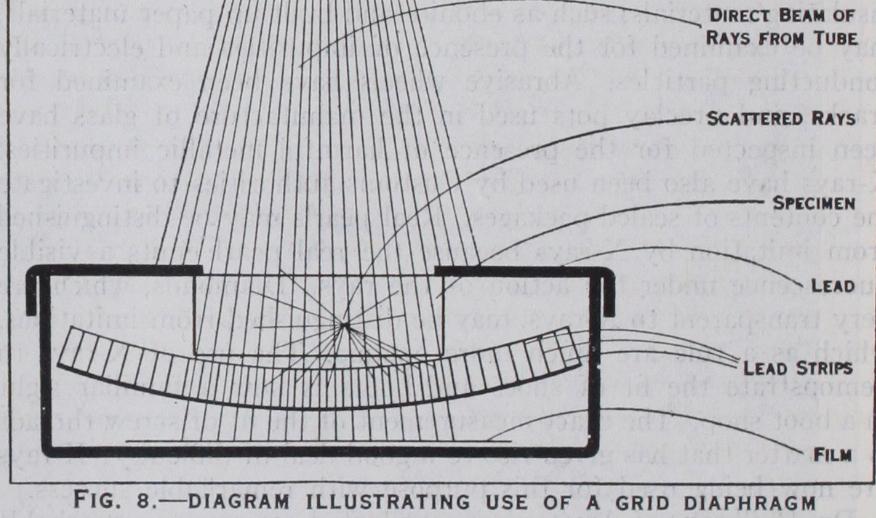
When an object is radiographed only a part of the incident radiation emerges, a large amount is absorbed and, as we say, scattered by the object itself. Not only is the radiation scat tered inside the object but also at all its surfaces; and if this general scatter, which may be likened to a fog, reaches the photo graphic film its effect will be to produce photographic fogging and so destroy much of the valuable detail of the picture. One of the most important points, therefore, in radiographic technique is, first, to suppress all the X-rays coming from the tube except those which pass directly through the specimen to the photo graphic film and, secondly, to arrange that those rays which are scattered by the surfaces of the specimen itself shall be pre vented as far as possible reaching the photographic emulsion.
The first condition is usually realized by enclosing the X-ray tube in a box made of a highly absorbent material ; by reason of its high atomic weight, combined with its comparative cheapness, metallic lead is usually adopted for this purpose. The box is fitted with an adjustable aperture or diaphragm to control the size of the emergent X-ray beam.
There are many methods of realizing the second condition and the choice is governed by the character, shape, and size of the object to be radiographed. For medium sized objects it is often convenient to protect all the surfaces by sheet or powdered lead, and to protect the film in the same way. The diagram will illustrate the general method employed. When the object has very irregular edges it may be convenient to use a wax impreg nated with lead or other heavy element. Another method is to immerse the specimen in a liquid having about the same coefficient of absorption as the specimen. In order to obtain good radio graphs it is very necessary to centre the focal spot of the X-ray tube target over the middle or most important part of the ob ject. The rays must fall nearly perpendicularly on the film, as obliquity of the rays will result in distortion and consequent loss of detail in the image.