Showing Approximate Armaments and Position of Minefields Fig 3-Map of Dardanelles Defences
british, flotilla, submarine, sunk, boats, loss, ships, motor and monitors
The End of the Submarine Campaign.
By the middle of 1918 the mastery of the Allies over the submarine was in sight, both from the number destroyed and from the lessening toll they took of merchant ships. In the first nine months of the year over 6o submarines were sunk by the Allied naval forces: the average weekly loss of British merchant ships was over 17 in the first quarter of the year and by the third quarter this figure was re duced to under II. During 1918, 1,1o8 submarine attacks were made upon British merchant ships; of these 581 were sunk and 527 escaped, a far higher percentage than hitherto. During 1918 only 8 British ships were lost by mines, a figure that attests the effi ciency of the Auxiliary Patrol and Minesweeping services.
On July 19 a naval air raid, supported by the Grand Fleet, was made upon Tondern and a Zeppelin shed was destroyed. In an other raid on August II made into the Heligoland Bight by cruisers and coastal motor boats, a Zeppelin was brought down and destroyed, but the motor boats suffered heavily from the enemy air craft. These proved to be the last two important operations of the Grand Fleet during the war.
The White Sea, 1918-19.
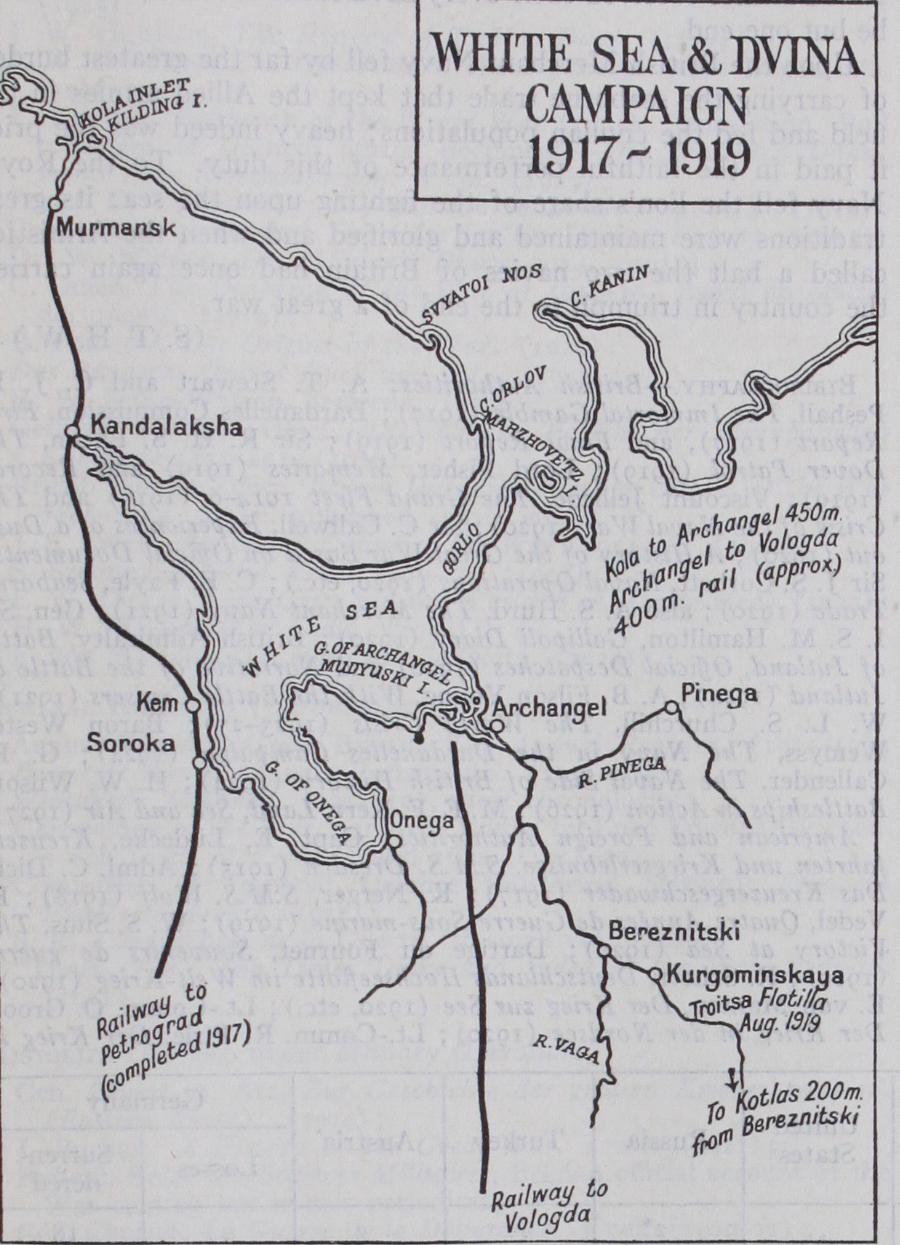
The closing of the Black Sea and the Baltic brought the northern route to Russia into promi nence and vast quantities of munitions and fuel were, in 1917, sent to the ice free port of Murmansk (connected by rail to Petrograd in 1917) and to Archangel, which was open from July to October. When Russia collapsed in 1917 the old battleship "Glory" and the cruisers "Cochrane" and "Amiral Aube" (Fr.) were sent to Murmansk and were followed in May 1918 by the cruiser "Attentive," the seaplane carrier "Narana" and a force of 9,00o troops (2,100 British). The object of the ex pedition was to prevent Germany using these ports as submarine bases, to keep open supplies and give support to the anti Bolshevik forces under Kolchak (q.v.). Archangel was occupied in August after a spirited duel between the "Attentive" aided by the Narana's seaplanes and the forts, and an advance was made along the railway towards Vologda and up the Dwina river towards Kotlas, the latter being supported by a flotilla, which included a British monitor and a number of local river steamers fitted out as gunboats and motor launches, mostly manned by British crews. Troitsa, 25o miles from Archangel, was occupied in September, when the flotilla had to retire before the river began to freeze. In April 1919 a British flotilla, which eventually included 6 monitors, 6 river gunboats, minesweepers, and coastal motor boats, 18 seaplanes and a kite balloon, assisted in the attempt to advance to Kotlas, but Kolchak's effort failed and political influences caused the Allied Governments to order a withdrawal from North Russia. The flotilla successfully coveredthe re-embarkation with the loss of two small monitors. By the end of Sept. 1919 the evacuation was complete.
The Baltic, 1918.
The British submarine flotilla, working under the orders of the Russian commander-in-chief, was stationed at Helsingfors during the winter of 1917-18. After the break-up of Russia, the Germans advanced upon Helsingfors, and on April 3,1918, the flotilla of seven boats was taken to sea through the ice and sunk to avoid falling into the hands of the enemy.
The Mediterranean and Black Sea, 1918.
Early on the morning of Jan. 20, the "Goeben" and "Breslau" suddenly re appeared in the Mediterranean. Shadowed down the Dardanelles by two British destroyers, they made for Imbros Island, where they found the monitors "Raglan" and "M. 28" at anchor. The two British ships were soon set on fire and sunk but in rounding the south of the island the Germans met disaster. The "Breslau" struck a mine and sank and the "Goeben" shortly afterwards struck two mines in quick succession. In a sinking condition she crept back into the Straits and was beached in the Narrows. Con tinuous attacks upon her from the air failed to do material dam age and a desperate attempt to torpedo her, made by "E. resulted in the loss of the submarine. Eventually the "Goeben" was towed off and once more made her escape to Constantinople.
The loss of merchant tonnage on the congested traffic lanes of the Mediterranean remained severe and although the unified control of Trade Protection gradually reduced this loss the Medi terranean was one of the chief danger areas on the trade routes until the end of the war. The Otranto barrage, though a de terrent, was unable to close the passage to the German and Austrian submarines and its patrols were always open to sudden raids. On April 22 Austrian destroyers made a descent upon the patrols but were driven off and in June the Austrian dreadnought squadron at last moved out of Pola and sailed for Cattaro with the intention of attacking the barrage. The squadron was attacked by Italian torpedo boats, the dreadnought "Svent Istvan" was sunk, the attack was abandoned and the Austrians returned to Pola. On Oct. 31 the defences of that port were pierced by the Italian mosquito craft and the battleship "Viribus Unitis" was torpedoed and sunk. During the closing months of the war a flotilla of British monitors and small craft were employed on the northern shores of the Adriatic in co-operating with the flanks of the Italian Army in their final struggle with the Austrians.