Wrestling
style, styles, games, ground, catch-as-catch-can, amateur, international and wrestlers
Catch-as-catch-can.
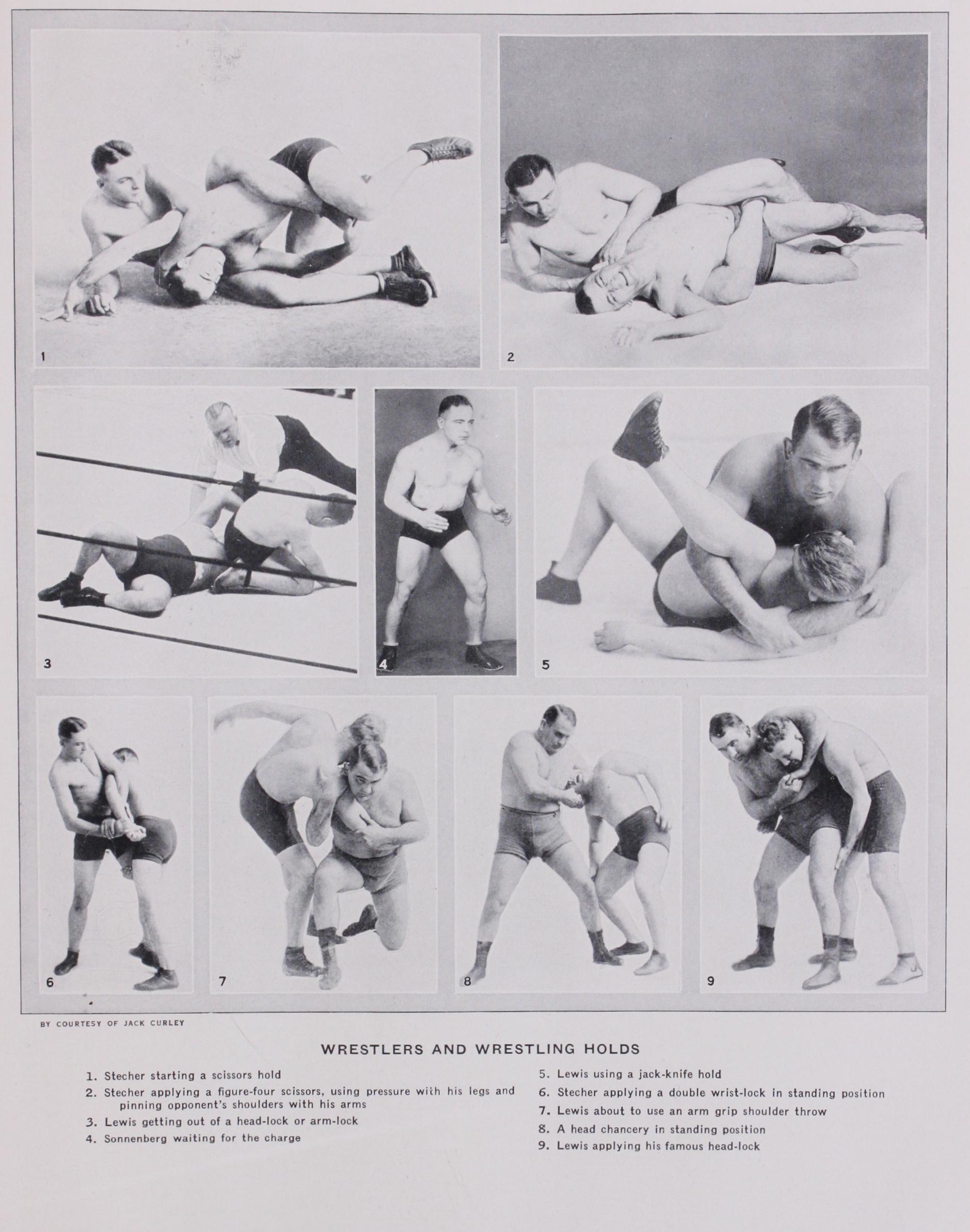
The Lancashire style, generally known as "catch-as-catch-can," is practised in Lancashire, throughout Great Britain generally, and is the most popular style in the United States, Canada, Australia, Switzerland and some other countries. It is the legitimate descendant of the ancient Greek upright wrestling combined with ground struggling, but minus the "all-in" freedom the Greeks permitted, and undoubtedly is representative of the wrestling of the middle ages. A fall is gained when both shoulders of one wrestler touch the ground together, and very seldom are falls registered from standing throws. This neces sitates most contests being completed while struggling on the ground or mat. Much of this ground work is admittedly very skilful. No kicking, striking, or other foul practices are permitted, but theoretically every hold is legitimate. Exceptions are made of strangle holds or others designed to cut off an opponent's breath ing, also grips or forms of attack causing acute pain or intended to force the defender to roll on his shoulders to avoid injury by dislocation or fracture. The style contains practically all the manoeuvres known to other methods with many peculiar to itself ; and because of its freedom and opportunity for the display of strategy, skill, and strength, is, when upstanding wrestling and tripping—the very essence of wrestling—are not neglected, the most preferable.
In Scotland a combination of the Cumberland and Westmor land and catch-as-catch-can styles is sometimes practised, the contest commencing in the first named style and continued on the ground if a direct fall on both shoulders does not result from a throw.
In Ireland, the national style is called "collar and elbow" (prac tised in America also), from the holds taken by the two hands, and first down, any part (in America, any three points) is loser.
Graeco-Roman Style.—The style chiefly affected by the conti nental European wrestlers is the Graeco-Roman (so-called, though it bears almost no resemblance to classic wrestling), which arose about 1860, and is a product of the French wrestling schools. It is a very restricted style, neither tripping nor any hold below the hips being allowed, the result being that the bouts consist chiefly of ground struggling. When no time limit is enforced, contests are usually tediously long. British and American wrestlers, accus tomed to their own freer styles, seldom compete under Graeco Roman rules. These, however, of late years have been revised by the governing body of international wrestling, the International Amateur Wrestling Federation (inaugurated 1921), with the re sult that the character and quality of this style of wrestling have greatly altered and improved. The pre-eminence that French
wrestlers formerly held has been transferred to the Scandi navian countries. The Finnish wrestlers show a marked advance. Finland shared with Sweden the wrestling championships at the Olympic games of 1912, held at Stockholm, repeated the success at Antwerp in 1920, and won four of the six weights at Paris, in 1924. A wide distribution of the honours in 1928 was followed by a decided victory for Sweden in 1932 with 77 points to 47 for Finland and 3o for the U. S. A.
Wrestling in the Olympic Games.—The popularity of wrestling as an amateur sport has received a considerable develop ment through the institution of the modern Olympic games, as is proved by the increase in the number of nations entering com petitors at this quadrennial athletic festival. In 1908, when the games were held in London, 15 nations were represented (Grae co-Roman and catch-as-catch-can styles) ; at the games of 1924, 25 countries sent competitors. In 1914, the permanent inclusion of catch-as-catch-can (free style) wrestling in the standard pro gramme was secured by Great Britain, and since then this style has made great progress, the nations entering for these compe titions in 1924 numbering II as compared with the five at the games of 1908; with an increase to 15 for the games of 1928 at Amsterdam. In 1924, Japan, Turkey, and Egypt were represented for the first time, with results indicating that the Western styles of wrestling are being well studied throughout the East. The International Amateur Wrestling Federation has fixed the number of championship weights at seven for the catch-as-catch-can style and six for the Graeco-Roman. Under authority of the I. A. W. F., European (amateur) championships in both styles have been instituted and are decided annually (except in the year when an Olympiad takes place) ; and numerous international matches are disputed every year, leading to a higher development of the sport and a marked increase in public interest, which will be yet further extended if the proposal to bring the two styles within one code of rules is carried into effect.
In Great Britain, apart from the professional tournaments or ganised by'local associations in the northern and western counties, it seems probable the sport would have disappeared altogether but for the exertions of the National Amateur Wrestling Associa tion. This organisation has kept the sport alive by the promotion (the years of the World War excepted) of annual championships at various weights in the Cumberland and Westmorland and catch-as-catch-can styles.