Wurttemberg
south, ft, forest, black, lake, country and alb
WURTTEMBERG, a Land, and a component State of the German Reich, forming a tolerably compact mass in the south west angle of Germany. In the south it is cleft by the long narrow territory of Hohenzollern, belonging to Prussia; and it encloses several small enclaves of Baden and Hohenzollern, while it owns some small exclaves within the limits of these two states. It lies between 47° 34' 48" and 49° 35' 17" N., and between 8° 15' and o° 3o' E. Its greatest length from north to south is 140 m. ; its greatest breadth is 1 oo m. ; its boundaries, almost entirely arbitrary, have a circuit of 1,116 m. ; and its total area is 7,53o sq.m. It is bounded on the east by Bavaria, and on the other three sides by Baden, with the exception of short distances on the south, where it touches Hohenzollern and the lake of Constance.
Physical
undulating fertile terraces of Upper and Lower Swabia may be taken as the characteristic parts of this agricultural country. The usual estimates return one-fourth of the entire surface as "plain," less than one-third as "mountain ous," and nearly one-half as "hilly." The average elevation above the sea-level is 1,640 ft.; the lowest point is at Bottingen (410 ft.), where the Neckar quits the country; the highest is the Katzenkopf (3,775 ft.), on the Hornisgrinde, on the western border.
The chief mountains are the Black Forest (q.v.) on the west, the Swabian Jura or Rauhe Alb stretching across the middle of the country from south-west to north-east, and the Adelegg Moun tains in the extreme south-east, adjoining the Algau Alps in Bavaria. The Rauhe Alb or Alp slopes gradually down into the plateau on its south side, but on the north it is sometimes rugged and steep, and has its line broken by isolated projecting hills. The highest summits are in the south-west, viz., the Lemberg (3,326 ft.), Ober-Hohenberg (3,312 ft.) and Plettenberg (3,293 ft.). To the south of the Rauhe Alb the plateau of Upper Swabia stretches to the lake of Constance and eastwards across the Iller into Bavaria. Between the Alb and the Black Forest in the north west are the fertile terraces of Lower Swabia, continued on the north-east by those of Franconia.
About 7o% of WUrttemberg belongs to the basin of the Rhine, and about 3o% to that of the Danube. The principal river is the
Neckar, which flows northward for 186 m. through Wurttemberg to join the Rhine, and with its tributaries the Rems, Kocher, Jagst, Ens, etc., drains 57% of the country. The Danube flows from east to west across the south half of Wurttemberg, a dis tance of 65 m., a small section of which is in Hohenzollern. Just above Ulm it is joined by the Iller, which forms the boundary between Bavaria and Wurttemberg for about 35 m. The Tauber in the north-east joins the Main; the Argen and Schussen in the south enter the lake of Constance. The lakes of Wurttemberg, with the exception of those in the Black Forest, all lie south of the Danube. The largest is the Federsee (I sq.m.), near Buchau. About one-fifth of the lake of Constance is reckoned to belong to WUrttemberg. Mineral springs are abundant; the most famous spa is Wildbad, in the Black Forest.
The climate is temperate, and colder among the mountains in the south than in the north. The mean temperature varies at different points from 43° to 50° F. The abundant forests induce much rain, most of which falls in the summer.
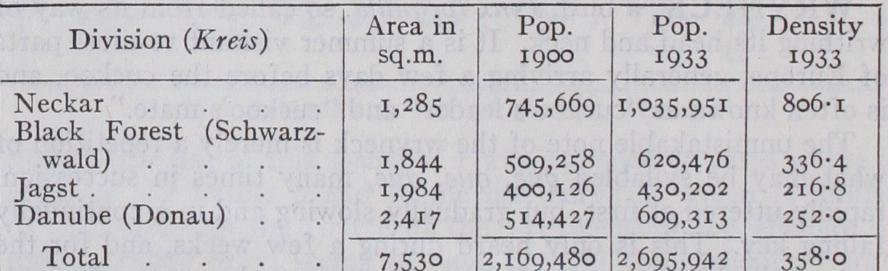
population of the four divisions (Kreise) into which the kingdom is divided is shown below :— The population is particularly dense in the Neckar valley from Esslingen northward. The people of the north-west belong to the Alamannic stock, those of the north-east to the Franconian, and those of the centre and south to the Swabian.
The largest towns in the kingdom are Stuttgart (with Cann stadt), Ulm, Heilbronn, Esslingen, Reutlingen, Ludwigsburg, Giippingen, GmUnd, Tubingen, Tuttlingen and Ravensburg.