Wyoming
park, yellowstone, ft, plains, south, river and range
WYOMING, popularly known as the State be cause it was the pioneer in woman suffrage, is one of the central western States of the United States of America, and is situated between and II 3' long. W. and and N. lat. It is bounded north by Montana, east by South Dakota and Nebraska, south by Colorado and Utah, and west by Utah, Idaho and Montana. Including Yellowstone park (area 3,114 sq.m.), Wyoming has an area of 97,914 sq.m. of which 366 sq.m. are water surface. Over Yellowstone park, however, the United States has exclusive jurisdiction and control. East and west the State has an extreme length of 367 m., and north and south an extreme breadth of 277 miles. In shape it is an exact rectangle. Its mean elevation is 6,700 ft. above sea-level and in this respect it is exceeded only by Colorado. The name originally bestowed upon the Wyoming valley in Pennsylvania, is a corruption of a word of the Delaware Indians meaning the great It is not known who first applied it to the State.
Physical Features.—The great plains in Wyoming have an ele vation of from 5,000 to 6,000 ft. over much of the State, and consist of flat or gently rolling country, barren of tree growth, but often covered with nutritious grasses, and possessing a soil rich in the mineral elements necessary for plant life which it produces abundantly when it receives sufficient moisture. Erosion buttes and mesas occasionally rise as picturesque monuments above the general level of the plains, and in the vicinity of the mountains the plains strata, elsewhere nearly horizontal, are bent sharply upward and carved by erosion into ridges. These features are well developed about the Big Horn mountains, an outlying range of the Rockies which boldly interrupts the continuity of the plains in north-central Wyoming.
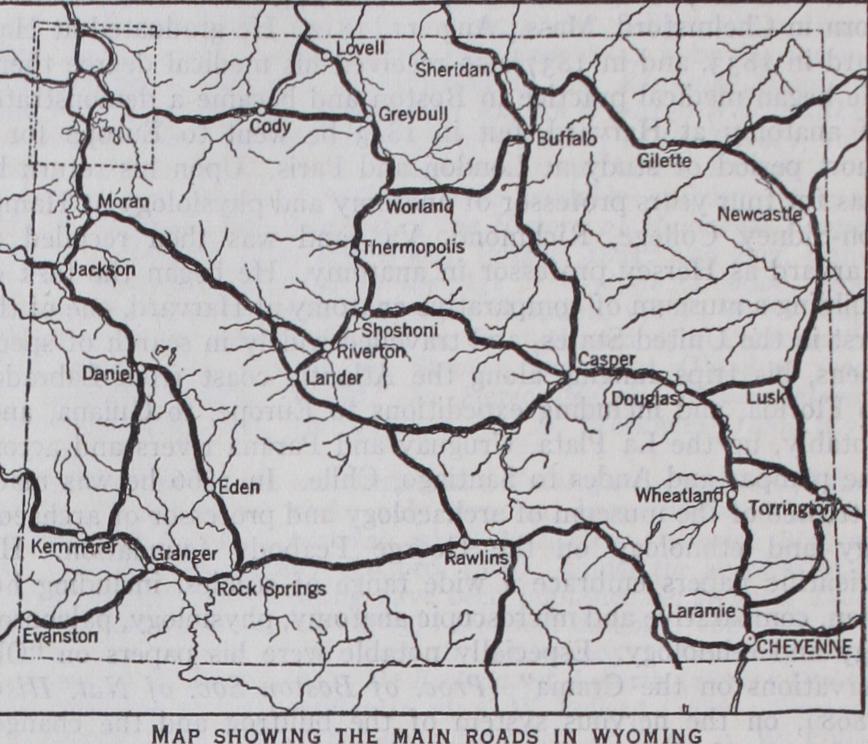
Notwithstanding high elevations in both the northern and south ern portions of the State, the low central portion makes a distinct break in the continuity of the northern and southern ranges of the Rockies, giving a broad relatively low pass through which went the Oregon and Overland trails in the early days and later the Union Pacific railway. In this central region the plains are inter
rupted by minor mountain groups, volcanic buttes and lava flows. In the north-east are outlying spurs of the Black hills, the Little Missouri buttes and the Tower, the latter a prominent erosion remnant of volcanic intrusion. The higher levels of the Big Horn range have been modified by local glaciation, giving glacial cirques, alpine peaks and many mountain lakes and water falls. Several small glaciers still remain about the shoulders of Cloud Peak (13,165 ft.), the highest summit in the range. The various ranges in the north-western part of the State form some of its most magnificent scenery. A vast portion of this has been set aside as Yellowstone National park, but areas in the Absarokas east of the park are also considered beautiful. Just south of the park, the Teton mountains rise abruptly from Hole to elevations of io,000 and ii,000 feet. They are an imposing land mark and were hailed by all emigrants of the Oregon Trail as a welcome sign that they were approaching Pacific waters. In the famous Wind River Range farther south-east are Gannett Peak (13,785 ft.), the highest point in the State, and Fremont Peak (13,720 ft.).
In addition to the hot springs of the Yellowstone region, men tion should be made of large hot springs (about F) at Thermopolis and Saratoga.