Yale University
school, college, haven, established, arts, charter and harvard
YALE UNIVERSITY, the third oldest institution of higher education in the United States, situated at New Haven, Conn. In I 700 the needs of New England in the way of higher education were supplied by Harvard college, at Cambridge. Massachusetts Bay Colony was naturally the chief patron of Harvard, but Con necticut bore her full share in support of the enterprise. The two commonwealths, however, diverged to some extent in their theo logical and political development and there arose the desire for a separate college in Connecticut. The first distinct traces of this scheme appear in the early summer of 1701, in the neighbourhood of New Haven. The Rev. James Pierpont (Harvard, 1681), minister of the New Haven church, was the chief promoter.
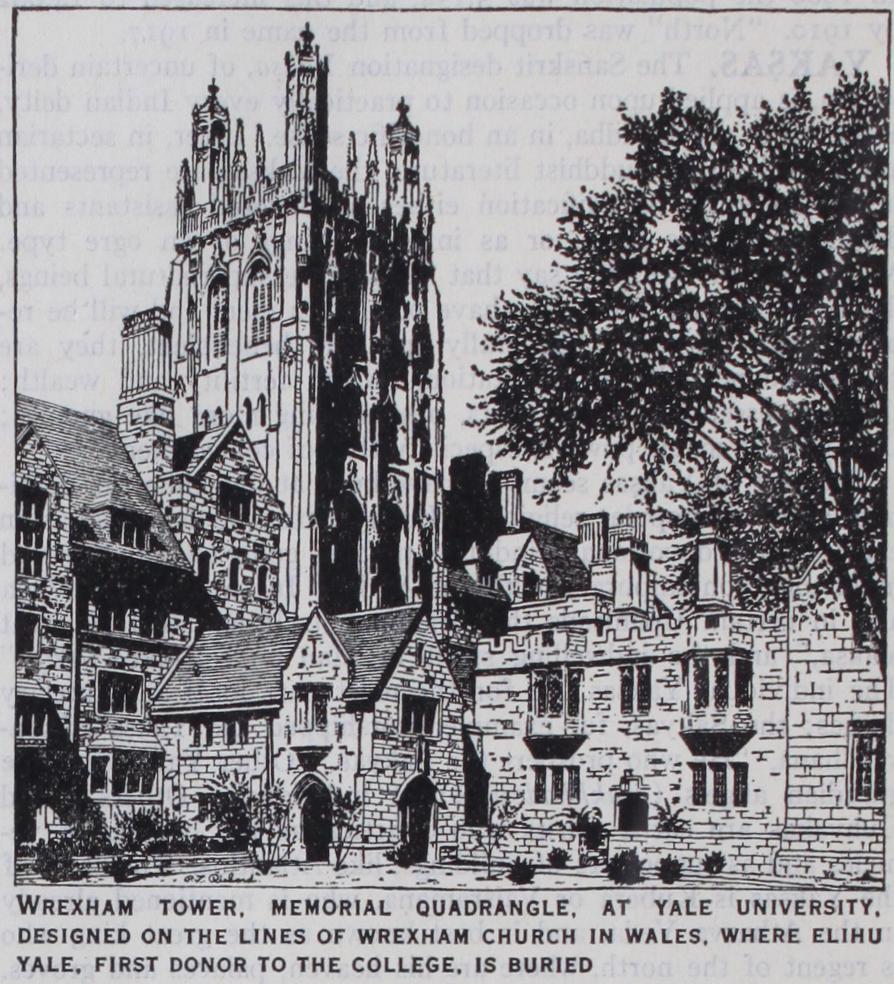
The General Court of the Colony met at New Haven on Oct. 9, 1701, and a charter was granted (probably on Oct. 16) "for the founding, suitably endowing and ordering a Collegiate School within his Majesty's Colony of Connecticut." The founders chose the Rev. Abraham Pierson of their number as rector of the Col legiate school and it was at his parsonage in Killingworth that the first scholar sought admission in March 2702.
The school continued at Killingworth, with the annual corn mencements at Saybrook, until the death of Rector Pierson on March 5, 1707. From 2707 to 1716, although the commencement exercises were held annually at Saybrook, the students resided in the several towns where their tutors were established. It was not until a gift of nearly 1,00o volumes of great value was secured by Jeremiah Dummer, the agent for Connecticut at London, that a building for the school became necessary. After much argument it was decided to establish the institution at New Haven. A cargo of gifts for the Collegiate school, from Elihu Yale, former gov ernor of Ft. St. George, Madras, India, and a native of Boston, including, besides books, East India goods which were sold in Boston for £562.125., led the trustees to use the name Yale col lege at the first commencement (1718) in the completed college building.
President Clap secured the passage in 1745 of a new charter which legalized the name "Yale College" and in general provided a more explicit and liberal statement of powers and privileges conferred in 1701 and 1723. The organization of a College Church
in 1757 provoked much criticism and revived the struggle to bring the college under the control of the legislature.
The charter drawn up by President Clap is still in force. In 1792 the governor and lieutenant governor of the State and six senior State senators were made ex officio members of the cor poration. In 1872 the six senators were replaced by six graduates, chosen by the alumni. The act authorizing the name Yale univer sity was passed in 1887.
The curriculum of the college changed but little before the administration of Timothy Dwight the Elder (1795-1817), who expanded the usefulness of the college by the organization of pro fessional schools. Benjamin Silliman, Sr. (1779-1864), was ap pointed to the first chair in chemistry, mineralogy and geology in the United States in 1802. In 1810 a medical department was established, and the theological and law departments were organ ized in 1822 and 1824.
Under the administration of Theodore Dwight Woolsey (1846 71) graduate courses were organized in 1846 and the Graduate school (under the title Department of Philosophy and the Arts) was established the following year. The degree of Doctor of Philosophy was first conferred in the United States by Yale in 1861. In 1847 courses in applied chemistry were offered and in 1852 instruction in engineering. Two years later these courses were distinguished as a separate section with the title "Yale Scientific School," which was changed in 1863 to "Sheffield Scientific School" in appreciation of the assistance of Mr. Joseph E. Sheffield, of New Haven, who endowed the school in 186o. From 1863 to 1892 this school was also the State college of agri culture and applied arts. The School of Fine Arts, established through the generosity of Augustus R. Street, was opened to stu dents in 5869, the first of its kind to come within the scope of any university. The elective system of instruction in Yale college was substituted for the fixed curriculum in 1876.