Yucatan
peninsula, coast, east, south, expedition, quintana, roo, low and cozumel
YUCATAN, a peninsula of Central America, which includes in its area of 55,400 sq.m. the States of Campeche and Yucatan and the territory of Quintana Roo in Mexico, plus small parts of British Honduras and Guatemala. The natural boundary of the peninsula on the south is formed in part by the ridges extending across northern Guatemala, the line terminating in the east at the lower part of Chetumal bay, and in the west at Laguna de Termi nos. From this base the land extends north and slightly east be tween the Gulf of Mexico and the Caribbean sea in nearly rec tangular form for about 28o m., with a mean breadth of about 200 m., and a coast-line of 700 miles.
Physical Features.
The coast on the north and west is low. sandy and semi-barren. The outer shore-line on the north for nearly 200 M. consists of a narrow strip of low sand dunes, within which is a broad channel terminating to the east in a large lagoon. There are a number of openings through the outer bank and several small towns or ports have been built upon it. The eastern coast consists of bluffs, indented with bays and bordered by several islands, the larger ones being Cozumel (where Cortes first landed), Cancum, Mujeres and Contoy. There is more vegetation on this coast, and the bays of Chetumal, Espiritu Santo, Ascencion and San Miguel (on Cozumel island) afford good protection for shipping. It is, however, sparsely settled and has little commerce except in henequen, and in chicle, the basis for chewing gum.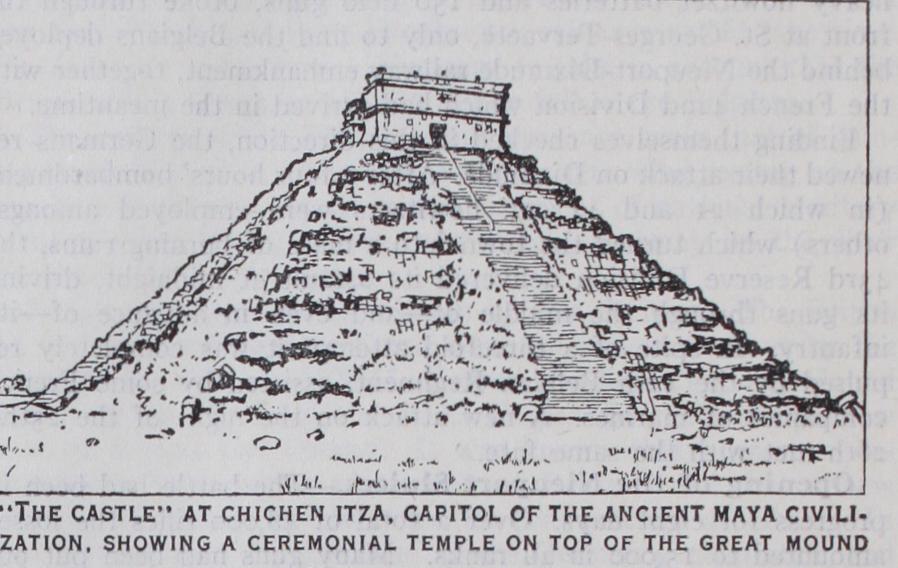
The peninsula is almost wholly composed of a bed of coralline and porous limestone rocks, forming a low tableland, which rises gradually toward the south until it is merged in the great Central American plateau. It is covered with a layer of thin, dry soil, through the slow weathering of the coral rocks.
The climate of Yucatan is hot and dry and the absence of high mountainous ridges to intercept the moisture-bearing clouds from the Atlantic gives it a limited rainfall. The temperature ranges from 75° to 98° F in the shade, but the heat is modified by cool sea winds which prevail day and night throughout the greater part of the year. The atmosphere is also purified by the fierce tem porales, or "northers," which oc casionally sweep down over the Gulf and across this open region. The dry season lasts from Oc tober to May, the hottest months appear to be in March and April, when the heat is increased by the burning of the corn and henequen fields.
All the northern districts, as well as the greater part of the Sierra Alta, are destitute of large trees; but the coast-lands on both sides towards Tabasco and British Honduras enjoy a sufficient rainfall to support forests containing the mahogany tree, several valuable cabinet woods, vanilla, logwood and other dye-woods.
Logwood forests fringe all the lagoons and many parts of the sea board. which are flooded during the rainy season. The chief culti vated plants are maize, the sugar-cane, tobacco, cotton, coffee and especially henequen, which produces the so-called "sisal hemp." History.—The modern history of Yucatan begins with the expedition of Francisco Hernandez de Cordova, a Spanish adven turer settled in Cuba, who discovered the east coast of Yucatan in Feb. 1517, when on a slave-hunting expedition. He followed the coast round to Campeche, but was unable to penetrate the interior. In 1518 Juan de Grijalva followed the same coast, but added nothing to the information sought by the governor of Cuba.
In 1519 a third expedition, under Hernando Cortes, the conqueror of Mexico, came into collision with the natives of the island of Cozumel. In 1525 the inland part of the peninsula was traversed by Cortes during an expedition to Honduras. The conquest of the peninsula was undertaken in 15 2 7 by Francisco de Montejo, who encountered a more vigorous opposition than Cortes had on the high plateau of Anahuac. In 1549 Montejo had succeeded in establishing Spanish rule over barely one-half of the peninsula, and it was never extended further. The Spaniards found here the remains of a high aboriginal civilization which had already entered upon decline. There were deserted cities falling into ruins, and others, like Chichen-itza, Uxmal and Tuloom, which were still inhabited by remnants of their former Maya populations. (For details of the Maya civilization see CENTRAL AMERICA : Archae ology and Ethnology; also CHRONOLOGY : Mexican and Maya.) Since the Spanish conquest, the Mayas have clung to the semi barren, open plains of the peninsula, and have more than once revolted. They seceded in 1839 and maintained their independence until 1843. In 1847 another revolt followed, and the Indians were practically independent throughout the greater part of the penin sula until near the beginning of the Diaz administration. In 1910 there was another revolt with some initial successes, such as the capture of Valladolid, but then the Indians withdrew to the un known fastnesses of Quintana Roo.
The Mexican State of Yucatan occupies the northern part of the Yucatan peninsula, and is bounded east and south by the territory of Quintana Roo, and south and west by the State of Campeche. Its population in 1930 was 386,096 or a density of 25.96 per square mile. The capital is Merida.
Quintana Roo was separated from the State of Yucatan in 1902 and received a territorial government under the immediate super vision of the national executive, but its few remaining Indian tribes (pop. in 1930, 10,227 or 0.52 per sq.m.) are practically independent.