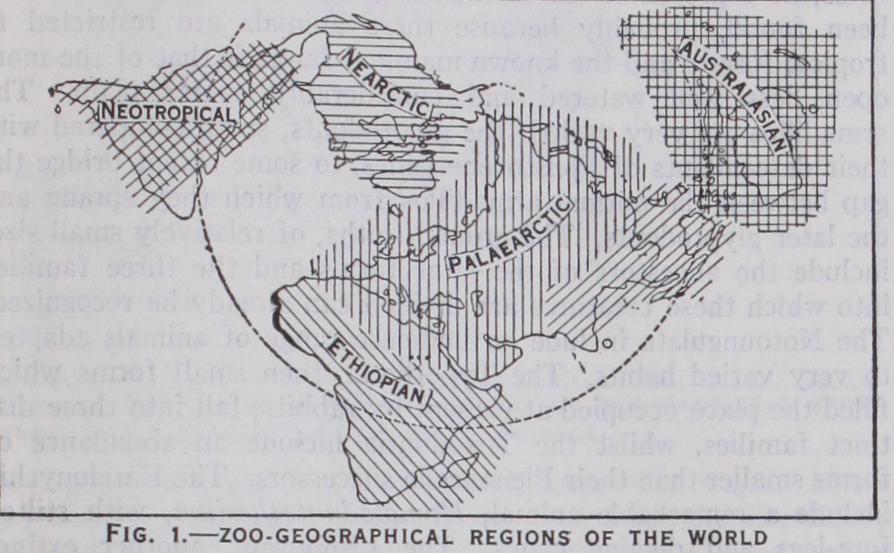
Zoological Regions
notogaea, australia, cretaceous, america, guinea, eutherian and mammals
Many minor modifications of these regions have been suggested which, although they may be useful, especially in the study of certain groups, are not of great significance. Max Weber has grouped these six regions into three main realms, as follows:— I. Arctogaea comprising Holarctica, the Ethiopian and Oriental regions.
2. Neogaea, comprising the Neotropical region.
3. Notogaea, comprising the Australian region.
This arrangement has the merit of emphasizing the distinctness of the two last faunas.
Notogaea.—Notogaea is by far the most distinct of the three realms. That portion of the area which alone is inhabited by mam mals (New Guinea, Australia and Tasmania) is the home of the only monotremes which are known; Proechidna restricted to New Guinea, and Echidna and Ornithorhynchus in the other two areas. The great bulk of the other mammals are marsupials belonging to the two great divisions Polyprotodonta and Diprotodonta. Poly protodont marsupials still exist in South America in several genera of the Didelphidae, and one species (the Virginian opossum) ex tends northwards into Canada. The other group, the Diprotodonta, have no representatives outside Notogaea. Coenolestes from South America, which was at first regarded as a diprotodont, has now been shown by a complete investigation of its anatomy to be nothing but a peculiarly modified didelphid. The only eutherian mammals found in Notogaea are rodents and bats, together with a pig in New Guinea, the native dog or dingo in Australia, and man himself throughout the realm. There is every reason to believe that the pig and dog were introduced by man and may be disre garded in considering the earlier history of the region. The bats present no special features; some of them indeed belong to forms with a world-wide range. The rodents on the other hand are often of peculiar genera not found elsewhere, but are all members of the Muridae, which have unusual powers of dispersal.
Thus Notogaea so far as its mammal fauna is concerned is re markable not only for the presence of many animals entirely peculiar to it, but also by the absence of all representation of the higher eutherian orders. There are no insectivores, carnivores, edentates, ungulates or primates, orders whose members are to be found in all other regions. The absence of these forms receives a simple and complete explanation if Notogaea has been separated from all other land-masses since a period which preceded the evolutionary development of these orders, or indeed of the basal eutherian stem from which they arose. Existing palaeontological
evidence suggests that this period cannot have been later than the end of the Cretaceous times, and may be pushed back at least as far as the end of the Lower Cretaceous if certain Mongolian discoveries be correctly interpreted.
The Australian polyprotodonts form a series, the more primitive of which are small mammals of insectivorous and commonly arboreal habits. These forms have their headquarters in Australia,, in which the majority of forms are found, but some of them ex tend on into New Guinea and into the Aru and neighbouring islands. From this primitive group have arisen forms (Myrme cobius), which have very small teeth and are committed to a diet of ants; others (the bandicoots), which are in part herbivorous, although they certainly also eat animal food. One of them is a little hopping animal, superficially recalling the jerboas. On the other hand there is a series of forms which become progressively more and more highly specialized for a carnivorous diet, resulting finally in Thylacinus, an animal as large as the collie-dog, ca pable of killing and eating sheep. Other representatives of the Polyprotodonta occur in SouthAmerica and as far north as Canada, but these belong to two living families, one which is closely similar to the native cats of Australia, whilst the other represents an aberrant side-branch of South American origin, which parallels superficially the Diprotodonta. During early Tertiary times, opos sums similar to those now living in North America ranged over North America and Europe, and a perfectly typical member of the same family is known from the Upper Cretaceous rocks of the United States. Thus the possession in common of Polyprotodonta by Arctogaea and Neogaea on the one hand and Notogaea on the other, does not necessarily imply that these realms were con nected with one another after the end of the Cretaceous. The fact that the polyprotodonts of Notogaea have radiated into such diverse forms whilst those of Arctogaea are restricted essentially to one type, may be explained by the absence of the competition of eutherian mammals in one case, and its presence in the other.