the Battle of Ypres
corps, division, oct, french, front, sea and cavalry
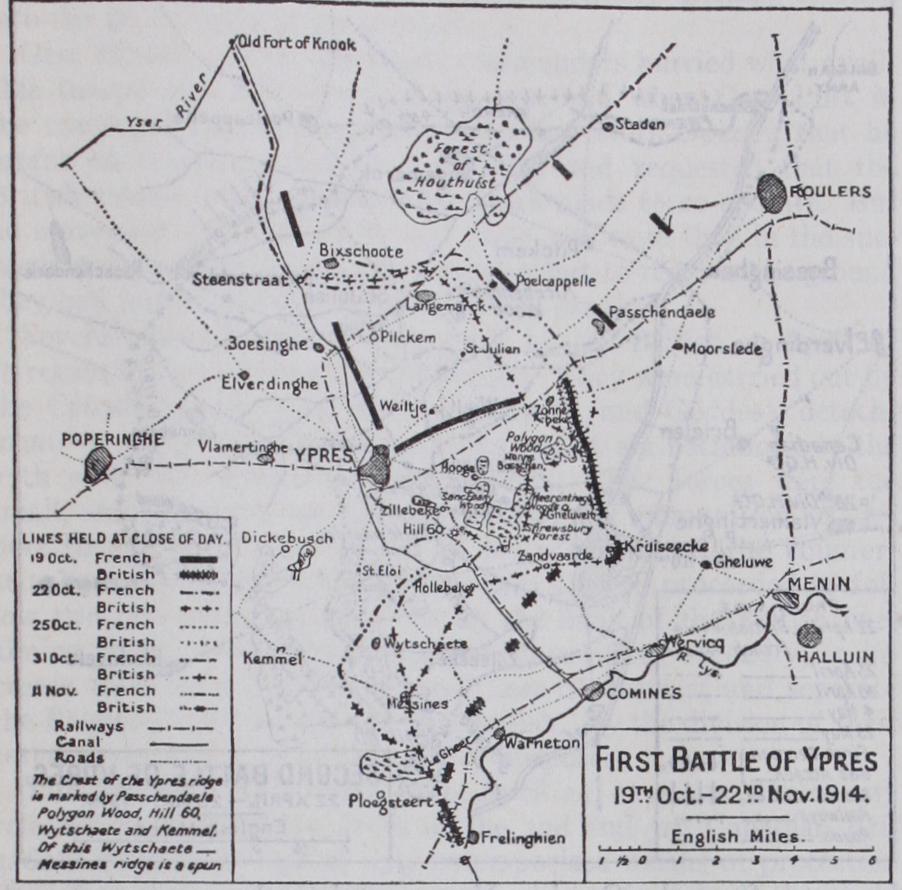
YPRES, THE BATTLE OF, 1914, is the name given to the heavy but indecisive fighting near Ypres at the close of the "race to the sea" (Oct. 19 to Nov. 22, 1914). It is commonly spoken of as the First Battle of Ypres.
Genesis of the Battle.—When in Oct. 1954 the British Expe ditionary Force under F.M. Sir John French left the Aisne front to be transferred to Flanders, its various corps, as they arrived in succession on the left of the Allied line, at once came into contact with the enemy, for each of the two belligerent forces was simultaneously extending its front northwards. Thus the II. Corps (Smith-Dorrien) on Oct. Io began the "battle of La Bassee," and the III. Corps (Pulteney) and the Cavalry Corps (the 1st and 2nd Cavalry Divisions under Allenby), on Oct. 12-13, the battles of "Armentieres" and "Messines." On Oct. 14-15 the IV. Corps (Rawlinson), the Belgian army and a French Marine bri gade, falling back from Antwerp, and de Mitry's cavalry corps and two French Territorial divisions, coming up from the west be tween Ypres and the Belgians, completed the Allied line to the sea. Of this line, the British held the portion from the La Bassee canal to Langemarck, north of Ypres.
The co-ordination of the Allied operations in Flanders was placed by Gen. Joffre in the hands of Gen. Foch, and the general plan now adopted was for the British, supported by the French and Belgians, to advance from the neighbourhood of Ypres, break through the enemy's front, cut off any Germans between the gaps thus made and the sea, and then turn southward to roll up the German line.
The Opening of the Battle.—On Oct. 19, on the arrival behind Ypres of the I. Corps (Haig), Sir J. French sent forward Rawlinson's corps (consisting only of the 7th Division and the 3rd Cavalry Division) towards Menin, and directed Pulteney's and Allenby's corps to move down the Lys on both banks in the same direction. But on the day previous, the i8th, the enemy, with a general plan similar to that of the Allies, had also begun an advance, with a new IV. Army under Duke Albrecht of Wiirttem berg, on a front from the Ypres-Gheluvelt (Menin) road to the sea. This army consisted of the new XXII., XXIII., XXVI. and XXVII. Reserve Corps composed of young volunteers with 25%
of old soldiers and the III. Reserve Corps of three divisions which had besieged Antwerp. Thus, as the German VI. Army, under Crown Prince Rupprecht of Bavaria, south of the IV.
Army, also attacked, battle was engaged on the 19th on the whole front from La Bassee to the sea. In the sector between the river Lys and the sea, the German XIX. Corps attacked the left wing of Wilson's division (4th) of Pulteney's corps; four German cav alry corps advanced against Allenby's two cavalry divisions; whilst of the 11 divisions of the German IV. Army, four were sent against Capper's division (7th) and Byng's cavalry division of Rawlinson's corps, two and one-half against the French north of Ypres, and four and one-half against the Belgians.
On Oct.
21, just as Haig's corps, which had been put in on the left of Rawlinson's, was making good progress towards Lange marck, the French on its left fell back before the enemy to the Ypres canal. Haig, with his flank thus exposed to the attack of the XXIII. Reserve Corps, whilst engaged with the XXVI. on his front, had to use his reserve to cover his left, and his advance, thus deprived of any fresh impetus, came to an end. Elsewhere, the British were opposed to at least double their numbers : Cap per's division to the XXVII. Reserve Corps, the three British cavalry divisions to eight German, and Wilson's division to the XIX. Corps. Nevertheless, they managed to hold their line un broken on the 21st and 22nd. When on Oct. 23 the French IX. Corps (Gen. Dubois) reached Ypres and took over the Zonne beke–Langemarck sector from Lomax's 1st Division of Haig's corps, a further slight advance was made ; but the enemy was in superior numbers and had too much heavy artillery for any deci sive success to be obtained. On the 24th Duke Albrecht equally abandoned any hope of a break-through until he could be rein forced; but desultory fighting continued, and on the 26th Cap per's division lost the Kruiseecke salient, south-east of Gheluvelt. Meantime, the Belgians had been hard put to it and on Oct. 27 let in the sea at Nieuport to form an inundation in front of their line along the Yser.