the Battles of Ypres
division, line, april, german, french, attack and canal
YPRES, THE BATTLES OF, 1915, commonly called the second battle of Ypres, comprise the period of severe fighting that took place in front of Ypres beginning on April 22 with the first gas attack and continuing to May 25, 1915. It resulted in heavy casualties and considerable loss of ground round the town of Ypres, the base of the Allied salient, measured along the Ypres canal, being reduced from 8m. to 51m., and its maximum depth from 6m. to 21 miles.
Phases of the Battle.
For the purposes of general descrip tion, the battle is best divided into five phases (see sketch map) : (I) the first German attack on April 22 against the French, result ing in the loss of the Pilckem area; (2) the second attack on April 24 against the Canadian Division, resulting in the loss of the St. Julien-Gravenstafel area; (3) the fruitless British counter-attacks; (4) the British withdrawal to the Frezenberg line, abandoning the Zonnebeke area ; and (5) the renewed German attacks (Frezen berg-Bellewaarde), resulting in further loss by the British of a narrow belt of ground.
The Situation Before the Battle.
During the winter of 1914-15 the German Supreme Command had decided to carry out an offensive against Russia in 1915, and to stand on the defensive in the western theatre, leaving only sufficient troops there to hold the line. No general attack at Ypres was contem plated. It was, however, desired to try a new weapon, gas, thor oughly in the field, and the Ypres front was selected for the pur pose on the advice of the German meteorological experts. Duke Albrecht of Wurttemberg commanding the IV. Army, which held the sector from the Comines-Ypres canal to the coast, proposed to turn the use of gas to local advantage, to improve his position. If he could obliterate the Ypres salient and drive the Allies beyond the canal, he would deprive them of a bridgehead which gave them facilities for attack. The duke's forces consisted of the XV. Corps, the four new Reserve Corps, XXVII., XXVI., XXIII. and XXI1., and two Ersatz and two Landwehr brigades which had fought at the first battle of Ypres. The Marine Divi sion guarded the Belgian coast.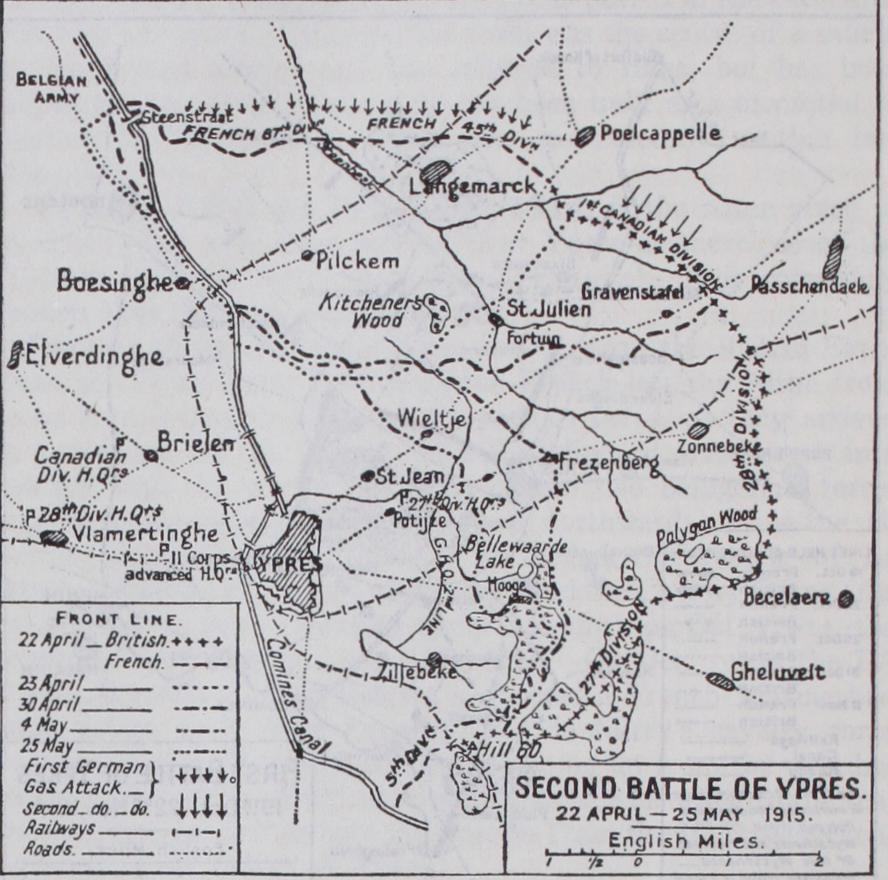
The Allied line from the Comines canal northward was held by part of the 5th Division (Morland), as far as Hill 6o; the 27th Division (Snow) ; the 28th Division (Bulfin) ; and the 1st Cana dian Division (Alderson). The last three formed the II. Corps
(Plumer) of the II. Army (Smith-Dorrien). The 27th and 28th Divisions had been formed of troops from Indian and overseas garrisons, but, having suffered heavily from the winter conditions in Flanders, contained in April a considerable proportion of par tially trained reinforcements. The Canadian Division had reached England in Oct. 1914, and had embarked for France in Feb. 1915. After being in the line at Neuve Chapelle, it had, between April 15 and 17, relieved French troops covering Ypres. The front de fences taken over by the II. Corps were poor, but there was a well-developed back line known as "the G.H.Q. Line." The left of the Canadians extended as far as the Ypres—St. Julien—Poel cappelle road, beyond which were two French divisions under Gen. Putz : the 45th Division, which had arrived on April 16, con taining nine newly raised Zouave battalions and three battalions of African natives, these latter being in the line; and the 87th Territorial Division, a division of elderly reservists.
The First Gas Attack.—On April 22, after an afternoon of comparative quiet, suddenly at 5 P.M. a yellowish cloud—now known to have proceeded from chlorine gas released from cylin ders in the trenches—was seen to form on the German front opposite the African troops and French Territorials. It blew slowly towards them, whilst the German artillery opened with every kind of gun, firing on the French troops with shrapnel and bombarding all the villages in the salient and the town of Ypres with high-explosive shell. The French infantry in the line fled beyond the canal, leaving their artillery to be captured, abandon ing a large area of ground and entirely exposing the British left flank (see map). Fortunately for the Allies, the enemy had begun his attack so late in the afternoon that in the dusk he did not discover his immense success. Content with having se cured Pilckem ridge and establishing outposts beyond it, about 7.3o P.M., according to plan, as it is asserted, but more probably in consequence of the stout defence put up by various small Canadian detachments, the Germans ceased any attempt to push into the gap, except at Steenstraat.