Khyber Pass
kabul, road, british, war, afghan, river and plains
KHYBER PASS, the most important of the passes which lead from Afghanistan into India, and is now threaded by road and rail. It is a narrow defile winding between cliffs of shale and limestone 600 to 1,000 ft. high, stretching up to more lofty moun tains behind. No other pass in the world has possessed such strategic importance or retains so many historic associations as this gateway to the plains of India. Owing to its difficulty and the intractability of the tribes on the route, it has not been so much used before modern times as has been generally supposed. The great invasions of India, either came via what is now British Baluchistan on Multan, or else if coming via Kabul turned aside somewhere below Jalalabad to travel the easier routes north of the Kabul river. The mountain barrier which separates the Pesha war plains from the Afghan highlands differs in many respects from the mountain barrier which intervenes between the Indus plains and the plateau farther south. To the south this barrier consists of a series of flexures folded parallel to the river, through which the plateau drainage breaks down in transverse lines forming gorges and clefts as it cuts through successive ridges. West of Peshawar the strike of the mountain systems is roughly from west to east, and this formation is maintained with more or less regularity as far south as the Tochi river and Waziristan. Almost immediately west of Peshawar, and stretching along the same parallel of lati tude from the meridian of Kabul to within ten miles of the Pesha war cantonment, is the great central range of the Safed Koh, which forms throughout its long, straight line of rugged peaks the southern wall, or water-divide, of the Kabul river basin.
Pursuing the main road from Peshawar to Kabul, the fort of Jamrud, which commands the British end of the Khyber Pass, lies some II m. W. of Peshawar. The road leads through a barren stony plain and some three miles beyond Jamrud, enters the mountains at an opening called Shadi Bagiar, where the Khyber proper begins. The highway runs for a short distance through the bed of a ravine, and then ascends on the left-hand side to a pla teau called Shagai. From here can be seen the fort of Ali Masjid, which commands the centre of the pass, and which has been the scene of more than one famous siege. Still going westward the
road turns to the right, and by an easy zigzag descends to the river of Ali Masjid, and runs along its bank. The new road along this cliff was made by the British during the second Afghan War (1879-8o), and converted during and after the third Afghan War (1920) to a double motor road. This is the narrowest part of the Khyber, not more than 15 ft. broad, with the Rhotas hill on the right fully 2,000 ft. overhead. Some three miles farther on the valley widens, and on either side lie the hamlets and some sixty towers of the Zakka Khel Afridis. Then comes the Loargi Shin wari plateau, some seven miles in length and three in its widest part, ending at Landi Kotal, where is another British fort, which closes this end of the Khyber and overlooks the plains of Afghan istan. The broad gauge railway from Peshawar to Jamrud has now been extended to Landi Kotal, and half-trains can climb to that place, where since the third Afghan War a British brigade is cantoned in the uplands. After leaving Landi Kotal the great Kabul highway passes between low hills, until it debouches on the Kabul river and leads to Dakka. The road has been greatly im proved and motors and light lorries run through to Kabul.
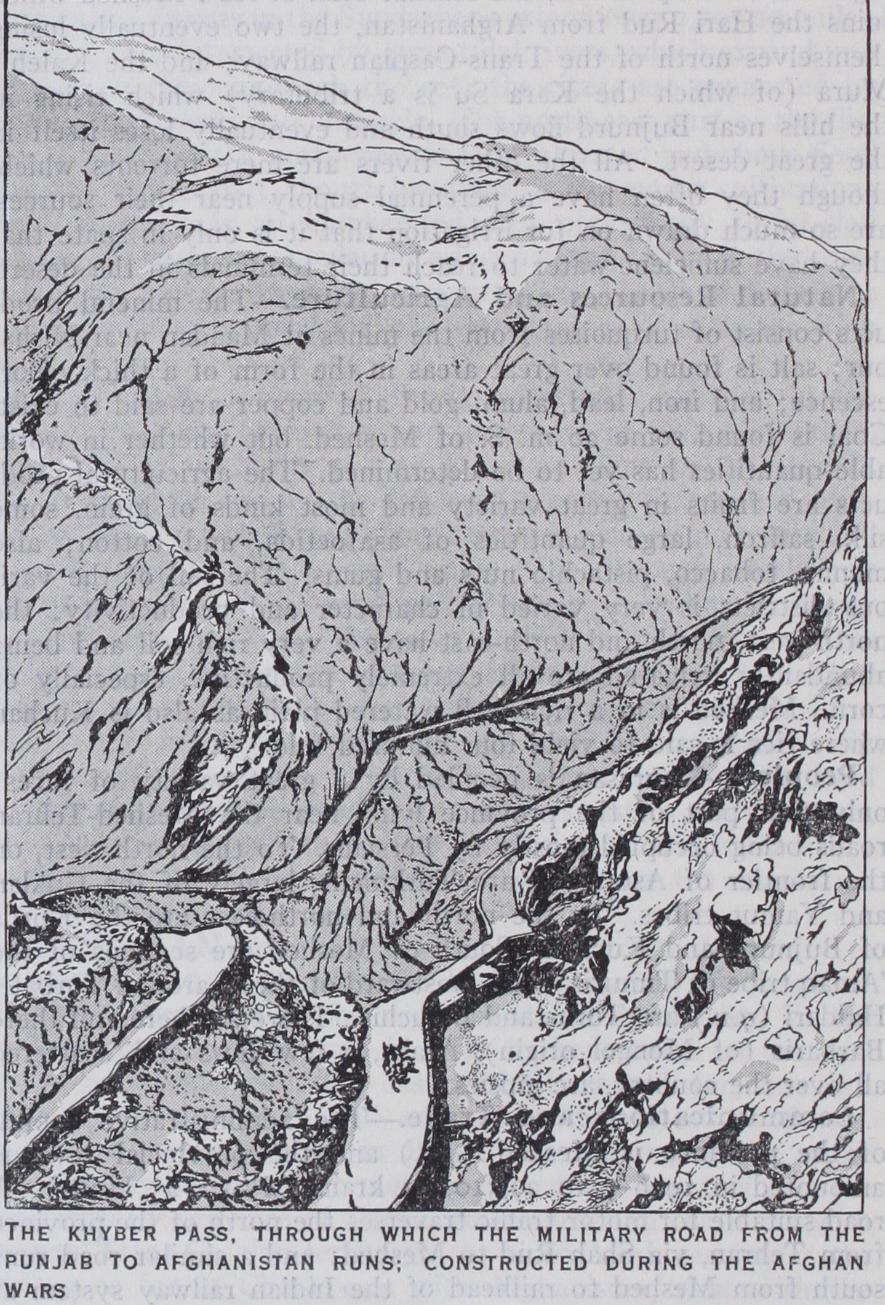
The Khyber Pass has been adopted by the British Govern ment as the main road to Kabul, but the old road to India left the Kabul river near its junction with the Kunar, crossed the great divide between the Kunar valley and Bajour, and turned south wards to the plains. During the first Afghan War the Khyber was the scene of many skirmishes with the Afridis and some disasters to the British troops. It was at the fortress of Ali Masjid that Sir Neville Chamberlain's friendly mission to the amir Shere Ali was stopped in 1878, thus causing the second Afghan War; and on the outbreak of that war Ali Masjid was captured by Sir Samuel Browne. The treaty which closed the war in May 1879 left the Khyber tribes under British control. In 1897 the Afridis seized the pass, on the withdrawal of the British officers, and held it for some months. This was the chief cause of the Tirah expedition of 1897.
See Sir Robert Warburton, Eighteen Years in the Khyber (190o) ; Sir T. Holdich, Indian Borderland (19oi) Tate, The Kingdom of Afghanistan (Bombay, 1911).