Korea
japanese, japan, korean, seoul, ports, foreign and courts
Many varieties of admirable paper, thin and poor silk, horse hair crinoline for hats, fine split bamboo blinds, hats and mats, coarse pottery, hemp cloth for mourners, brass bowls and grass cloth are the main side-industries. Paper and ginseng are the only manufactured articles on the list of Korean exports.
Commerce.
A commercial treaty was concluded with Japan in 1876, and treaties with the European countries and the United States of America were concluded subsequently. An imperial edict of the 20th of May 1904 annulled all Korean treaties with Russia. After the opening of certain Korean ports to foreign trade, the customs were piaced under the management of European com missioners nominated by Sir Robert Hart from Peking. The ports and other towns open are Seoul, Chemulpo, Fusan, Wonsan, Chin-nampo, Mokpo, Kun-san, Ma-san-po, Song-chin, Wiju, Yong-ampo, and Phyong-yang. The value of foreign trade fluctu ates considerably; in 1926 imports were L37,216,978 and exports £36,295,480. The principal imports are cotton goods, railway materials, mining supplies and metals, tobacco, kerosene, timber and clothing. Japanese cotton yarns are imported to be woven into a strong cloth on Korean hand-looms. Beans and peas, rice, cowhides and ginseng are the chief exports, apart from gold.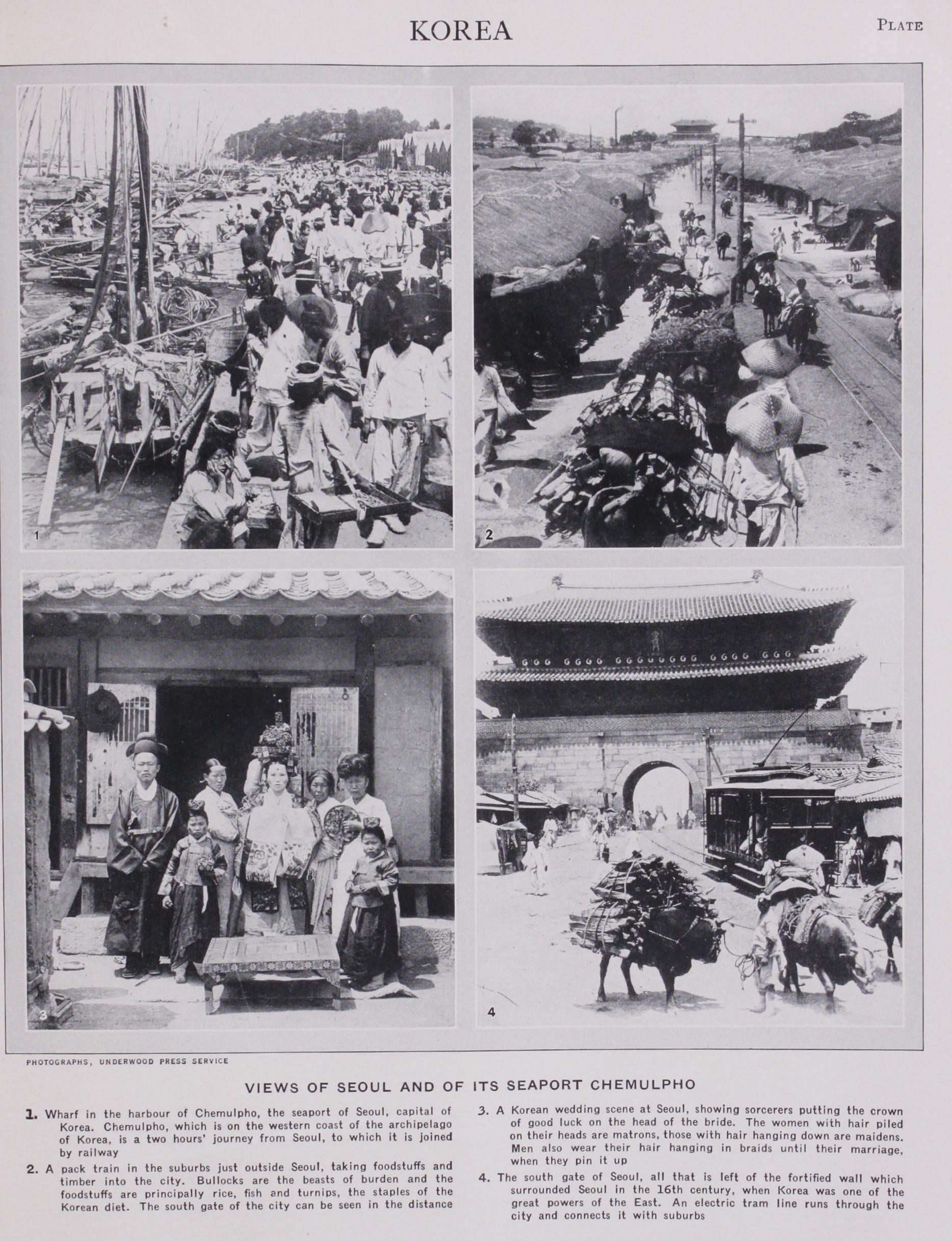
Communications.
Roads continue to improve in Korea and in 1927 there were nearly ir,000 miles of completed roads. In the same year the total length of railways had reached 1,821 m. and there were 21,503 m. of telegraph lines. Transport in the interior is largely by porters, pack-horses, oxen, river, motor-vehicles and rail. Bridges are made of posts, carrying a framework either cov ered with timber or with pine branches and earth. The larger rivers are unbridged, but there are numerous government ferries.
A postal system, established in 1894-1895, has been gradually extended. The Japanese, under the agreement of 1905, took over the postal, telegraphic and telephone services. Korea is connected with the Chinese and Japanese telegraph systems by a Japanese line from Chemulpo via Seoul to Fusan, and by a line acquired by the empire between Seoul and Wiju. The state has also lines from Seoul to the open ports, etc. Korea has regular steam communica tion with ports in Japan, the Gulf of Pechili, Shanghai, etc. Her
own mercantile marine is considerable. The shipping entered in 1926 at the open ports represented a tonnage of 5,801,322, that cleared of 5,550,152.
From 1895, when China renounced her claims to suzerainty, to 1910 the king (since 1897 emperor) was in theory an inde pendent sovereign, Japan in 1904 guaranteeing the welfare and dignity of the imperial house. Under a treaty signed at Seoul on Nov. 17, 1905, Japan directed the external relations of Korea, and Japanese diplomatic and consular representatives took charge of Korean subjects and interests in foreign countries. Japan undertook the maintenance of existing treaties between Korea and foreign powers ; and Korea agreed that her future foreign treaties should be concluded through the medium of Japan. A resident-general represented Japan at Seoul, to direct diplomatic affairs, the first being the Marquis Ito. Under a further con vention of July the resident-general's powers were enor mously increased. In administrative reforms the Korean govern ment followed his guidance. By a treaty dated August 22nd 1910, which came into effect seven days later, the emperor of Korea made "complete and permanent cession to the emperor of Japan of all rights of sovereignty over the whole of Korea." The entire direction of the administration was then taken over by the Japanese resident-general, who was given the title of governor general.