Windows and Doors
sashes, window, hung, sash, weights, styles and lights
WINDOWS AND DOORS Windows.—The parts of a window sash are distinguished by the same terms as are applied to similar portions of ordinary framing, and are formed of rails and styles, with sash bars rebated for glazing. The upright sides are styles; the horizontal ones, which are tenoned into the styles, are rails (fig. 7).
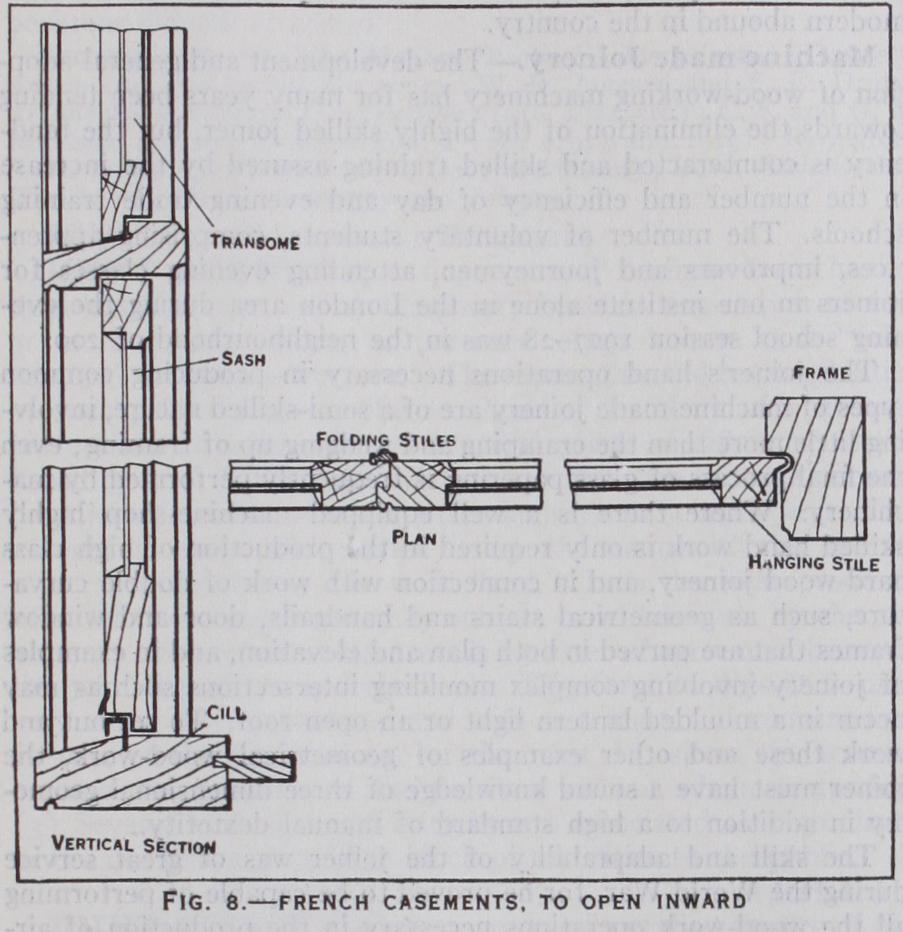
Sashes hung by one of their vertical edges are called casements. They are really a kind of glazed door and sometimes indeed are used as such, as for example French casements (fig. 8). They may be made to open either outwards or inwards. It is very difficult with the latter to form perfectly water-tight joints; with those opening outwards the trouble does not exist to so great an extent. Yorkshire sliding sashes move in a horizontal direction upon grooved runners with the meeting styles vertical. They are little used, and are apt to admit draughts and wet unless efficient checks are worked upon the sashes and frames.
Lights in a position difficult of access are often hung on centre pivots; metal pivots are fixed to the frame and the sockets in which these pivots work are screwed to the sash. Movement is effected by means of a cord fixed so that a slight pull opens or closes the window to the desired extent, and the cord is then held by being tied to, or twisted round, a small metal button or clip, or a geared fanlight opener may be used. For the side sashes of lantern lights and for stables and factories this form of window is in general use.
In the British Isles and in America a common form of window is the cased frame with double hung sliding sashes. This style has many advantages. It is efficient in excluding wet and draughts, ventilation may be easily regulated and the sashes can be lowered and raised with ease without interference with any blinds, curtains or other fittings, that may be applied to the windows. In the ordinary window of this style, however, difficulty is experienced in cleaning the external glass without assuming a dangerous posi tion on the sill, but there are many excellent inventions now on the market which obviate this difficulty by allowing—usually on the removal of a small thumb-screw—the reversal of the sash on a pivot or hinge. For a small extra cost these arrangements may be provided; they will be greatly appreciated by those who clean the windows. The cased frames are in the form of boxes to enclose the iron or lead weights which balance the sashes (fig. 7), and con
sist of a pulley style—which takes the wear of the sashes and is often of hard wood on this account—an inside lining, and an out side lining; these three members are continued to form the head of the frame. The sashes are connected with the weights by flax lines or chains of special make working over metal pulleys fixed in the pulley styles. Access to the weights for the purpose of fitting new cords is obtained by removing the pocket piece. A thin back lining is provided to the sides only and is not required in the head. The sill is of oak weathered to throw off the water. A parting bead separates the sashes, and the inside bead keeps them in position. A parting slip hung from the head inside the cased frame sepa rates the balancing weights and ensures their smooth working.
The inside lining is usually grooved to take the elbow and soffit linings, and the window board is fitted into a groove formed in the sill. The example shown in fig. 7 has an extra deep bottom rail and bead; this enables the lower sash to be raised so as to permit of ventilation between the meeting rails without causing a draught at the bottom of the sash. This is a considerable improvement upon the ordinary form, and the cost of construct ing the sashes in this manner is scarcely greater.
Bay windows with cased frames and double hung sashes often require the exercise of considerable ingenuity in their construction in order that the mullions shall be so small as not to intercept more light than necessary; at the same time the sashes must work easily and the whole framing be stable and strong. The sills should be mitred and tongued at the angles and secured by a hand-rail bolt. Frequently it is not desired to hang all the sashes of a bay window, the side lights being fixed. To enable smaller angle mullions to be obtained, the cords of the front windows may be taken by means of pulleys over the heads of the side lights and attached to counter-balance weights working in casings at the junction of the window with the wall. This enables solid angle mullions to be employed. If all the lights are required to be hung the difficulty may be surmounted by hanging two sashes to one weight. Lead weights take up less space than iron, and are used for heavy sashes.