La Paz
city, lake, line, ft, government, titicaca and railway
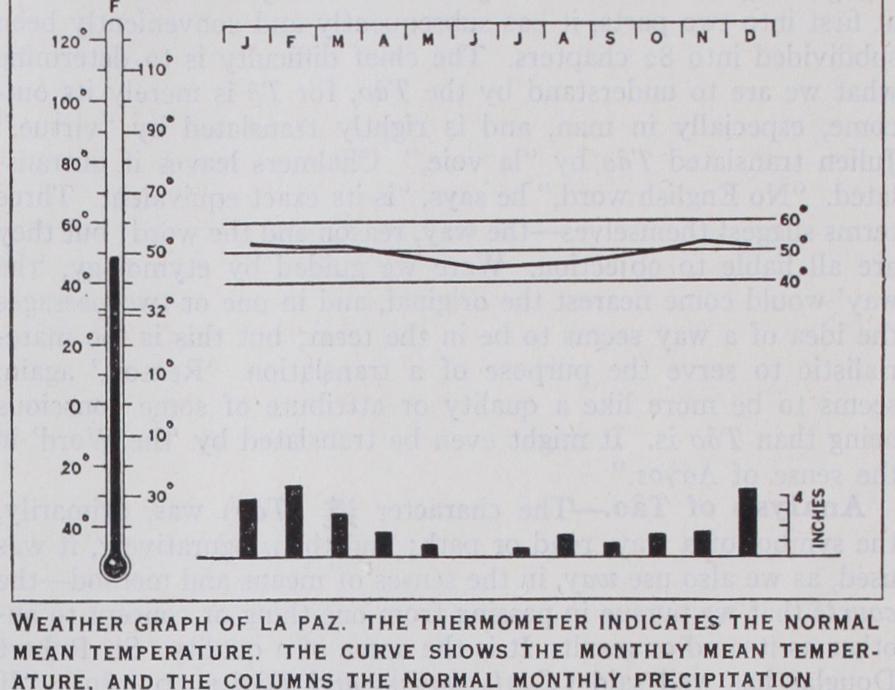
LA PAZ (officially La Paz de Ayacucho), the de facto capital of Bolivia since 1898, the see of a bishopric created in 1605 and capital of the department of La Paz, 42 m. S.E. of Lake Titicaca in 16° 3o' S., 68° W. Pop. (1932 estimate) 150.165. The city is built in the deeply-eroded valley of the La Paz river which, a few miles below, cuts its way eastward through the Cordillera Real to join the Beni. The valley is about io m. long and 3 m. wide. Its precipitous sides, deeply Bullied by torrential rains and diversely coloured by mineral matter, rise 1,500 ft. above the city to the margin of the great plateau surrounding Lake Titicaca, and above these, on the east are the snow-capped summits of Illimani and other giants of the Cordillera. The elevation of La Paz is 11,800 ft. above sea-level, which places it within the plena climatic region, in which the temperatures are low throughout the year. Pneumonia and bronchial complaints are common, but consumption is rare. The valley's surface is very uneven, and the city's transverse streets are steep and irregular. Near the centre of the city is the Prado, a handsome public promenade with parallel rows of exotic trees, shrubs and flowers, which are maintained with no small effort in so inhospitable a climate. The trees which thrive best are the willow and eucalyptus. The older streets are narrow and roughly paved; a great many of the newer ones are spacious avenues. There are numerous bridges across the river. The dwellings of the poorer classes are commonly built with adobe walls and covered with tiles, but stone and brick are used for the better structures. The cathedral, which was begun in the i 7th cen tury when the mines of Potosi were at the height of their produc tiveness, is still unfinished. It faces the Plaza Mayor and is dis tinguished for the fine stonework of its facade. Facing the same plaza are the Government offices and legislative chambers. Other notable edifices and institutions are the old university of San Andres, the San Francisco church, a national college, a seminary, a public library and a museum rich in relics of the Inca and pre Inca periods.
La Paz, important commercially, has three railway connections with the coast. A Peruvian line runs from Mollendo to Puno (via Arequipa), and a Bolivian extension, from Huaqui to the Alto de La Paz (Heights of La Paz), the two lines being connected by a steamship service across Lake Titicaca. An electric railway 5 m. long extends from the Alto de La Paz to the city, 1,5oo ft. below. This route is 528 m. long, and is expensive because of the elevations crossed, the trans-shipments at the lake, and the cost of handling cargo at Mollendo. A second railway 719 m. long connects La Paz with the port of Antofagasta in Chile, its steam locomotives descending into the city itself. The newest and shortest line is that constructed by the Chilean Government from Arica to Viacha, which affords La Paz an outlet to the sea, 273 m. in length. Two railways connect La Paz also with the interior of the country, the branch of the Bolivia-Antofagasta line which runs from Oruro to Cochabamba, and the recently built line from La Paz to the Yungas, on the eastern slope of Illimani. The vicinity of La Paz abounds in mineral wealth; most important are the tin deposits of Huayna-Potosi, Milluni and Quimza Cruz. The La Paz valley is auriferous and since long before the founda tion of the city gold has been taken from the gravel washed down from the mountain sides.
La Paz was founded in 1548 by Alonzo de Mendoza on the site of an Indian village called Chuquiapu (Heritage of Gold) and was called the Pueblo Nuevo de Nuestra Senora de la Paz in com memoration of the reconciliation between Pizarro and Almagro, and soon became an important colony. At the close of the war of independence (1825) it was rechristened La Paz de Ayacucho, in honour of the last decisive battle of that protracted struggle. It was made one of the four capitals of the republic, but the revolu tion of 1898 permanently established the seat of government here because of its accessibility, wealth, trade and political influence.
(G. M. McB.)