Labour Turnover
period, employees, rate, labor, employers, review, handling and association
LABOUR TURNOVER. Students of labour turnover differ as to its definition. A committee on management terminology of the American Management Association has defined it as "(I) The extent of shift and replacement of labour occurring in the mainte nance of the working force. (2) The condition involved in the hiring, loss and replacement of labour." In the United States the attention of employers was first called to the importance of labour turnover when Magnus Alexander, of the General Electric Company, and W. H. Grieves, of the Jeffrey Manufacturing Company, made estimates of its cost to industry in 1912 and 1913. With the increase in the number of centralized employment and personnel departments, the organi zation of a national association of employment managers a few years later, and the need for war-time economies in the handling of labour, labour turnover came to be regarded as a serious prob lem. Various authorities have figured the average cost of replac ing an employee to be from $5 to $5oo; in the case of execu tives and supervisory officials it is often much higher. Its amount depends upon the method of estimating costs which is followed and such factors as: The industry and occupation considered, and the degree of skill which newly hired employees bring to the jobs in which they are placed. In making such estimates the principal items considered as costs to the employer are the cost of hiring; training; extra labour, power, lubrication and materials caused by reduced rate of output ; loss of profits due to impossibility of filling orders because of smaller productive capacity during the breaking in period and the vacancy which preceded it; interest, depreciation, insurance, taxes and repairs on additional plant investment necessary because of the lessened output caused by turnover; spoiled work by new operatives in excess of the normal rate of experienced workmen; greater wear and tear on machinery; increased cost of accidents due to their greater frequency during the learning period ; the loss of business and good will caused by the greater number of mistakes and less satisfactory service rendered by inexperienced employees; and the limitation placed by turnover upon the training which can profitably be given workmen. These estimates do not, of course, take into account the cost of turnover to employees ; neither are they strictly accurate because they include so many intangible items of cost which can only roughly be estimated. Their chief value is that they have made employers realize the importance of turnover control.
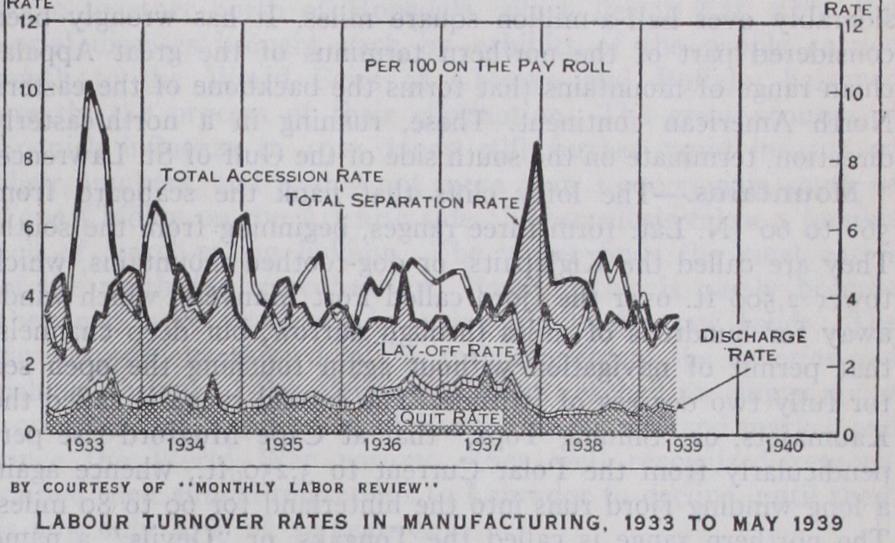
The standard formulae for computing labour turnover in the United States are when T = turnover rate, S = separations, R = replacements, F = force report (the average number actually working during the period), and P = average number on payroll. The United States Bureau of Labor Statistics has published monthly turnover figures for years in the Monthly Labor Review. They are gathered from a selected, representative body of employers. Much of their turnover data is published by industries, such as the automobile, meat pack ing, and sawmilling industries. In the Review for July 1937, is a summary for the period 1930-36. These figures, since they apply to a serious depression period, show a lower quit rate and a higher lay off rate than would obtain in a period of prosperity or over a long period of years. The accompanying chart, from the Monthly Labor Review, Aug. 1939, shows the trend of separations, classi fied by types, from 1933 to 1939.
In the main all activities in the general classification of person nel work are directed at labour turnover. Some of these activities seek to improve health, others to promote safety or to encourage thrift. Whatever the direct objective of the plan, its ultimate goal is to stabilize the working force. To control labour turnover it is essential that all directly responsible for handling labour have a good understanding of human nature, of the various jobs, and of the proper adjustment between employees and their jobs. Fre quently, the causes of labour turnover are studied and such cor rective measures as seem practicable are adopted. A common method of learning these causes is by interviewing all employees at the time of leaving. Grievances and misunderstandings are fre quently brought to light and the reputation of the company for fair dealing is maintained. Because business conditions affect the supply of and demand for labour, turnover has both cyclical and seasonal fluctuations. Employers are able to take account of such economic influences on turnover by comparing their experience with national, State, local and industrial indexes when such are available.
See M. Alexander, Hiring and Firing—Its Economic Waste and How to Avoid It (address at convention of National Association of Manu facturers, 1915) ; W. H. Grieves, The Handling of Men (address before Detroit Executives Club, 1914) ; S. H. Slichter, The Turnover of Fac tory Labor (i919). (L. R. M.; X.) LABOUR UNIONS: see TRADE UNIONS.