Labyrinth
egyptian, centre, near, maze, word, chambers, planted and ancient
LABYRINTH, the name given by the Greeks and Romans to buildings, entirely or partly subterranean, containing a number of chambers and intricate passages, which rendered egress difficult. The word is considered by some to be of Egyptian origin, others connect it with the Gr. Xctiva, the passage of a mine or with Xcia3pvs, a Lydian or Carian word meaning a "double-edged axe" (Journal of Hellenic Studies, mid. 109, 268).
Pliny (Nat. Hist. xxxvi. 19, 91) mentions the following as the four famous labyrinths of antiquity.
I. The Egyptian, of which a description is given by Herod otus (ii. 148) and Strabo (xvii. 811). It was situated to the east of Lake Moeris, opposite the ancient site of Arsinoe or Croco dilopolis. According to Egyptologists, the word means "the temple at the entrance of the lake." According to Herodotus, the entire building, surrounded by a single wall, contained twelve courts and 3,00o chambers, 1,500 above and ',5o° below ground. The roofs were wholly of stone, and the walls covered with sculpture. On one side stood a pyramid 4o orgyiae, or about 243 ft. high. Herod otus himself went through the upper chambers, but was not per mitted to visit those underground, which he was told contained the tombs of the kings who had built the labyrinth, and of the sacred crocodiles. Other ancient authorities considered that it was built as a place of meeting for the Egyptian nomes or political divisions ; but it is more likely that it was intended for sepulchral purposes. It was the work of Amenemhe III., of the 12th dynasty, who lived about 2300 B.C. It was first located by the Egyptologist Lepsius to the north of Hawara in the Fayum, and (in 1888) Flinders Petrie discovered its foundation, the extent of which is about i,000ft. long by 800ft. wide. (See W. M. Flinders Petrie, Hawara, Biahmu and Arsinoe, 1889.) 2. The Cretan, said to have been built by Daedalus on the plan of the Egyptian, and famous for its connection with the legend of the Minotaur. It is doubtful whether it ever had any real existence. By the older writers it was placed near Knossos. and it is represented on coins, but nothing corresponding to it has been found during recent excavations, unless the royal palace was intended. Later writers (e.g., Claudian, De sexto Cons. Honorii, 634) place it near Gortyna, but some winding passages and cham bers close to that place are, in reality, ancient quarries.
3. The Lemnian, similar in construction to the Egyptian with 150 columns.
4. The Italian, a highly intricate series of chambers in the lower part of the tomb of Porsena at Clusium. This tomb is said to be recognizable in the mound named Poggio Gajella, near Chiusi.
Lastly, Pliny (xxxvi. 19) applies the word to a rude drawing on the ground or pavement.
During the middle ages a maze or labyrinth was frequently indicated on the floors of French cathedrals, and the names of the architects were often incorporated in its design. That at Amiens (destroyed in the 19th century and now replaced by a copy) contained a verse in which the name of the builders ap peared. In the centre were placed figures of the bishop and the three architects, inlaid in white marble. No satisfactory explana tion of the existence of these mediaeval mazes has yet (1928) been given.
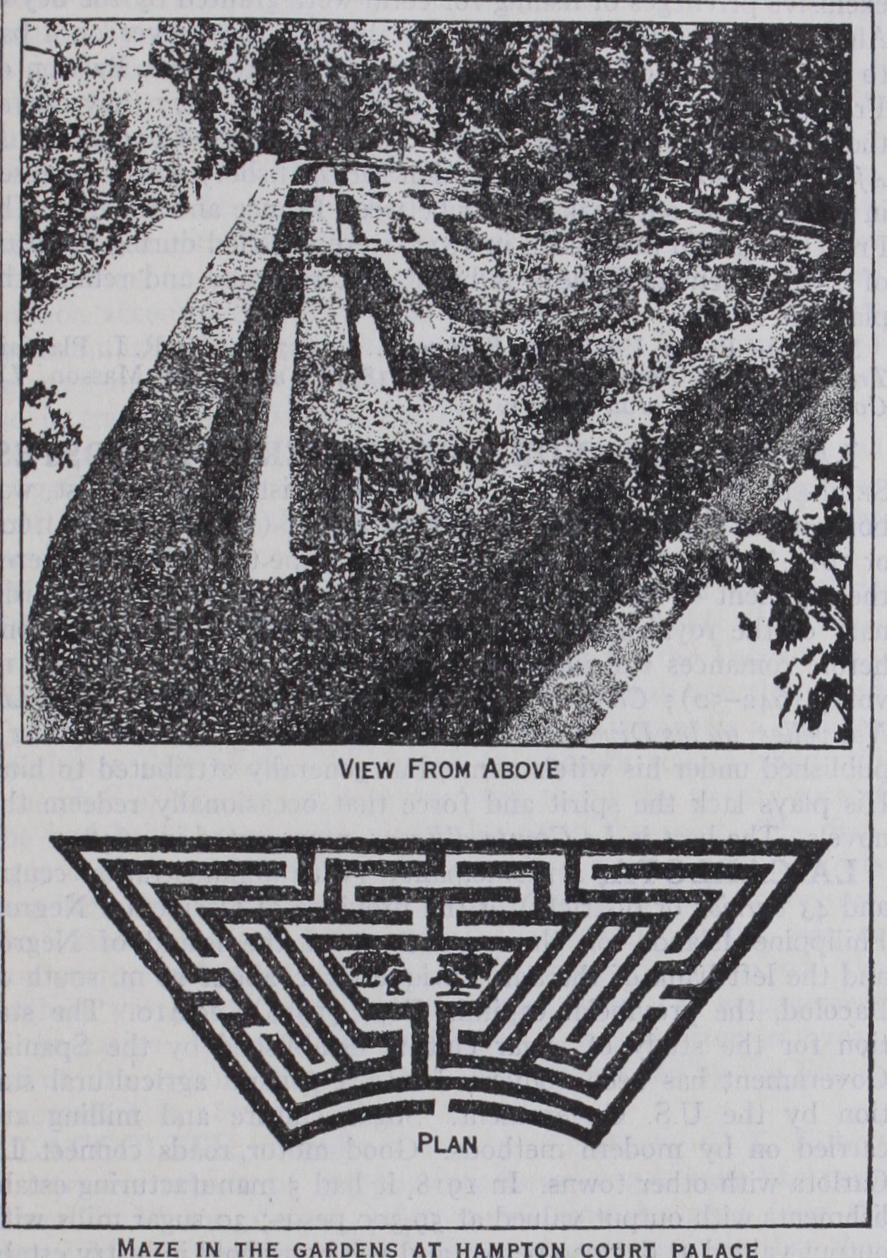
In gardening, a labyrinth or maze means an intricate network of pathways enclosed by hedges or plantations of which it is difficult to find the centre or exit. It is a remnant of the old geometrical style of gardening. The more common kind consists of walks, formerly called alleys kept to an equal width by parallel hedges, which should be too close and thick for the eye readily to penetrate them. The task is to get to the centre, marked in some conspicuous way, then to return; but even those who know the key are apt to be perplexed. Sometimes the design consists of alleys only, such as one published in 1706 by London and Wise. Of a more pretentious character was a design published by Switzer in 1742 showing "six different entrances, whereof there is but one that leads to the centre, and that is attended with some difficulties and a great many stops." The maze in the gardens at Hampton Court Palace which is considered one of the finest examples in England, was planted in the reign of William III. It is constructed on the hedge and alley system, and was, it is believed, planted with hornbeam, replaced by hollies, yews, etc. The key to the centre is to go left on entering, then, on the first two occasions when there is an option, go right, but thereafter go left.
The maze in the gardens at Somerleyton Hall, near Lowestoft was designed by Mr. John Thomas; the yew hedges have been planted about 6o years.
There was a labyrinth at Theobald's park, near Cheshunt, when this place passed from the earl of Salisbury into the possession of James I. An 18th century one is said to have existed at Wim bledon House, the seat of Earl Spencer.
On the Egyptian labyrinth, see A. Wievemann, Agyptische Ge schichte (1884), and his edition of the second book of Herodotus (i8go) ; on the Cretan, C. Hock, Kreta (1823-29), and A. J. Evans in Journal of Hellenic Studies; on the subject generally, articles in Roscher's Lexikon der Mythologie and Daremberg and Saglio's Dic tionnaire des Antiquitis.