Lacrosse
ball, player, game, goal, attacking, players, field, play and played
LACROSSE, the name given by the French settlers of Can ada to the old Indian game of "baggataway" (because the imple ment used, the curved netted stick, resembled a bishop's crozier), is the oldest organized sport in America. It was played by the Six Nations tribes of the Iroquois throughout the territory now known as upper New York State and lower Ontario before Columbus landed at San Salvador in 1492. The Iroquois Confederation adopted the sport as a training measure for war. The extremely brutal pastime underwent some changes as the game was taken up by the French in 174o and the English in 1847. Lacrosse is the national summer sport of Canada and is played by many prepara tory schools, high schools, colleges and clubs in the United States. A modified form of the original American game also flourishes in the British Isles and Australia.
Numerous historians have confused "baggataway" with a game of ball played with two small bats, resembling tennis rackets, and a rawhide ball, by the Cherokees and Choctaws along the Mississippi valley. However, lacrosse has been proved to be strictly of Iroquois origin and is still played by the Mohawks, Senecas, Cayugas, Oneidas, Onondagas and Tuscaroras, on the various Government reservations in the United States and Canada.
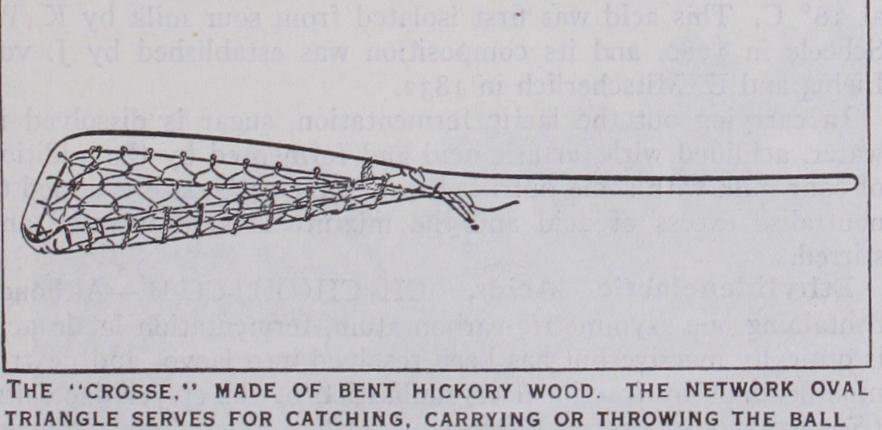
The ball is made of india-rubber sponge, weighs between 4 anti 5 oz. and measures 7/ to 8in. in circumference. The "crosse" is formed of a light staff of hickory wood, the top being bent to form a kind of hook, from the tip of which a thong is drawn and made fast to the shaft about 2ft. from the other end. The oval triangle thus formed is covered with a loose network of gut or raw hide. At no part must the crosse measure more than i2in. in breadth, and no metal must be used in its manufacture. It may be of any length to suit the player. The goals are set up not less than I oo nor more than 13oyd. apart, the goal-posts being 6ft. high and the same distance apart. They are set up in the middle of the "goal-crease," a space 18f t. by i2ft., marked with chalk. A net extends from the top rail and sides of the posts back to a point 6ft. behind the middle of the line between the posts. Boundaries are agreed upon by the captains. Shoes must have india-rubber soles, and no spikes are allowed unless made of rubber.
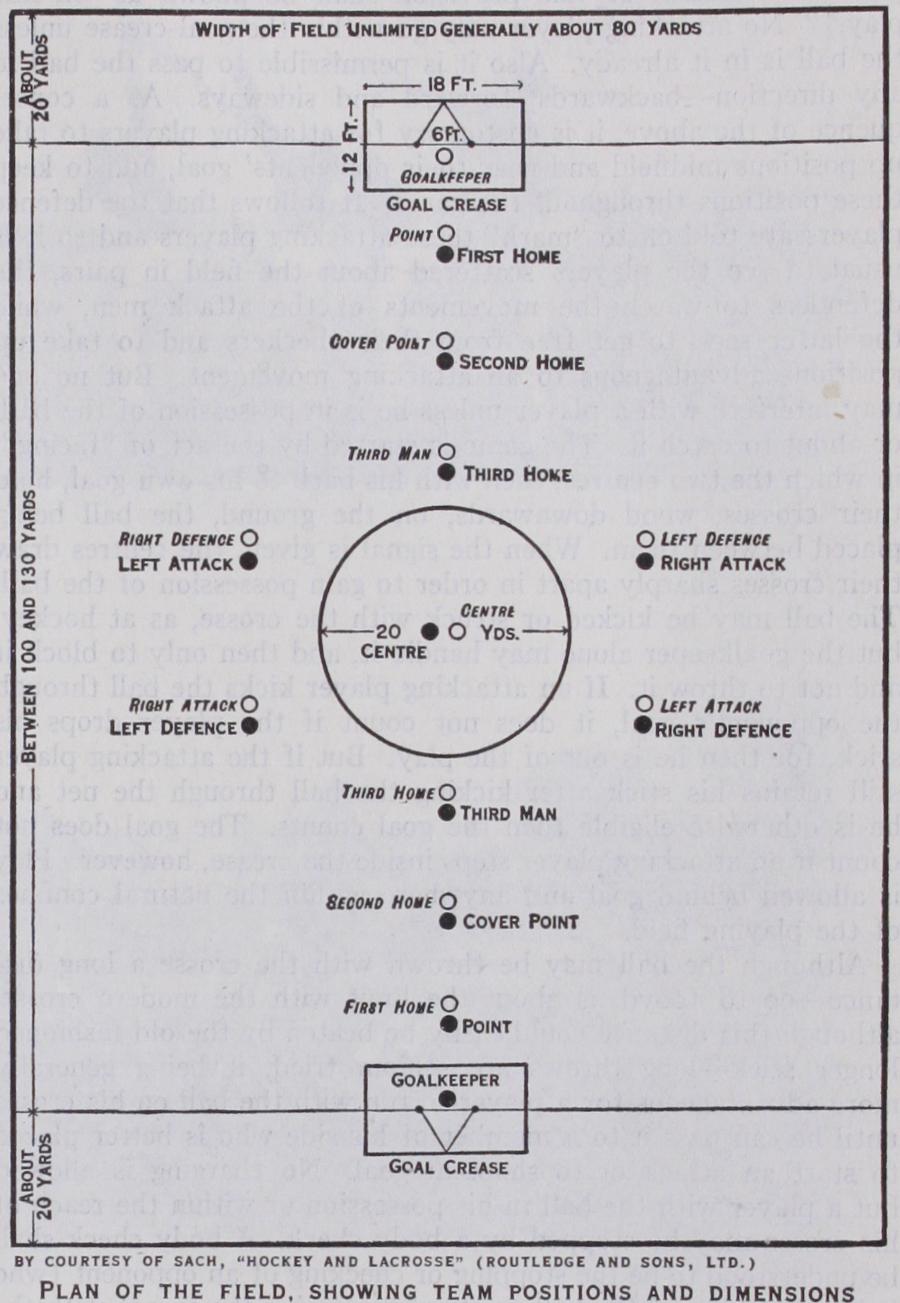
The object of the game is to send the ball, by means of the crosse, through the enemy's goal-posts as many times as possible during the two periods of play, precisely as in football and hockey. There are twelve players on each side. The players are designated as follows : goal-keeper ; point ; cover point ; first, second and third defence; a centre; third, second and first attack; outside home and inside home. The game is divided into two playing halves of
normally 3o min. each with a short rest period between. Under English rules should an accident or injury incapacitate a player, the opposing side must withdraw one of their players, to equalize numbers. But should the injury be due to a foul and the referee suspend the offending player, he shall be withdrawn, as well as another of his team. The game as played in Canada and the United States allows an injured man to be replaced by a re serve player. "At no time during a match shall a team have less than three men on the attack between the centre of the field and the boundary of the field of play behind the opponent's goal. At no time during the match shall a team have less than three men, not counting the goal-keeper, on the defence between the centre of the field and the boundary of the field of play behind its own goal. A violation of this provision shall be known as `off-side play.' " No attacking player may go within the goal-crease unless the ball is in it already. Also it is permissible to pass the ball in any direction—backwards, forward and sideways. As a conse quence of the above, it is customary for attacking players to take up positions midfield and near their opponents' goal, and to keep these positions throughout the game. It follows that the defence players are told off to "mark" these attacking players and so it is usual to see the players scattered about the field in pairs, the defenders to watch the movements of the attack men, while the latter seek to get free from their checkers and to take up positions advantageous to an attacking movement. But no one may interfere with a player unless he is in possession of the ball, or about to catch it. The game is started by the act of "facing," in which the two centres, each with his back to his own goal, hold their crosses, wood downwards, on the ground, the ball being placed between them. When the signal is given, the centres draw their crosses sharply apart in order to gain possession of the ball. The ball may be kicked or struck with the crosse, as at hockey, but the goalkeeper alone may handle it, and then only to block it and not to throw it. If an attacking player kicks the ball through the opponent's goal, it does not count if the player drops his stick, for then he is out of the play. But if the attacking player still retains his stick after kicking the ball through the net and he is otherwise eligible then the goal counts. The goal does not count if an attacking player steps inside the crease, however. Play is allowed behind goal and anywhere within the natural confines of the playing field.