Lamaism
century, translation, doctrine, buddhism, mahayana and king
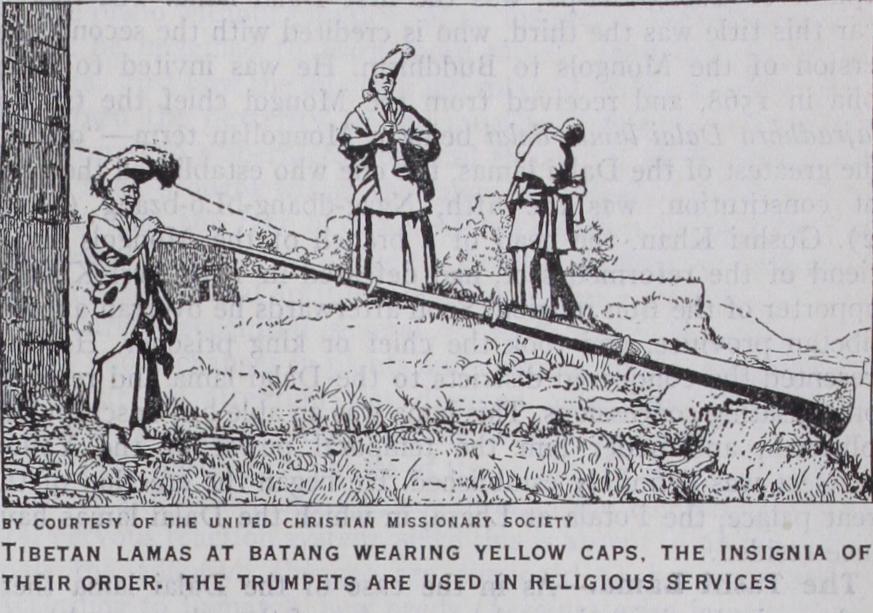
LAMAISM, the modified form which BUDDHISM (q.v.) has assumed among the peoples of Tibet and Mongolia. The name is derived from the Tibetan lama (bla-ma), properly a title of the monks in the higher ranks of the hierarchy. It owes its peculiar character not to any fundamental change of doctrine, but chiefly to political causes. The monastic Order has developed a hier archic organization, and the head of the Order has acquired tem poral sovereignty. There is also little doubt that the prominent position which magic and divination hold is due to the influence of the native Tibetan religion known as Bon, but these practices were well enough established in Mahayana Buddhism to form a natural breeding ground for the native superstitions (see MAHAY ANA). The stages in this development are the official introduction of Buddhism into Tibet in the 7th century A.D., its reintroduction in the loth, the reformation under Tsong-kha-pa in the 14th century and the acquisition of temporal power.
King Srong-tsan Gam-po, a strong ruler who had carried on successful wars with China, married a daughter of the ruler of Nepal and also a daughter of the Chinese emperor. Both of them were Buddhists, and their influence on the king led to the intro duction of some of the scriptures and to the erection of two mon asteries. About 632 his minister Thon-mi Sambhota was sent to India to acquire sacred books, and to him is attributed the invention of the Tibetan alphabet (see TIBETAN LANGUAGE) and the translation of some Buddhist works. In the next century under king Khri-srong-lde-btsans the teacher Padma Sambhava was invited from Udyana in North-west India. His doctrine was much infected with magic and Hindu practices, and his followers still exist as the Red Hat sect. At this time the systematic translation of the sacred texts was undertaken, but it was not completed till much later.
Of this period, termed "the first introduction of the doctrine," little is known. It was brought to an end by the opposition of the
native Bon religion. King Lang-dar-ma in the loth century perse cuted and almost expelled Buddhism, till he was assassinated by a monk. Two important consequences followed : Buddhism was reintroduced, and, as there was no longer a strong central rule, the country fell into the power of a number of practically indepen dent chiefs. This anarchy occasioned the beginning of the acqui sition of temporal power by the monasteries in self-defence.
The second introduction of the doctrine was chiefly carried through in the i ith century by the patriarch Atga and his follow ers. He had been invited from Magadha, and under him the work of translation was resumed. His doctrine was to some extent a reform of the earlier teaching, and was based on the Madhyamika school of Mahayana. Among the various sects which arose at this time one of the most important in political influence was that of the Sa-kya (Saskya) monastery. In this sect a kind of marriage was allowed, and the headship passed from father to son. The leaders of this sect sought in the 13th century to strengthen their position by alliances with the Mongols, especially Kublai Khan (q.v.), then emperor of China.
By the beginning of the 14th century the translation of the scriptures was completed and revised. It is known as the Kanjur (bKah-hgyur), "translation of precepts," and consists of io8 volumes divided into (I) Vinaya (discipline), (2) Sher-chin (sutras teaching the Mahayana doctrine of the void), (3-5) three other collections of Mahayana sutras, Buddhavatamsaka, Ratna kfita, and mDo or sutra proper, (6) Nirvana (on the death of Buddha), (7) Tantra (charms and magic). A second collection, the Tanjur (bsTan-hgyur), "translation of commentaries," con tains besides sutras and charms many commentaries, grammars and other secular works.