Latvia
riga, timber, ventspils, liepaja, trade and russia
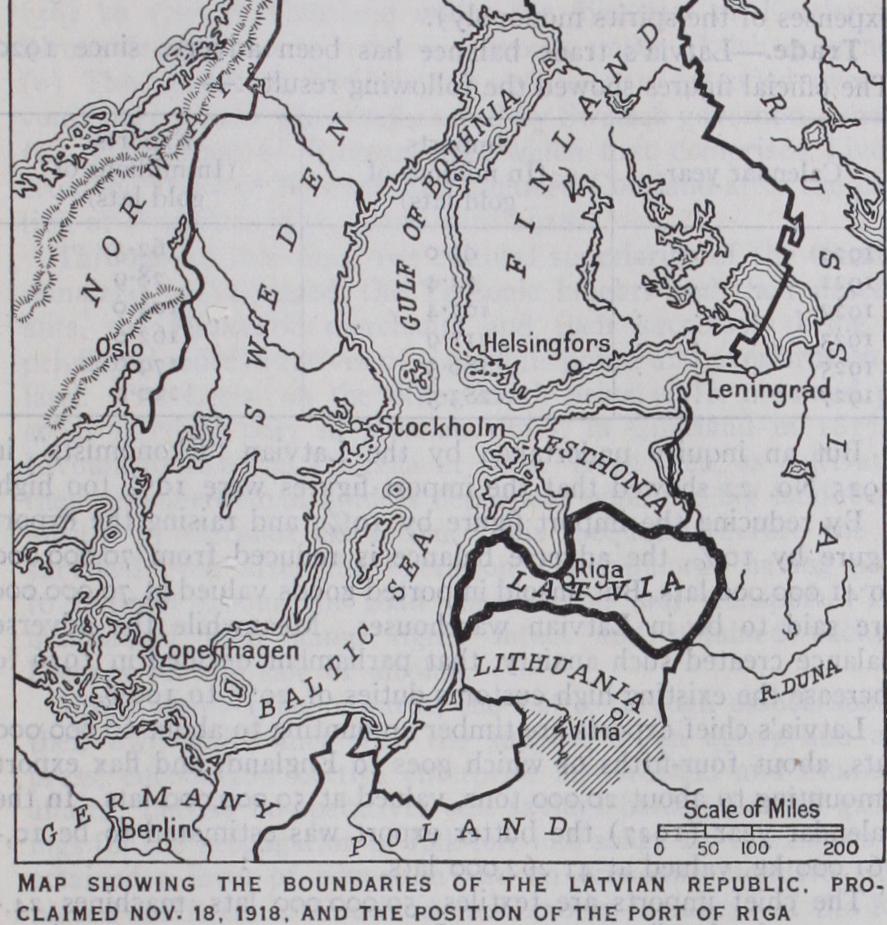
LATVIA, an independent European republic, lying east and south of the Gulf of Riga, bounded N. by Estonia, E. by Russia, S. by Lithuania and Poland, and W. by the Baltic Sea. Area 25,390 sq.m. Pop. (1935) 1,950,000, of whom about 77% are Letts, 11.9% Russians, 4.5% Jews, 2.9% Germans, and 2.2% Poles. The coast line extends for 338 m., and has three important harbours, Riga, the capital, Liepaja, and Ventspils. Transit trade with Russia goes by rail from Riga to Stalingrad, from Ventspils to Moscow and from Liepaja to Romni, and also by waterways.
The surface is low-lying, with a small patch of higher land lying west of the Mitau plain, and with a wide extension of the Russian plateau in the east, but no part is over I ,000 ft. above sea-level. The republic lies in a morainic region, with boulder clays, marshes, numerous lakes and much evidence of glacial striation.
The climate is damp and foggy, and the Gulf of Riga is ice bound from December to March, though Liepaja and Ventspils, lying on the open Baltic sea are ice-free all the year round. Spring is cold and dry, and rain falls in July and August ; this is a disad vantage for grain cultivation, and makes stock-raising and poultry keeping more suitable to the country. The chief crops raised are rye, barley, oats and flax. Horses, cattle, sheep and pigs are bred and there is some dairying. Before 1914, Riga was the greatest timber port of the world, fed by the Daugava (Dwina) and its waterways which drew on Russian supplies, a source now much diminished.
Latvia possesses about 5,000,000 acres of forest suitable for exploitation, and one-third of its surface is forest-covered. The trees are chiefly coniferous, though there is some oak, elder and birch. Latvia was devastated during the 1914-1920 war period, and the demand for timber for new farm buildings is at present heavy. The republic has no coal, and in the past much timber was consumed as fuel on the railways and in factories. The State Forestry Department is endeavouring to prevent undue exploita tion, since timber is a valuable export and asset of the country.
Coal is now imported, peat is increasingly used, and a project for an electric station utilizing the waterpower of the Daugava, is being considered. The former paper mills, cellulose and match factories, and wood distilleries were, in the majority of cases, ruined and dismantled during the World War, and timber is mainly exported in the raw, though manufactures are reviving. Timber and flax are the two chief exports of Latvia, and coal, fish, textiles, and metal goods, the chief imports.
In order to encourage transit trade through Latvian ports, the lines converging on Riga and Ventspils from Russia have been altered to the Russian gauge, while those for the Riga-Ostend-Paris line and for internal communications are normal gauge. The rail way net is comparatively good, and there are several macadamized roads. Navigable inland waterways (211 m.) carried over 1,150, oco tons of goods in 1925. In January 1925, 36 steamboats, 52 sailing vessels and motor vessels were sailing under the Latvian flag, and the republic owns 5 ice-breakers. The export trade of Latvia is mainly with the United Kingdom, Belgium and Germany and the import trade with Germany, the United Kingdom, Soviet Russia and Lithuania. The chief towns are Riga, Liepaja (Libau), Daugavpils (Dvinsk), Jelgava (Mitau), Ventspils Mindau), Rezekne and Cesis (Wenden) (qq.v.).
Administration, Education, etc.
There are some 6,000 State officials. Teachers, judges, foresters, railwaymen, the agents and employees of government enterprises and monopolies are paid by the state.
The whole country is divided into 19 administrative districts and 3 prefectures : Riga, Libau, Daugavpils. Extensive autonomy is granted to the towns and parishes. The smallest units of rural self-government are the rural communes, of which there are about 510 in all. Markets are held in 8o towns and villages, 37 of these having town councils.