Lead in Art
garden, vases, found, examples, vase and cast
LEAD IN ART. The uses to which lead has been put, wherein it achieves a definitely artistic value, in the working of which are needed the judgment and perception of the artist as well as the technique of the craftsman, cover a wide field, ranging from purely architectural application, where structural utility is the chief consideration, and the aesthetic value is achieved by the appreciation of the nature and quality of the material for the purpose, and the sympathetic use of appropriate ornament, to its use in a completely decorative sense, for statuary, garden ornaments, fountains, etc.
It is generally assumed that lead, for the latter purpose, is used from motives of economy, as a substitute for a richer and more costly metal, but this is quite erroneous, as a careful study of the leadworker's art will prove. Used as its limitations permit, it has a charm and dignified simplicity that is achieved with no other material. It is not suitable for the grander conception which needs bronze as its expression, and although capable of much refinement and delicacy of treatment, it is of a kind which would not be happily interpreted in stone.
Its durability and resistance to climatic conditions is such that Sir Christopher Wren wrote in 1708, at the age of 76, re garding roofing for spires, lanterns, etc.,—"Lead is certainly the best and lightest covering, and, being of our own growth and manufacture and lasting, if properly laid, for many hundreds of years, is without doubt the most preferable." The use of lead has been apparent from the earliest times. As far back as the 6th century, we know that the Spartans used it for casting their votive figures. It has been used for prac tically all purposes for which it is suitable, since the earliest days c f which we have record. The Romans made considerable use of it, as proved by the lead pigs, and the large amount of worked lead in various forms which has been found in every part of the country, where they had a permanent settlement. Many lead coffins of excellent craftsmanship have been found, those dis covered at Colchester, England, being notable examples; and numbers of cast seals and tokens have been brought to light.
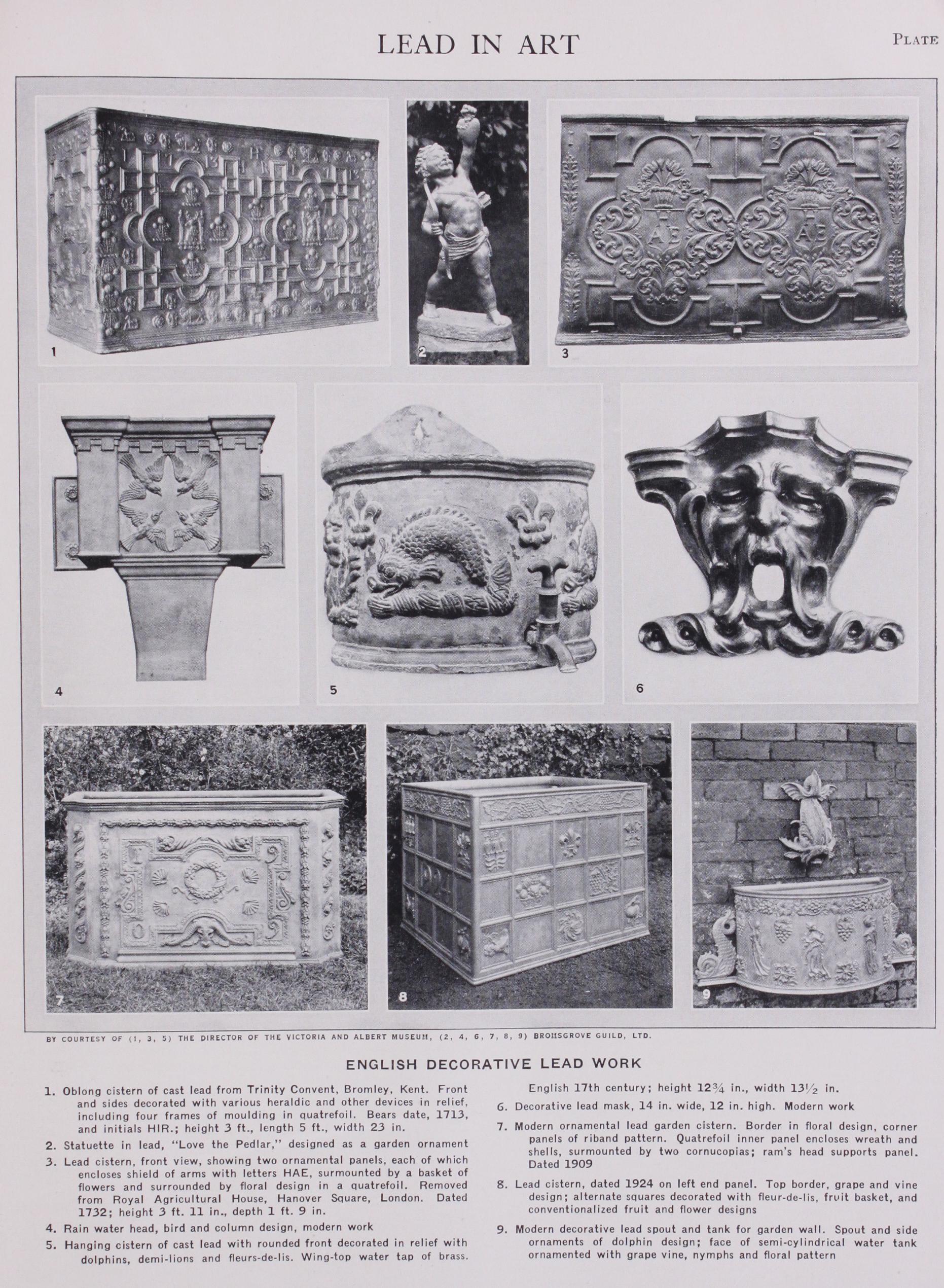
After the Roman occupation in England the use of lead was of an even more extensive nature. Apart from its structural uses, chiefly for roofing, and the supply and conveyance of water, such as tanks and cisterns, ornamental rainwater pipes and pipe heads, etc., we have fine examples of mediaeval fonts cast in lead; in various parts of the country, and pilgrims' signs and tokens were cast in great numbers in the 13th, i4th, and 15th centuries. In many places the custody of the casting moulds was vested in the sacristan; this was the case at Walsingham; other moulds have been found at Lynn, and at Dundrennan is a mould which casts six signs at once, which is an indication of their extensive use. Lead was also used for memorial tablets, but not to a great extent. An inscribed leaden tablet was found near Bath, which is an example of its use in this direction.
The sculptors of the i8th century did a great deal for the architectural side of garden craft, and much good lead-work originated at this period,—cisterns, pipes, pipeheads, and garden statuary, vases, and ornaments. Its delightful silvery grey colour, and peculiar appropriateness, rendered its use in the creation of the many beautiful formal gardens planned at this time, a particularly perfect inspiration ; its soft delicate unobtrusive quality harmonizes with the gentle and restrained colouring of our countryside, and conveys a sense of complete fitness for an atmosphere essentially English. Among examples of its use in this direction are: Longford Castle, "Flora," by Sir Henry Cheere, in garden temple; Stoneleigh Abbey, vases on Gate Piers; Rousham, Bacchus; Canon's Ashby, Shepherd playing with flute; Nuns Moreton, statues; Wilton House, Amorini ; Chiswick House, two vases; Enfield Old Park, vase; Penshurst, vase ; Ilford Manor, vase, Victoria and Albert Museum and En field, cisterns, Drayton House, Northants, four vases.