Leather
lime, usually, method, wool, hair, liming, removal and condition
Unhairing.
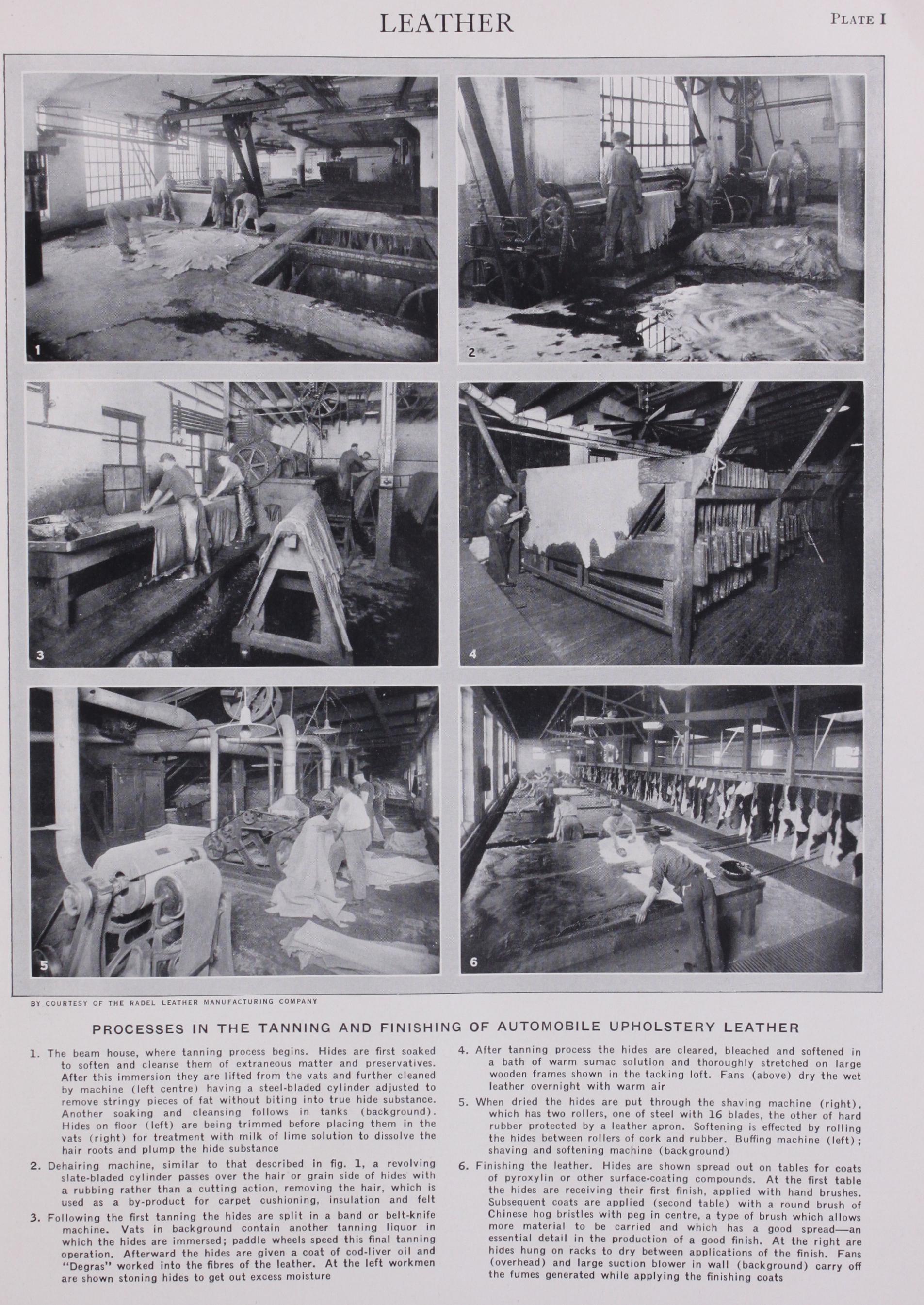
The next process is a suitable treatment that will loosen the hair covering so that it can be removed by me chanical means. One of the oldest methods is the one known as sweating. This consists in hanging the goods in a closed chamber or sweat pit, usually constructed below ground floor level in order to provide regularity of temperature. The skins or hides are hung in the chamber previously heated to warm summer temperature ' and left until putrefactive organisms have effected the requisite loosening of the hair or wool. This process is now usually used only upon fine woolled sheepskins, as it has less deleterious influence upon the wool than the alkaline treatment.
The modern sweat chamber is usually lined internally with white glazed tiles or bricks with a floor which can be kept scrupu lously clean, and is provided with means of regulating the heat and humidity. Temperature, atmospheric humidity and ventila tion must be very carefully controlled. The time required for this operation is usually three or four days. During this time watchfulness is necessary to guard against the destruction of the grain surface of the skin. On account of the difficulty of con trol this method is confined to skins carrying high grade wool.
The Liming Process.
The object of liming is to solu bilise the epidermis layer, thereby loosening the hair sheath and making easy the removal of the hair by mechanical means, and to swell the hide fibres to the degree requisite for the production of leather possessing the desired properties, either of plumpness, solidity or stretch. The method ordinarily practised consists in immersing the goods in a mixture of lime and water for varying periods. During the process of immersion the goods are periodi cally withdrawn from the liquor, piled up, and allowed to drain.
The methods of liming can be classified as follows :—(r) Pit method, (2) Paddle method, (3) Painting methods. The first mentioned is the oldest and is carried out in a series of rectan gular brick pits, varying in size, according to the class of goods to be processed, from a capacity of 30o to 1,200 gallons. It is customary to use an amount of lime greatly in excess of that which is soluble, and consequently the major portion of the lime is in suspension in the liquor. The goods are thrown into the well mixed liquor singly, and a thin film of undissolved lime de posits itself on the uppermost side of each skin as it is submerged.
The greater the amount of lime in direct proximity to the goods, the more rapidly will the lime solution be maintained saturated.
The modern method consists usually of "sharpening" the lime by the addition of sodium sulphide, which dissolves keratin with very great rapidity and consequently effects quickly the loosening of the hair. Liming has also been speeded up by mechanical aid. Sheepskins and goatskins are commonly limed in a paddle wheel, where they can be kept in motion by the operation of a paddle fixed to a semi-circular vessel and slightly dipping in the liquor.
In the case of sheepskins where it is undesirable that the wool covering should come in contact with lime, the method of fell mongering these goods consists in the application to the flesh side of a paste of lime to which sodium sulphide sufficient in quantity to loosen the wool in a maximum period of 12 hours has been added.
When the skins have been limed to a condition in which the epidermis has become sufficiently loosened they are removed from the liming pit or vat and are then unhaired. Unhairing is more commonly done in the case of calf and goat skins by machine. Fleshing.—The next operation is the mechanical one of flesh ing. This is also effected either by hand over the fleshers' beam or by machine, and has for its object the removal of fat and fleshy matters from the underside of the skin.
Washing and Deliming.
Next in order is the washing opera tion preliminary to the chemical removal of lime and other al kali, and to convert the pelt from an alkaline to a mildly acid condition, as it is not possible to tan pelt by the usual processes when in an alkaline condition. The goods are first washed in water. The operation is preferably done in running soft water and is prolonged until the goods are freed from surface lime. The more complete removal of the lime content is commonly effected by the use of a suitable acid. The degree of deliming is determined by the condition required in the resulting leather; for example, when the leather is to be firm and lacking in stretch, e.g., sole leather, the deliming is usually carried to a stage in which the lime is only removed from the outer surfaces. If the leather is required to be soft and pliable deliming is carried on until all of the lime has been neutralised. In the case of lighter leathers, e.g., sheepskins, the deliming is always carried out thoroughly.