Lens
polishing, glass, surface, surfaces, papers, lenses, soc and polished
About this time Hooke was working on the microscope (see his Micrographia 1667). He describes a way of making microscope objective lenses, in which he drew a piece of broken Venice glass into a thin thread, then held one end of this thread in a flame till a globule of glass was formed. He then polished a flat surface on the thread side of the globule, first on a whetstone then on a smooth metal plate with tripoli. These lenses, however, being too small he used good plano-convex object glasses, and there is no indication that he made these himself.
The great Dutch microscopist, Leeuwenhoek, made his own lenses, but left no account of his methods, for reasons that he gives in a letter to Leibnitz dated 28th September 1715. "As to your idea of encouraging young men to polish glass—as it were to start a school of glass polishing—I do not myself see that would be of much use. Quite a number, who had time on their hands at Leyden, became keen on polishing glasses, owing to my discoveries; indeed there were three masters of that art in that town, who instructed students who were interested in such things.
But what was the result of their labour. Nothing at all, so far as I have learnt." (Leeuwenhoek, Epistolae Physiologicae super Compluribus Naturae Arcanis, 1719.) Newton (Optiks 1721) makes some important remarks on polishing, which though refer ring to mirrors are also applicable to lenses; and appears to have been the first to use pitch for polishing, an important innovation.
Herschel in 1774 used a pitch polisher for polishing the specu lum mirrors, some of them very large, for his telescope. He mentions (see his Collected Papers Roy. Soc. and R.A.S., 1912) that the polishing operation was carried out by ten men on one occasion. He gave an account of the polishing of a large speculum by a machine which he made to avoid the necessity of employing so many men, but gives no very clear description of the machine, nor any illustration of it. Fraunhofer, who made telescope lenses of great excellence, is said to have been the first to use proof spheres for testing the accuracy of his surfaces. Lord Rosse described before the Royal Society (see his Collected Papers 1926) a machine for polishing large specula, and in the course of the same papers he describes the mode of preparation of his rouge by calcination, at a dull red heat, of peroxide of iron produced as a precipitate with ammonia water from a dilute solution of iron sulphate.
Grinding and Polishing.
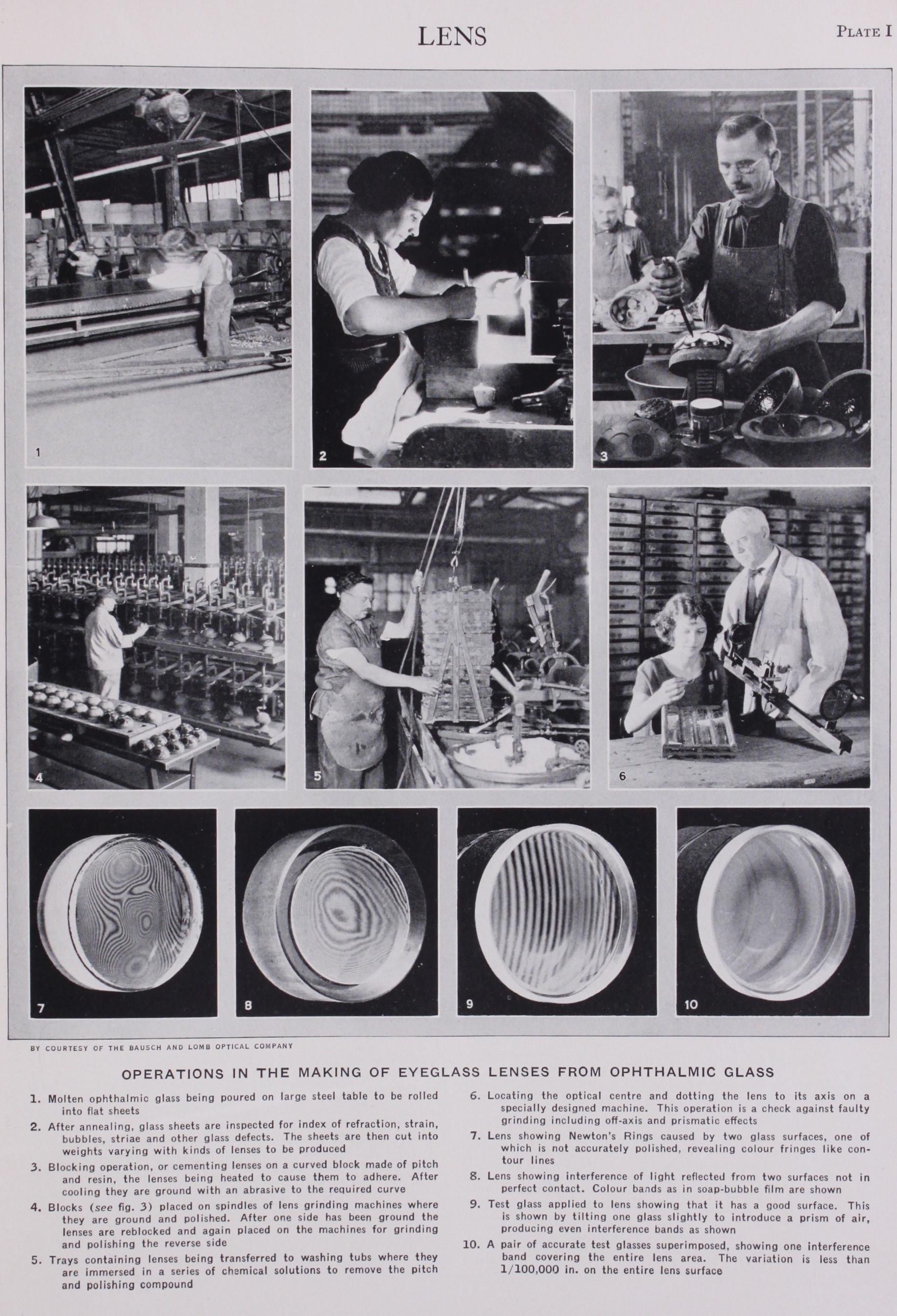
The object of lens polishing is to produce regular transparent surfaces of revolution on a piece of glass or other clear substance. The surfaces are usually requiredto be flat or spherical, while occasionally slight departures from these shapes are needed in order to obtain some optical advantage not otherwise attainable. The process is divided into two others, viz., grinding and polishing. The nature of ground glass surfaces was studied very thoroughly by Preston (Trans. Opt. Soc. 1922).
He shows quite conclusively that such surfaces consist of a great number of conchoidal fractures from which pieces of glass have been broken ; he has observed too that below this obviously broken surface there is a region in which there are small cracks which must be removed by polishing if the surface is to be perfectly clear.
There is no general agreement about the nature of polished glass surfaces. The late Lord Rayleigh (who had observed, though not with the particularity of Preston, that in grinding glass the particles of abrasive appear to act by breaking out small frag ments) thought that the process of polishing was not continuous with that of grinding, but consisted of a removal of molecular layers of the surface of the glass; and he measured the amount of glass so removed (see his Scientific Papers, vol. iv., 1901, and Proc. Roy. Inst., March, 1901). He attributed to Herschel the opinion that polished surfaces differ from ground ones only in the fragments removed being smaller; the process in each case being that of attrition. Attempts made by Rayleigh to discover whether the surface of polished glass were different in physical properties from the mass failed to reveal any certain difference between the surface and the interior. Some accept the conclusions of Beilby from his observations on metals, glass and Iceland Spar. According to Beilby (Proc. Roy. Soc. A, vol. lxxii., and other papers) in polishing the surface molecules are set in gliding motion by the polisher so that they form an extremely thin film of fluid subject to surface tension, which, he thinks, accounts for the smooth surface which is left by polishing. This view is sup ported by French who finds strong support for it from his own experiments (Trans. Opt. Soc. 1916 and 1917). These and other possible views are critically considered with evidence from his own work by Preston whose conclusion is that the process of polishing glass is principally one of ultra-microscopic abrasion (Trans. Opt. Soc. 1926).