Machine-Made Lace
machine, bar, loom, laces, carriages, net, machines, threads, wide and comb
The Levers Loom.
What is known as the Levers loom is one of the most important types for producing fancy lace. It has bobbins and carriages which may be said to correspond to the spool and shuttle of the weaving loom. The bobbin consists of two circular discs riveted together with sufficient space between to house about moyd. of yarn. The discs are free to revolve on the verge of a carriage and controlled in tension by a spring. A machine having 20 bobbins or carriages to the inch would be known as a io-point machine, 16 carriages per inch would give 8-point and so on for other gauges, the number of carriages being divided by two to give the gauge. Each comb bar in the loom can hold the full number of carriages back and front, each of which carry the combs set in an arc of about i2in., of which the centre is the facing bar. Both comb bars are fixed so that the combs in each bar are directly opposite. Along with each comb bar is the catch bar which moves along the curve of the comb, and the function of the catch bar is to move the carriage backwards and forwards. It does this by alternately engaging with the nibs of the carriage. Working in conjunction with each catch bar is a landing bar which supports the extremity of the carriage at each swing across the well of the combs. The usual range of gauges on lace looms are from 4-point to i6-point lace, and recent tendencies have all been in the direction of finer laces, and some idea of this delicacy may be gathered from the fact that the finest yarn which it is possible to spin is used for fine lace. This yarn is produced in Lancashire and holds the record in the world for fine cotton spinning. Cotton of 400 counts is used, that is to say 400X84o= 336,000yd. of this yarn are required to weigh i lb., this length being equivalent to 190 miles of yarn—a truly marvellous achieve ment.
The width of the lace loom is measured similar to the method adopted in the weaving industry, the unit being the quarter yard of gin., thus a width of six quarter (6/4) is equal to eight quarter would be 8X9=72in. wide. The unit of measur ing lace is known as the rack, and this consists of a definite num ber of motions, a motion being a clear position for the warp threads to shog. A rack of bobbin net equals 24o meshes counted vertically. If it is desired to designate the net quality, the num ber of holes is counted horizontally and diagonally and the total number of holes in one inch is given as the quality; for example, 13 diagonal holes and 9 horizontal holes per inch in a fabric would give 13+9=22 quality.
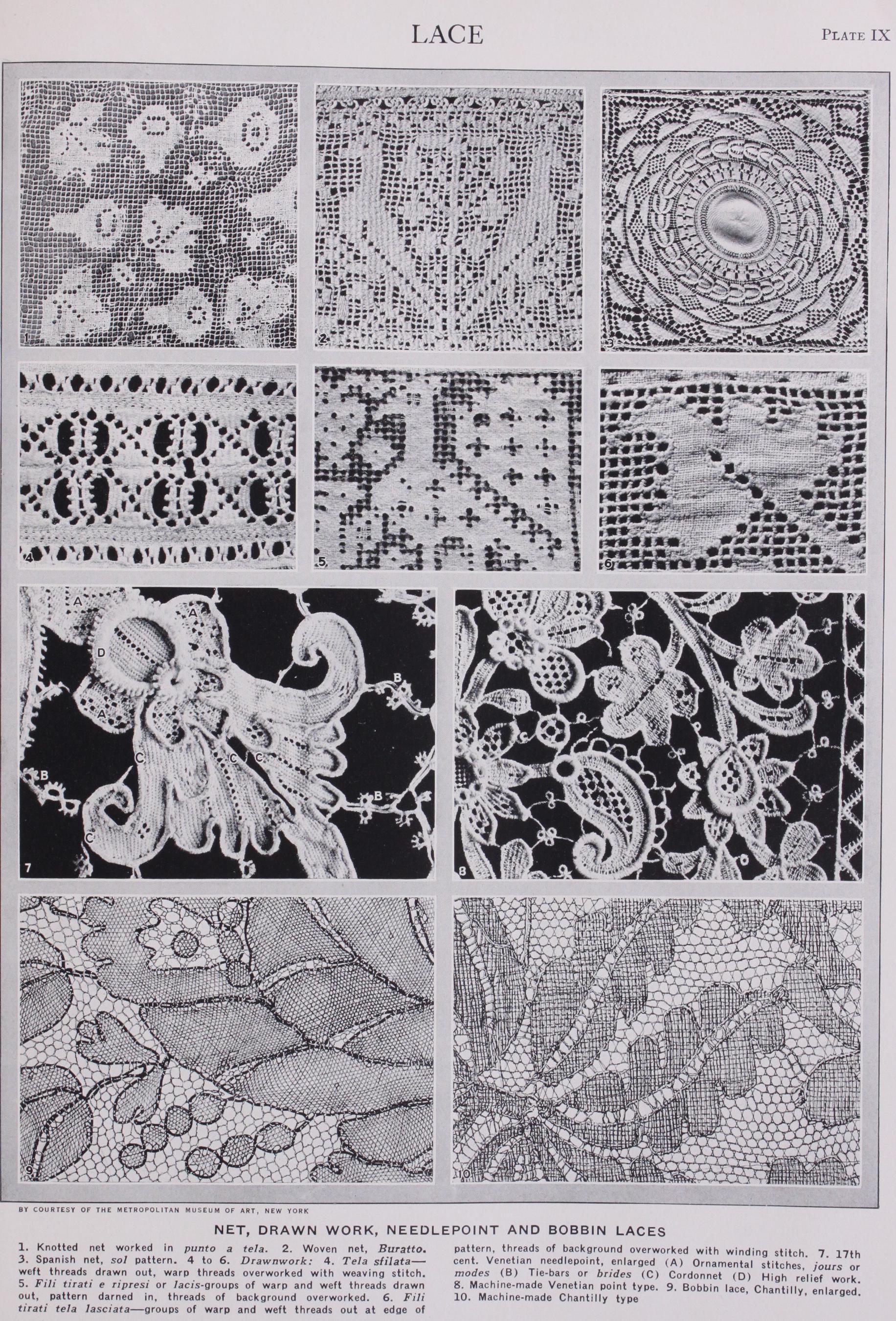
Lace machines are built in widths varying from 146in. to 222in., plain net machines are constructed from 2ooin. to 36oin. wide, the' wider machines being usually of a coarser point.
Speed of Modern Lace
machines which do not use beams the preparation of the warp is a most important matter and small neat winding machines are used. As there are often about 3,00o such bobbins in work at a time, they have to be arranged to occupy the smallest space possible and all bobbins on the modern lace machine are subjected to a pressure of several tons weight to each row. The modern lace machine has a remarkable speed when one considers the complicated nature of the mo tions; on a machine making Mechlin lace, for instance, the speed is about 35o motions per minute, the speed of the veiling machine varies between 175 and 200 motions per minute, the Gothro loom. averages 140, whilst the Levers machine runs at about 108 mo tions per minute. In making small laces the individual breadths are connected by a thread which can be afterwards drawn out to separate one breadth from another. The lace curtain machine is wide enough to take about eight curtains which finish 6oin. wide each, requiring 46oin. of machine breadth.
The Jacquard principle of selective mechanism has been adapted to the special requirements of the lace loom, and in the curtain machine, for instance, the threads of the warp pass through guides which are arranged in bars, each bar having gathered on to it all the threads which require an identical movement in the fabric. The guides are controlled by a cam or small Jacquard at one end of the machine and the pattern is actually produced by intercepting certain threads through individual tricks, each of which is controlled from an overhead Jacquard.
The rolling locker plain net lace machine is distinct from the Levers, Gothro or curtain type, in that there are two tiers of carriages; the front tier is continually traversed to the right, whilst the back tier is traversed to the left. This gives the diagonal effect to bobbin net laces which distinguishes them from all other types.
procedure regarding lace finishing varies in many ways from that adopted in other branches of textiles. The fabric has to be examined or viewed and the examiner has to re create the pattern where it has broken down, and in the very complicated character of many of those designs it requires one who has a thorough knowledge of the design structure. For white laces the material is bleached in the usual manner and the laces are joined together and given a preliminary softening by steeping them in water overnight. This performs the usual functions of steaming: it sof tens the material and also frees the larger and grosser impurities from the material. Keir boiling is next done in the usual manner by the use of a keir in which about 2 to 3% of caustic soda is used. After treatment in this way for several hours it is rinsed and at the next stages is treated with chloride of lime, after which the material is thoroughly washed and then run through a weak acid bath to neutralize the lime. It is then treated in the hydro extractor to remove the water, but the ma terial is left damp in preparation for the next process of starching, which makes the fabric very stiff, and in this state it is stentered or stretched over hooks to draw it out to the width required. The narrower laces are then treated with a spray of water to soften them and prepare them for the calender, when they are passed through between several pairs of heated rollers which impart a gloss. (W. Ds.)