Anatomy of Liver
lobes, fig, lobe, generalized, central, hepatic, gall, type and bladder
Minute Structure of the Liver.
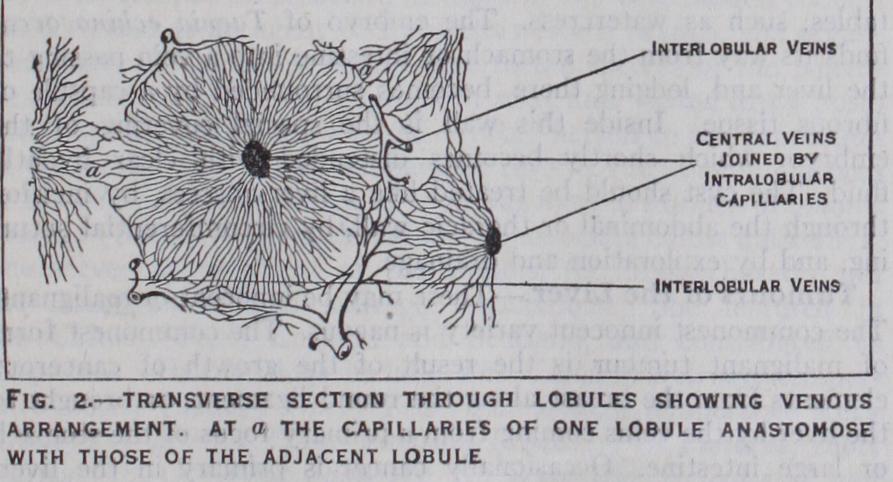
The liver is made up of an enormous number of conical lobules (fig. 3). If the portal vein is followed from the transverse fissure, it will be seen to branch and rebranch until minute twigs called interlobular veins (fig. 2), ramify around the lobules. From these intralobular capillaries run toward the centre of the lobule, forming a network among the polygonal hepatic cells. On reaching the core of the conical lobule they are collected into a central or intralobular vein (fig. 2) which unites with other similar ones to form a sublobular vein (fig. 3). These eventually reach the hepatic radicles, and so the blood is conducted into the vena cava. In man the lobules are not dis tinctly separated one from the other, but in some animals, e.g., the pig, each has a fibrous sheath derived from Glisson's capsule (fig. 3).
Embryology.
The liver first appears as an entodermal hol low longitudinal outgrowth from the duodenum into the ventral mesentery. The upper part of this forms the future liver, and grows up into the septum transversum from which the central part of the diaphragm is formed (see DIAPHRAGM). From the cephalic part of this primary diverticulum solid rods of cells called the hepatic cylinders grow out, and these branch repeatedly until a cellular network is formed surrounding and breaking up the umbilical and vitelline veins. The liver cells, therefore, are ento dermal, but the supporting connective tissue mesodermal from the septum transversum. The lower (caudal) part of the furrow-like outgrowth remains hollow and forms the gall bladder. At first the liver is embedded in the septum transversum, but later the dia phragm and it are constricted off one from the other, and soon the liver becomes very large and fills the greater part of the abdomen. At birth it is proportionately much larger than in the adult, and forms one-eighteenth instead of one-fortieth of the body weight, the right and left lobes being nearly equal in size.
Comparative Anatomy.
In the Acrania (Amphioxus) the liver is probably represented by a single ventral diverticulum from the anterior end of the intestine, which has a hepatic portal circu lation and secretes digestive fluid. In all the Craniata a solid liver is developed. In the adult lamprey among the Cyclostomata the liver undergoes fetrogression, and the bile ducts and gall bladder disappear, though they are present in the larval form (am mocoetes). In fishes and amphibians the organ consists of right and left lobes, and a gall-bladder is present. The same descrip tion applies to the reptiles, but a curious network of cystic ducts is found in snakes and to a less extent in crocodiles. In the Varanidae (monitors) the hepatic duct is also retiform. In birds two lobes are present, but in some, e.g., the pigeon, there is no gall bladder.
In mammals Sir William Flower pointed out that a generalized type of liver exists, from which that of any mammal may be derived by suppression or fusion of lobes. The accompanying diagram of Flower (fig. 4) represents an ideal mammalian liver. It will be seen that the umbilical fissure divides the organ into right and left halves, as in the lower vertebrates, but that the ventral part of each half is divided into a central and lateral lobe. The gall-bladder when present, is always situated on the caudal surface or in the substance of the right central lobe. The Spigelian and caudate lobes belong to the right half of the liver, the latter being usually a leaf-shaped lobe attached by its stalk to the Spigelian, and having its blade flattened between the right lateral lobe and the right kidney. The vena cava is always found to the right of the Spigelian lobe and dorsal to the stalk of the caudate. In tracing the lobulation of man's liver back to this generalized type, it is evident that his quadrate lobe does not correspond to any one generalized lobe, but is merely that part of the right central which lies between the gall bladder and the umbilical fissure. From a study of human variations compared with an Anthropoid liver, such as that of the gorilla, it is fairly clear that the human liver is formed, not by a suppression of any of the lobes of the generalized type, but by a fusion of those lobes and obliteration of certain fissures. This fusion is attributed by Sir A. Keith to the effect of pressure following the assumption of the erect position. The accompany ing diagram (fig. 5) shows an abnormal human liver in the anatomical department of St. Thomas's hospital which repro duces the generalized type.
The gall-bladder is usually present in mammals, but is want ing in the odd-toed ungulates (Perissodactyla) and Hyrax. In the giraffe it may be absent or present. The Cetacea and a few rodents are also without it. In the otter the same curious network of bile ducts already recorded in the reptiles is seen. (F. G. P.) LIVER AND DISEASES OF. Being somewhat friable, the human liver is often torn or ruptured by blows or kicks, and, the large blood-vessels being thus laid open, fatal haemorrhage into the belly-cavity may take place. The individual becomes increasingly collapsed, and there are pain and tenderness in the liver region. The right thing to do is to open the belly in the middle line, search for a wound in the liver, and treat it by deep sutures, or by plugging it with gauge.