Locust
locusts, swarms, carried and insects
The distances travelled by locust swarms are often great. In 1869 Schistocerca gregaria reached England in considerable num bers, and it is believed that they were part of a swarm that came from the west coast of Africa. Other locust swarms have been noted at sea quite 1,200M. from land; one swarm which crossed the Red sea in 1889 was estimated to be about 2,000sq.m. in ex tent. Some idea of the vast numbers composing these swarms may be gathered from the fact that in Cyprus, in 1881, the official re ports state that 1,300 tons of locust eggs alone were destroyed.
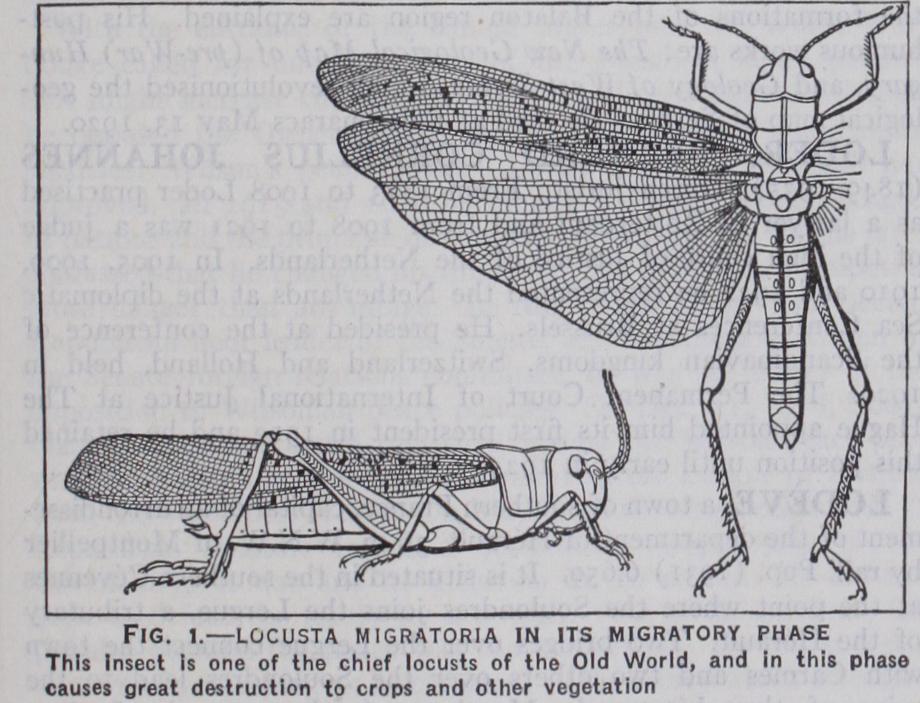
destruction of the actual breeding grounds by the advance of cultivation is the surest method of preventing locust swarms and, once an invasion of the latter has settled on the land, measures of repression need to be very promptly carried out if they are to be of any benefit. In North America and South Africa the broadcasting of a sweetened bran mash mixed with an arsenical compound is extensively used ; this bait is readily eaten by the locusts which are ultimately poisoned by the arsenic. The application of the aeroplane for distributing poisonous dusts over the herbage affords great promise, but is as yet in the experimental stage. Trials carried out in parts of Russia in 1924 and 1925 gave encouraging results when applied against the young or hopper stage of Locusta migratoria; in order to be effective against the winged locusts such tests require to be carried out in early morning before the insects become disturbed and disperse. The destruction of the
egg-masses, either by collecting, as has been carried out in Cyprus, or more usually by deep ploughing, is another measure. The hop pers may be restrained by digging trenches across their line of ad vance into which they fall and can be readily destroyed. In Amer ica machines termed hopper-dozers—light screen-frameworks mounted upon runners—are sometimes employed; these are drawn by horses across the land and the disturbed hoppers strike the screens only to fall back into a trough containing water covered with a film of kerosene. Migratory swarms of locusts are closely followed by birds which greedily devour the insects; among other enemies parasitic insects are important and they more especially attack the locusts in the egg-stage thus preventing large numbers from producing nymphs. Such parasites include beetles of the family Meloidae and flies of the families Bombyliidae and Tachi nidae. Locusts are also subject to bacterial diseases and D'Herelle drew attention to a disease occurring among locusts in Yucatan in 1911. Cultures of the bacillus concerned were subsequently utilized to spread the disease in the field as a means of control and some success has been claimed for Schistocerca gregaria.