Chair
front, rails and posts
CHAIR The rocking chair illustrated in Plate 15 (B) and detailed in Fig. 63 is a companion piece to the arm-chair just described.
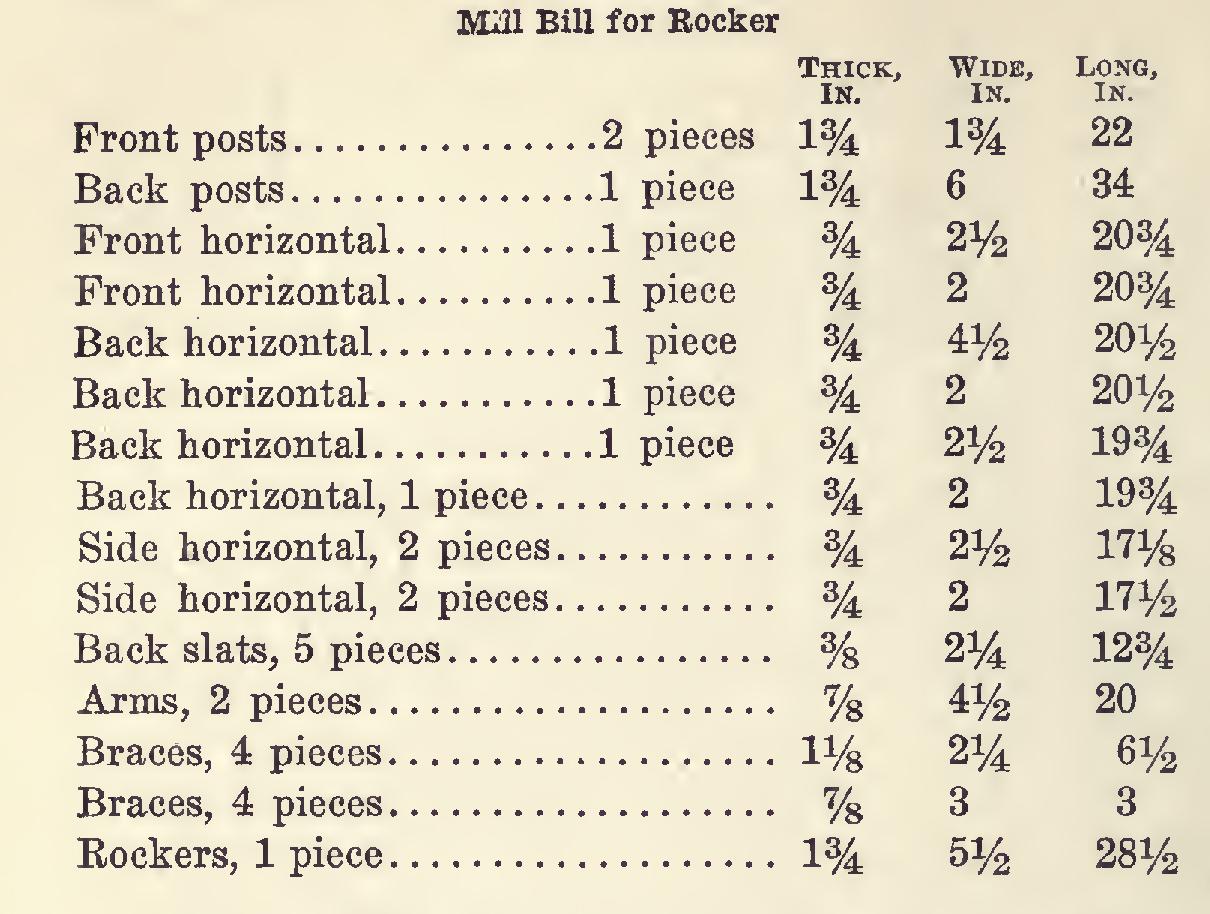
The stock bill gives the thicknesses and widths exact, except for the back posts, but makes allowances in length for "squaring up." The back posts are to be got from the one piece specified.
Begin work by squaring up the ends of the front posts and shaping the rear ones. Chamfer the ends, top and bottom, slightly, and lay out the mortises and tenons. The tops of the front posts are to be tenoned through the arms.
Next prepare the curved horizontals for the back. This is done by first preparing a curved form having a radius of 3 feet 6 inches. The pieces to be curved are steamed thoroughly, then clamped to this form, and allowed to dry.
The arms may be shaped while these pieces are drying, and the rails or horizontals of front and back tenoned. Note that the different lengths of rails on the sides will necessitate the use of the bevel in marking the shoulders. Also,
that the back, being narrower than the front, will necessitate slant in either tenon or mortise.
Assemble the front, then the back. The back slats are to have their ends "let into" the hori zontals a good inch each. When the glue has hardened, put the side rails and the arms in place. Dowel and glue the brackets under the arms.
The corners are to be reinforced with braces screwed to the inside of the seat rails.
After the finish has been applied, put on the seat as follows: Stretch a canvas over and around the seat rails, and tack it to their under sides. Cross-weave over this, and fasten under neath, webbing such as upholsterers use. On the webbing, place a cushion of elastic felt or hair. A piece of muslin placed over this, and on top of this the final covering of Spanish leather, completes the chair, except for the ornamental nails as shown in the picture.