Heavy Table
top, circle and stretchers
HEAVY TABLE The table illustrated in Plate 6 is rather out of the ordinary, and for that reason will appeal strongly to some, while to others it may seem too great a departure from the conventional. Personally, an unconventional piece of furni ture makes an effective appeal, provided, of course, that it has merit and does not partake of the bizarre.
The stock bill for the table is as follows: All pieces will be mill-planed and sanded on four surfaces.
It will be seen from the accompanying draw ing (Fig. 26), that the top is hexagonal or six sided. To lay out the sides of this hexagon, drive two brads in a stick so that they shall be 2 feet 4 inches apart. With this "strike," put on a circle—or those parts of a circle which will go on—placing one of the brads at the center of the board. With this same strike, begin on the circle at the end grain of the wood; and mark off, on the circle, points for chords that shall equal the radius of the circle. Connect these six points, and the hexagon is formed.
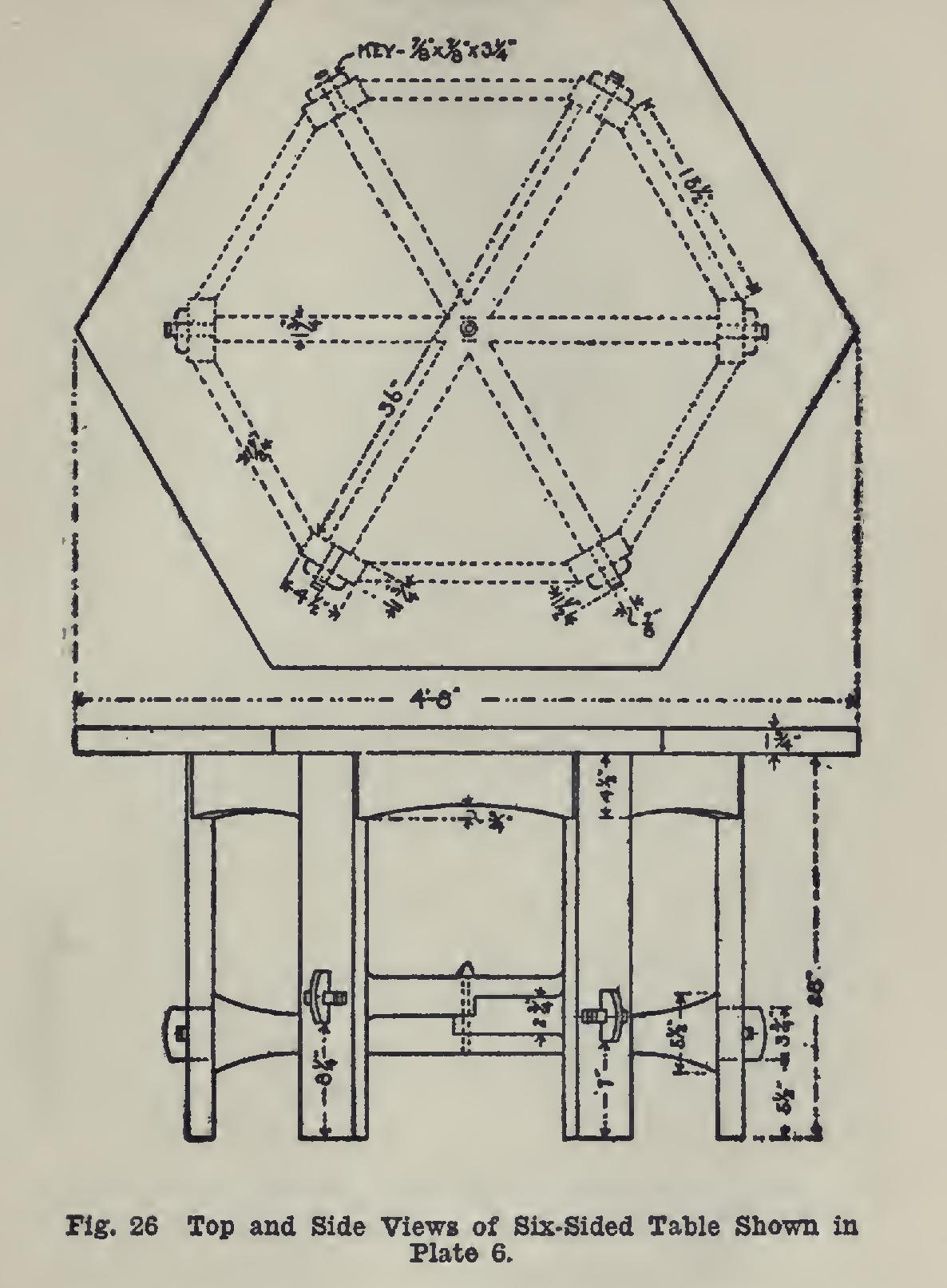
A hexagon could be formed by beginning to mark off at any point on the circle; but, by be ginning at that part which is near the end grain, none of the corners have grain running across them in such a way as to make them likely to break off.
First shape the six legs. The lower ends are rounded off about inch back on the bot tom and inches up the sides. The mortises necessitate working the legs in pairs.
Next work the tenons on the stretchers, and shape them as shown in the drawing. The joints where the stretchers cross are made by cutting one-fourth the width out of top and bottom stretchers, and one-fourth out of each side of the middle one. The angle at which to set the bevel is the same as that of the hexagonal top. The angle for the top rails, too, can be obtained from a line connecting the corners of the top, together with a side. The exact length of these top rails can be got by locating the positions of the posts in pencil on the under side of the top, then measuring the distance between.
These rails are to be doweled and glued to the posts, and the top fastened to them by means of two small angle-irons to each rail.
The pin for the center cross of the stretchers is of diameter, with a top shaped square or hexagonal as desired.