Set of Summer Porch Furniture
front, rails, tenons, inches, verticals, chair and cut
SET OF SUMMER PORCH FURNITURE Porch furniture should be light of weight so that it can be moved in and out of doors as occasion requires. As far as possible, the or dinary glue-joint construction should be avoided, so that, should sudden rains be blown upon it, no great damage will be done through unusual swelling and subsequent shrinkage. Of course it is possible to go to extremes in this respect and build pieces so rough and rugged that they are suggestive of the barn or factory rather than the house. The accom panying designs (Plates 8 and 9), show a fair proportioning of the two types of fastenings.
These pieces have seats of wood, with slats interspaced for ventilation and properly shaped for comfort.
Whatever finish is used, a waterproof final coat should be applied. Plain red oak is an ap propriate wood and may suitably be finished with a dark Flemish stain and filler, followed by a dull finish.
For the arm-chair (Plate 8, B), order the following: There will also be needed sixteen carriage bolts, with nuts and washers 1/4 inch by 2 inches, and four machine bolts by 3 inches.
Begin work on the verticals. Since the front verticals can have their top ends cut to the proper slant after the parts are assembled, begin the measurements for length from the bottom, and leave the top ends until ready to fit the arms. The rear verticals are to be shaped as indicated in the drawing (Fig. 40). The lower ends of both front and rear verticals are sloped slightly to make them harmonize with the curves of the bases.
Next prepare the bases. These shapes are rather unusual, and it may be well to make paper patterns or templets of thin wood to be used in laying them out.
The side rails are plain, except the front ends, which are rounded. These are to be by by 24 inches. With the 1/4-inch bit, bore the holes for the bolts which are to fasten the sides together. Bolt together the two sides of the chair.
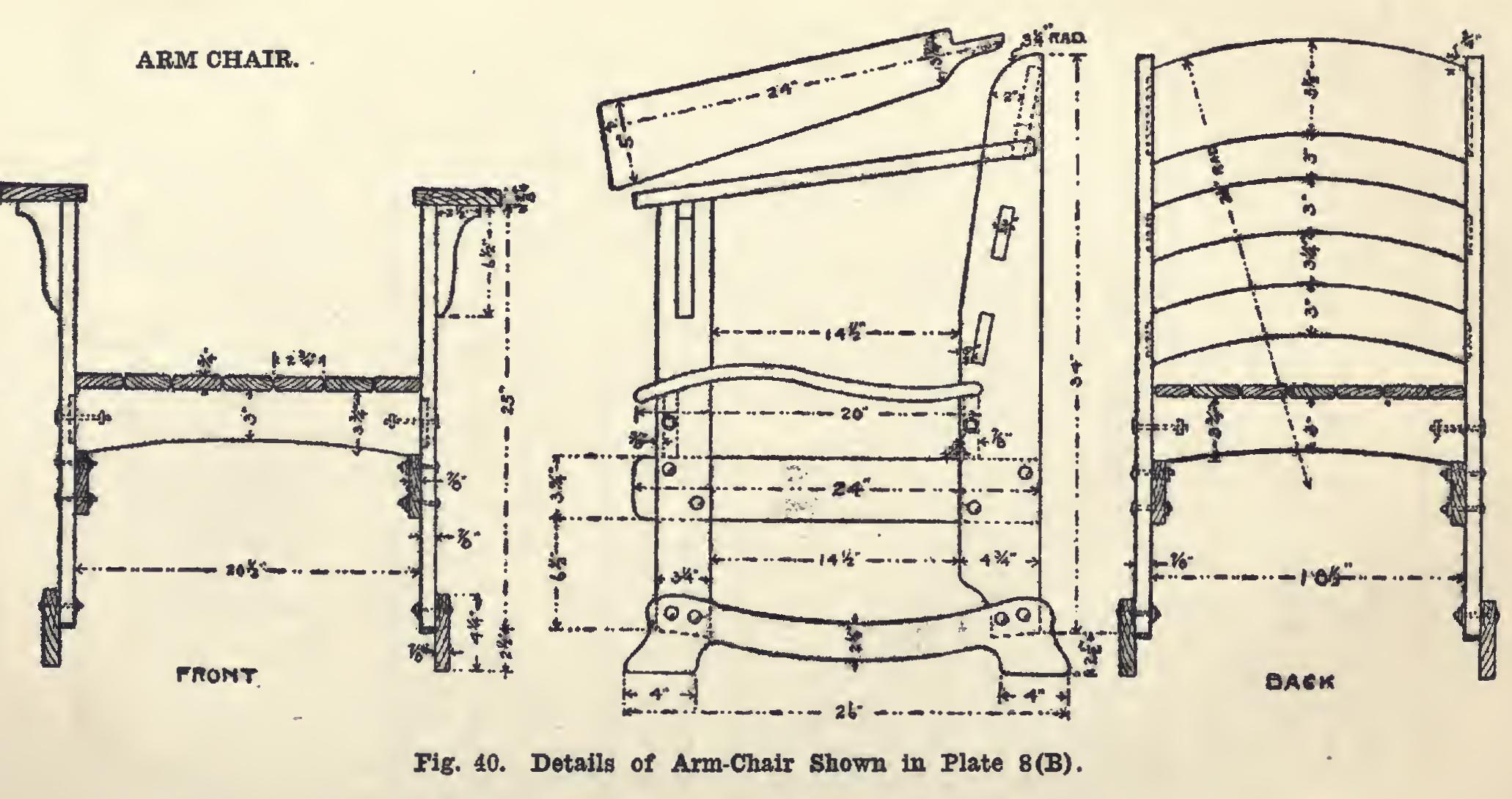
Slope the arms as shown in the drawing, and fasten them in place after having cut the tops of the front verticals to shape. To get this slope, hold the arm at the proper angle and alongside the verticals, at the proper height, and mark under the arm upon the vertical with a pencil or knife. Dowels and glue are to be
used to fasten the arms to the verticals. The position of the chair arm is somewhat out of the ordinary, the idea being to give the arm of the occupant an easy position away from the body.
It should be noted that the front end of the arm of the chair is not cut at a right angle to the inside edge of the chair, as are most chair arms, but is cut at an angle such as will bring the front edge parallel to the front of the chair.
Shape the braces, and fasten them in place under the arms, using dowels and glue.
Now prepare the rails for front and back. The front rail is to be inches wide at the ends, the lower edge being curved at such a radius as to give 3 inches at the middle of the piece. The corresponding rear rail is similarly shaped. Its length, however, is only inches between the posts, while that of the front is inches. This difference in length will necessitate cutting either the sides of the mor tises or of the tenons of the front and back rails at a slight angle; also the shoulders of the tenons.
The tenons to be used on these and the rest of the back rails are what are known as "stub" innons. Since the thickness of the pieces into which they enter is only of an inch, these tenons can be only about inch long.
Cut the tenons and mortises; then shape the edges of the back rails. These rails are curved on the edges only—they are not curved the flat way as are most chairs. The radius for each is 26 inches. The tenons might have been cut after the curves were shaped. However, by laying out the curves, then cutting the tenons before the curves, no confusion as to the proper location of the tenons need arise.
The front and back rails to which the seat is to be fastened, are to be secured to the ver ticals by means of draw-bolts, the 3-inch ma chine bolts being used for this purpose. The boring for the nuts that are to enter the rails will, of course, be done on the inner surfaces of the rails. The rest of the tenons, as well as the ones to be draw-bolted, are to be thoroughly glued and clamped.