Columns 46
column, gyration, radius, distance and axis
For columns carrying only vertical loads, some sort of section as is shown in Fig. 65 (b to i) is used. In case lacing bars or tie-plates are used, they are not assumed to take any of the load which comes upon the column. They are merely, to hold the two sides of the column to gether, so that they will act as one shape. In cases where channels or I-beams are used with lacing bars or tie-plates, the radius of gyration r for the two shapes is the same as for one; but the radius of gyration about the axis b-b is dif ferent from r', and it varies according to the distance apart the shapes are spread.
In order that the - may be equal to and therefore have the column equally strong in both directions, the I-beams or channels must be spaced as given in column 14 of (C 98, 100, and 102).
147 .151" m,,.7.84 if i a CJ I .1 rb-b+ r Z66 Fig. 70. Spacing for Equal Radii of Gyration.
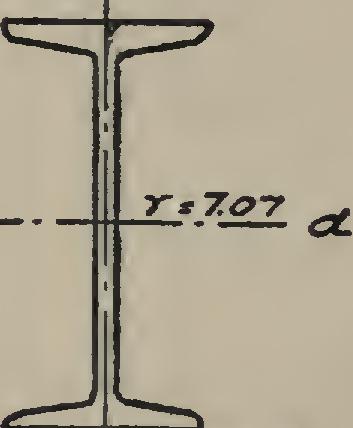
To illustrate the above, take a column of two 20-inch 80-pound I-beams, and another of two 15-inch 33-pound channels (Fig. 70). The radius of gyration about a-a is the same as for the one shape, and is found to be 7.86 for the I-beams, in column 9 (C 97); and 5.62 for the channels, in column 9 (C 101). In column 14 of their respec tive tables, the distance 15.47 inches and 9.50 inches are found. These are the distances which make for the I-beam and 5.62 for the channel. If these distances were lessened, the would be less than the values given; if the dis tances were made greater, the be greater in each case. The will remain the same, no matter what the distance D is. In order to have an economical column, the distance D must never be less than that given in the Car negie Handbook.
For any distance apart of the shapes, or for sections such as Fig. 65 (d to j), the radius of gyration for any axis may be determined by the following method: (a) To the moment of inertia of each shape for an axis parallel to the axis to which it is desired to find the radius of gyration, add the value obtained by twice mul tiplying the area of that shape by the distance between the two axes mentioned above.
(b) Divide the result by the total area of the sec tion.
(c) In the second column of (C 281-282) find the value which is nearest to the result obtained in b, but which has two more whole figures to the left of the dec imal point. Look opposite this, and in the first column on the left-hand side of the page will be found a value. Point off one decimal place at the right, and the result is the radius of gyration.
Moment of Inertia.
The moment of inertia is a certain value for any given shape, and, some what like the radius of gyration, indicates the strength-resisting qualities of the section.
Let it be required to compute the radius of gyration for the section in Fig. 71. In column 6 (C 111), the distance from the center of Fig. 71. Data for Computing Moment of Inertia.
gravity to the back of the long leg of the angle is found to be 0.75 inch for a 5 by 3 by l/2-inch angle; and in column 7, the distance from the back shorter leg is 1.75 inches. The moment of inertia with respect to the axis 1-1 for one angle, column 9, is 9.45; while that for axis 2-2, column 8, is 2.58. The center of gravity of the web plates is on the axis a-a.
The moment of inertia of plates is taken from 5.of .3