Design of Beams 38
roof, beam, loads, section and fig
When the loads are vertical and the beam is inclined (as, for example, when it is on a roof truss, Fig. 44), the Z-bar is the most economical section, as can readily be proved by higher mathematics. In this case the section modulus of a beam is different from that given in column 9 (C 104). Since Z-bars are seldom used as beams except in roof work (and then they are placed in position as in Fig. 44), the S for the sizes most used are given in Table XI for the different slants of roof most used. For other slopes, the values will lie between those given, and may be very closely determined from the values given. Thus, suppose the slope of your roof was between 30 degrees and is, between 30 and 34 degrees. If the slope of your roof was 33 degrees, this would be 33-30=3 de grees above the 30-degree slope; and the section modulus would then be: 8.9—{ (8.9-7.1) X3 } (34-30)=7.55 for a 21.0-pound Z-bar.
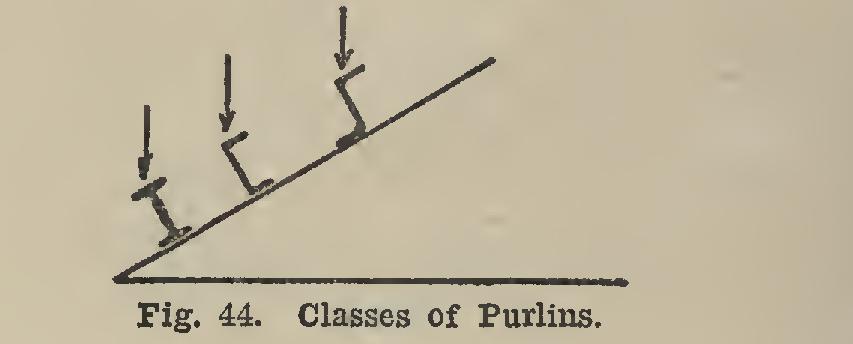
To show the strength when the Z-bar is turned, the bending moment of 126,000 pound inches will be taken, and the slope of the roof taken as 30 degrees. The allowable unit-stress being taken as 12,000 pounds per square inch, the required section modulus is the same as be fore, 10.5. According to Table X, a 6 1/8 by 3 5/8-in. Z-bar weighing 28.0 pounds per linear foot is required, thus showing a loss of 7 pounds, or an increase of 33 per cent in the cost when compared with the 21-pound sec tion as required when it was not tilted.
Channels and I-beams should not be used on roofs, if it is possible to avoid it, since the tilting of these shapes decreases the section modulus very rapidly. If the I-beam and channel as de
signed were tilted 30 degrees, their strength would be reduced as follows : These section moduli and moment capaci ties, as compared with the originals, show a de cided decrease in strength.
By referring to Fig. 43 it will be noticed that the ends of beams 1, 2, 3, and 4 rest on cross beams, which are in turn connected with the columns. These cross-beams A-B and C-D are usually termed floor girders, even in case they consist of non-built-up beams.
In C-D, the case is that of a beam carrying concentrated loads which are equal to the reac tions of the beams 1, 2, 3, and 4. It will be as shown in Fig. 45 the values given being one-half the total loads given on page 180. In the case of " The pitch of a roof is the value obtained by dividing the rise of the peak by the span.
A-B, the girder not only carries the reactions of beams 1, 2, 3, and 4, but also the reactions of beams 11, 12, 13, and 14. These last-mentioned beams may or may not carry the same floor load as the others; and they may or may not be of the same span. Let the span be 16 feet, and the load the same as before, 315 pounds per square foot of floor surface. The total loads and reactions are: The beam A-B will then be as in Fig. 46, a sim ple beam with concentrated loads equal to the sum of the reactions of the beams that meet at the various points.
The design of beam B-C will now be made. The reaction R, is: The right reaction is now readily computed to be 37,648. The reader should do this work. The moments under the several loads are now computed as follows: