Erection of Structures 69
traveler, truss, span and derrick
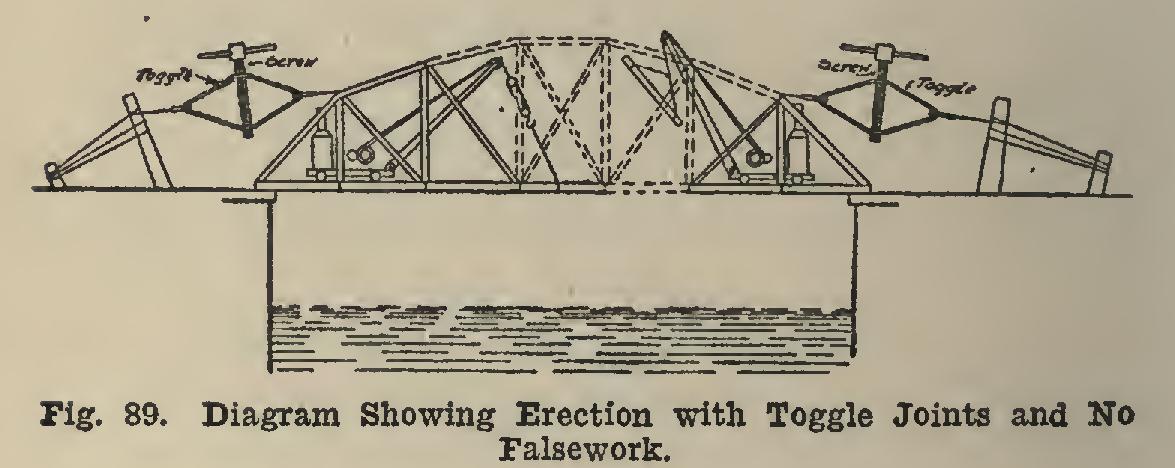
(c) By the cantilever method, the two sides of a truss are erected at the same time (Fig. 89). No falsework is required, the halves of the truss being kept in position by the stays at the ends. When the center is reached, the stays are lengthened or shortened by the turnbuckles, and the span goes together, and is connected up.

(d) In some instances where a number of spans of equal length are to be built, it is economical to use a truss traveler, as shown in Plate 31. When one span is begun, the traveler runs out until the end comes over the next pier ahead, and then the vertical posts are put under it. The truss is then erected piece by piece, and is held up by being hung to the traveler. When the last number is in position, the span is let down on the masonry, and the traveler moves up ready for the next span. No timber falsework is required in such cases.
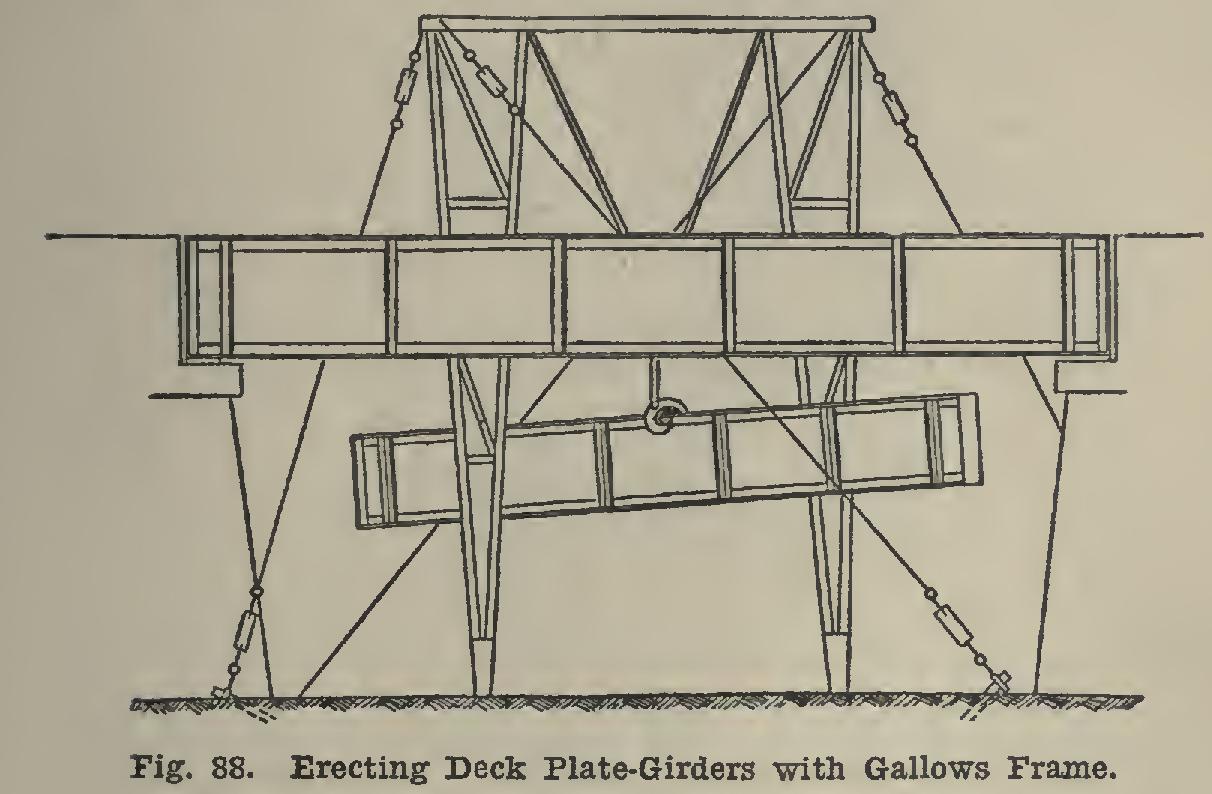
In the case of rolling-lift bridges, the erec tion is usually made when they are open, the traveler being so constructed as to move up the top chord (see Plate 32). Sometimes they are erected• when closed, and this is done by any of the methods described above for simple non movable bridges.
73. Erection of Viaducts. This is best done by the use of either a derrick car or a cantilever traveler (Plate 33). This method is fully illus trated in Plates 34 and 35. In erecting by these methods, care should be taken to see that the anchor-bolts are in the girders; otherwise the end girder is liable to be shoved forward by the action of the trains and travelers, and will fall from the masonry. One advantage of the canti
lever traveler over the derrick car is that it has a greater number of hoists, and can therefore hold members in any desired position much bet ter than the derrick car, which depends upon the balancing of the member.
74. Erection of Mill Buildings. Here the columns are first erected by means of a derrick, as in Plate 26, and are securely bolted to the masonry. In case the span of truss is small, the truss is completed before the erection; and the same derrick will raise the span into position and the workmen will bolt it up for the riveters. Where the span is great, falsework, as in the case of bridges, may be employed and travelers are used, the truss being erected a piece at a time (see Plate 36).